Thermal Drift & Zero Shift in Pressure Sensors
Understanding Thermal Drift & Zero Shift in Pressure Sensors
- Understanding Thermal Drift & Zero Shift in Pressure Sensors
- Key Causes and Factors Influencing Thermal Drift & Zero Shift
- Impact of Thermal Drift & Zero Shift on Pressure Sensor Performance
- Mitigation Techniques and Calibration Methods for Thermal Drift & Zero Shift
- How to Choose Pressure Sensors Considering Thermal Drift & Zero Shift
- Conclusion
- FAQ
- Partner with GAMICOS for Thermally Stable Pressure Sensing Solutions
- References
Thermal drift and zero shift in pressure sensors are often to blame when industrial automation systems give wrong results after being carefully set up. These things have a direct effect on the accuracy of measurements in chemical processing plants, medicine production lines, and oil factories. Knowing how changes in temperature affect sensor standard readings helps procurement managers and engineering teams choose measuring tools that stay accurate during demanding operating cycles. This keeps processes from stopping for too long and costs from going up, and it makes sure that regulations are followed.
Understanding Thermal Drift & Zero Shift in Pressure Sensors
Thermal drift and zero shift are two different but related problems that make measurements less reliable in industrial pressure sensing uses. When the electrical features of sensing elements change because of changes in temperature, this is called thermal drift. Zero shift, on the other hand, is the difference between the baseline reading and the actual reading when no pressure is applied. This creates an offset that makes measurement mistakes worse across the whole working range.
Defining Thermal Drift in Measurement Systems
When the temperature of the environment or the process changes and the electrical properties of sensing elements change, this is called thermal drift. In piezoresistive devices, silicon's resistance changes as expected with temperature. This causes unwanted signal changes that hide the real pressure readings. This effect is stronger in situations where temperatures change a lot, like when watching pipelines outside or controlling high-temperature processes.
Zero Shift Fundamentals and Baseline Stability
Zero shift shows up as an unexpected change in the sensor's baseline output, which re-calibrates the reference point automatically. This happens because of mechanical stress release in the diaphragm, differences in temperature expansion between sensor parts, or the effects of materials getting older. While thermal drift changes with temperature, zero shift can stay the same even after thermal balance is reached, meaning that the measuring tool needs to be recalibrated to get accurate results again.
Comparing Sensor Technologies and Thermal Sensitivity
Different types of sensing systems are affected by heat in different ways. Because silicon resistors have a higher temperature coefficient, piezoresistive devices have more thermal drift even though they are very sensitive and small. Because capacitance changes mostly depend on physical geometry rather than material qualities, capacitive instruments usually have better thermal stability. Because they are AC-coupled, piezoelectric sensors are great at measuring dynamic pressure but not for steady uses. This is because they don't have to worry about zero shift.
Key Causes and Factors Influencing Thermal Drift & Zero Shift
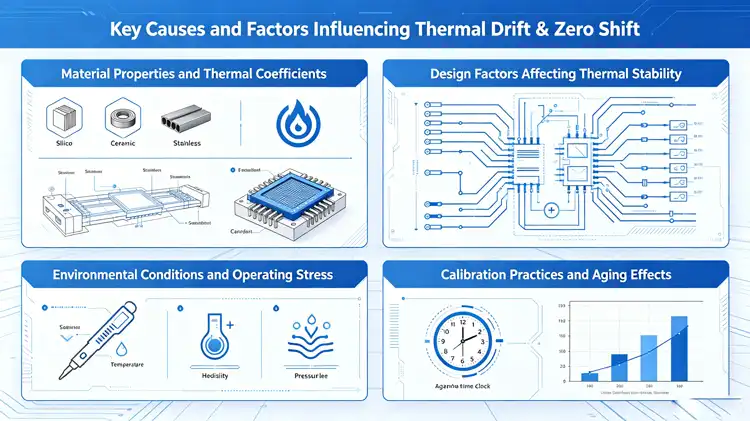
How badly temperature drift and zero shift affect the accuracy of pressure measurements depends on a number of factors that are all connected to each other. The long-term security of sensors in industrial systems is affected by the materials used, the way they are built, their exposure to the environment, and how they are maintained.
Material Properties and Thermal Coefficients
Sensor materials have a big impact on how well they work with heat. Temperature values of resistance for silicon-based piezoresistive elements are about 0.2% per degree Celsius. This means that correction circuits are needed to get good accuracy. Ceramic sense elements have slower rates of temperature expansion, which lowers the mechanical stress that leads to zero shift. Though stainless steel diaphragms are very resistant to chemicals and last a long time, they expand when heated up, which makers must account for by using careful mounting methods.
The GPT200 general pressure sensor solves these problems with its 316L stainless steel isolation diaphragm design, which makes it resistant to corrosion while also allowing for reliable thermal behavior. This diffused silicon pressure sensor has special correction hardware that turns millivolt signals into uniform outputs. This reduces the effects of drift before the signal is sent.
Design Factors Affecting Thermal Stability
The design of a sensor has a big effect on how well it works with heat. When the detecting element is mechanically connected to the housing, thermal stress paths are made that cause zero shift. These effects are greatly lessened by packaging methods that keep the sensing element from expanding or contracting with the housing's temperature. How well compensation methods can fix thermal mistakes depends on the electrical design choices made, such as the bridge circuit layout and amplifier topology.
Microamplifiers with voltage and current signal outputs are used in modern receivers to make long-distance communication stable. The GPT200's high-performance specialized circuits goes through a lot of design validation tests, such as cyclic loading and environmental simulation testing, to make sure it stays stable at all temperatures.
Environmental Conditions and Operating Stress
Changing temperatures, being exposed to humidity, and pressure pulses all speed up sensor age and make drift worse. Because different materials expand and contract at different rates, installations that are subject to fast thermal transients have higher zero shift rates. Chemicals can break down covering materials, letting water in that changes the electrical qualities. Over thousands of working cycles, pressure cycling causes mechanical wear and tear that moves the zero point.
Calibration Practices and Aging Effects
The frequency of calibration has a direct effect on how accurate measurements stay. When sensors are used without being re-calibrated on a regular basis, they slowly lose their accuracy, which leads to lower-quality data. Over months and years of use, aging processes like material hardening and stress release change the way sensors work. Calibration systems that work right plan recalibration times based on how important the application is and the rate of drift that has been seen.
Impact of Thermal Drift & Zero Shift on Pressure Sensor Performance
When temperatures aren't stable, measurements can go wrong, which can affect safety systems, process control, and following the rules in many industries. When procurement managers know about these effects, they can set the right performance goals for sensors in their apps.
Accuracy Degradation and Precision Loss
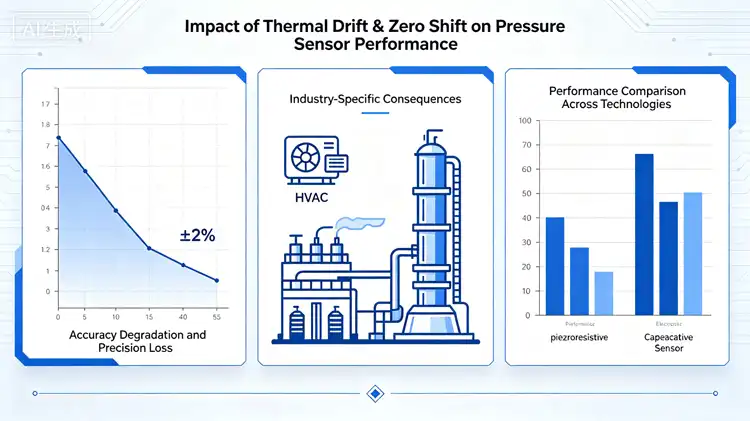
Thermal drift that isn't fixed can cause mistakes that are more than ±2% of full scale in normal industry temperature ranges. This loss of accuracy is not acceptable in situations where tight process control is needed, like when drugs are batch-processed or when precise chemical doses are given. Zero shift makes these mistakes even worse by adding a constant offset that throws off all measurements. This could hide dangerous process changes or set off needless alarms.
Industry-Specific Consequences
Pressure sensors are used in HVAC systems to measure the pressure difference between screens and pipes. Thermal shift in these measures can cause filter replacement alerts to go off too soon or, even worse, fail to find real blockages that make indoor air quality worse. Accurate pressure tracking is needed to control the distillation column in oil refining operations; measurement mistakes from zero shift can lower the quality of the product or make the working conditions dangerous.
Performance Comparison Across Technologies
Without any adjustments, piezoresistive sensors usually have temperature drift values of 0.1% to 0.3% of reading per degree Celsius. Capacitive sensors often get 0.05% or better, which is helpful in places with high temperatures. When choosing between technologies, this temperature performance has to be weighed against things like cost, size, and reaction time needs. When engineering managers look at different sensor choices, they have to compare these pros and cons to the temperature patterns and accuracy needs of the application.
Mitigation Techniques and Calibration Methods for Thermal Drift & Zero Shift
To fix temperature instabilities, you need a full measurement quality program that includes sensor selection, compensation methods, and testing practices. Modern emitters have a lot of different ways to deal with problems, so they work well in a wide range of temperatures.
Advanced Calibration Approaches
Multi-point temperature calibration describes how the sensor works at different temperatures across its operating range. This lets you make accurate connections between calibration points. By taking nonlinear temperature effects into account, this method works better than simple offset and span changes. Digital transmitters have real-time compensation routines that change the output all the time based on the temperature being recorded. This stops drift in real time.
During production, the GPT200 goes through strict process testing and curing. It is then loaded and aged in cycles to settle its traits before it is shipped. This complete production method cuts down on original zero shift and makes sure that long-term performance is predictable.
Material Selection and Packaging Innovations
Choosing materials with similar thermal expansion factors lowers the amount of stress that is created when temperatures change. Adhesives and mounting methods that let you control the flow of heat keep stress from building up at important surfaces. Newer methods of packing keep the sensing element of the pressure sensor from being affected by changes in the housing's temperature. This makes stable thermal conditions that lower the drift magnitude.
Digital Signal Processing Technologies
Digital signal processing (DSP) makes it possible to use complex correction methods that would not be possible with analog electronics. Temperature monitors built into the radio package measure temperatures in real time, which is used to figure out how much to compensate. Filtering methods can tell the difference between real changes in pressure and thermal effects, which makes measurements more accurate. Digital output types don't let analog signals lose quality while being sent, so the accuracy gained through correction is kept.
Its great steadiness and ability to block interference come from the fact that it combines digital processing with well-known piezoresistive sensing technology. This mix provides low drift performance that works well for tough industrial uses that need to send signals over long distances.
Documented Performance Improvements
When compared to sensors that aren't compensated, industrial setups that use advanced compensation methods report 5–10 times better measurement stability. Maintenance times range from every three months to once a year. This lowers running costs and raises the quality of the data. These known benefits make it worth the money to buy high-end receivers for measuring things that need to be done accurately for safety or process improvement reasons.
How to Choose Pressure Sensors Considering Thermal Drift & Zero Shift
To choose the right measuring tools, you need to look at the specs, compare the different technologies, and make sure that the sensor's abilities match the needs of the application. This methodical technique guarantees the best results while keeping costs low.
Critical Specifications to Evaluate
Temperature factors show how the output of a sensor changes with each degree of temperature change. They are usually given as a fraction of the full scale for each degree Celsius. Zero drift specs say how much the baseline is expected to change over time and temperature cycles. They are usually given as the highest shift over set intervals. These specs make it possible to directly compare two or more competing goods and see if their performance meets the accuracy standards for the application.
Managers of procurement should also look at the working temperature ranges to make sure that sensors work in all of the usual weather conditions. Because the GPT200 can measure absolute, gauge, and sealed gauge pressures, it can be used in a wide range of situations. Its small size also makes it easy to put in places with limited room.
Evaluating Manufacturer Solutions
Manufacturers with a good reputation give detailed temperature performance data that comes from testing in a wide range of working conditions. With this data, engineering teams can model the accuracy they expect in certain setups, taking into account the temperature profiles in those areas. When you compare products from well-known brands, you can see that they handle thermal compensation in different ways. For example, some focus on making the base sensor more stable, while others rely more on computer compensation.
OEM and Bulk Procurement Considerations
OEM users who need monitors that are built in must look at both heat performance and the ability to make changes. System integration is made easier when you can choose the electrical connections, mounting methods, and communication protocols. GAMICOS lets OEMs change the GPT200 in a number of ways, such as by offering different electrical interface choices and lightweight, compact designs that make it easier to integrate into bigger systems.
When you buy in bulk, you need to make sure that the making is consistent. Sensors from the same production batch should have similar temperature properties. Supplier quality systems and testing methods give customers trust in batch-to-batch repeatability, which is important for keeping extra parts on hand that will work as expected.
Conclusion
Thermal drift and zero shift are big problems in measuring pressure in industry. They have a direct effect on accuracy, process control, and safety. By understanding these occurrences, you can choose pressure sensor that meet your performance needs while staying within your budget. These effects are kept to a minimum in modern transmitters like the GPT200 by using advanced materials, compensation circuits, and strict production methods. These things make the transmitters reliable and long-lasting. Purchasing managers and engineering teams that carefully look at thermal specs, use the right calibration methods, and choose sensors that work well in the temperature conditions of their applications will have better measurement quality and lower upkeep costs.
FAQ
How often should pressure sensors be calibrated to minimize drift effects?
The amount of time between calibrations relies on how important the application is, how fast it drifts, and the rules that need to be followed. Critical safety instruments usually need to be calibrated every three months, while applications that track processes usually need to be calibrated once a year. Setting standard drift rates through initial frequent testing makes it possible to optimize intervals based on data. Longer calibration times are safe for high-quality receivers that have been shown to have low drift.
Can thermal drift be completely eliminated in pressure measurements?
It's not possible to get rid of all thermal effects, but current compensation methods make them almost invisible in most situations. High-performance emitters can get residual drift below 0.01% per degree Celsius, which is very small compared to other error sources like process variability or installation effects. When you specify pressure sensors with temperature performance that is better than what is needed for the application, you leave room for environmental and aging effects.
What practical signs indicate zero shift is affecting sensor reliability?
If there is a systematic difference between sensor readings and standard data, it means that there is no shift. When process control outputs move toward limits even though conditions are fixed, this is a sign of measurement bias. When you look at multiple monitors that are tracking the same pressures, you can find outliers that aren't changing at all. By checking regularly against established standards, growing zero shift can be found before it affects operations.
Partner with GAMICOS for Thermally Stable Pressure Sensing Solutions
To get accurate readings in places with high temperatures, you need more than just regular instruments. You need to work with a pressure sensor maker that is dedicated to fine engineering and full support. GAMICOS creates accurate pressure measuring systems that work across a wide range of temperatures for OEM customers, process industry workers, and companies that make industrial automation equipment all over the world.
Our GPT200 general pressure sensor shows how committed we are to thermal stability by using careful design validation, material selection, and quality control during production. The GPT200 is flexible for installation needs because it is small and light, has multiple electrical connections, and can be customized by the OEM. It also performs consistently well with low drift. Our engineering team can help you choose the best sensing options for your specific temperature setting and accuracy needs by giving you expert advice. Get in touch with our team at info@gamicos.com to talk about your pressure sensing problems and find out how our tried-and-true measurement technology can help you make your process more reliable and run more smoothly.
References
1. Webster, J.G. (2020). The Measurement, Instrumentation and Sensors Handbook: Spatial, Mechanical, Thermal, and Radiation Measurement. CRC Press.
2. Bao, M. (2019). Analysis and Design Principles of MEMS Devices: Pressure Sensors, Accelerometers and Gyroscopes. Elsevier Scientific Publishing.
3. Kirianaki, N.V., Yurish, S.Y., Shpak, N.O., & Deynega, V.P. (2018). Data Acquisition and Signal Processing for Smart Sensors. John Wiley & Sons Professional Publishing.
4. Pallas-Areny, R., & Webster, J.G. (2017). Sensors and Signal Conditioning: Thermal Effects and Compensation Techniques. Wiley-Interscience Publications.
5. Fraden, J. (2021). Handbook of Modern Sensors: Physics, Designs, and Applications. Springer International Publishing.
6. Wilson, J.S. (2019). Sensor Technology Handbook: Pressure Measurement and Thermal Stability. Newnes Technical Books.

Peter
Peter, Senior Sensor Technology Consultant, has 15-year industrial sensor R&D experience. He specializes in the end-to-end development of high-accuracy pressure and level sensors and he firmly believe, precision isn’t just a spec—it’s a promise.
We're here to help — submit your request anytime!
Let us know how we can help solve your pressure level measurement challenge.
_1757930850792.jpg)
Recommended Blog
Process Connection Installation: Thread, Flange & Clamp
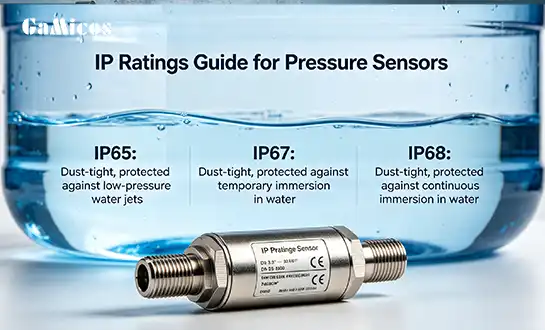
IP Ratings Guide: IP65, IP67, IP68 for Pressure Sensors
Corrosion-Resistant Pressure Transmitters for Ballast Water