ISO 9001 Pressure Sensor Calibration Schedule Guide
Understanding Pressure Sensor Calibration under ISO 9001
- Understanding Pressure Sensor Calibration under ISO 9001
- Establishing an Effective Pressure Sensor Calibration Schedule
- Step-by-Step Pressure Sensor Calibration Process
- Comparing Pressure Sensor Calibration Methods and Services
- Procuring Pressure Sensor Calibration Services and Tools: A B2B Buyer's Guide
- Conclusion
- FAQ
- Partner with GAMICOS for Precision Calibration Solutions
- References
To keep pressure measurement systems working well, you need to do more than just put in monitors and hope they work right. pressure sensor calibration is a key component of ISO 9001 Quality Management Systems, and it has a direct effect on the accuracy of measurements, the safety of processes, and adherence to regulations. When sensors aren't as accurate as they should be, it can affect the whole production process, leading to problems with quality, safety, and expensive fines for not following the rules. Setting up an organized calibration schedule stops these problems by regularly checking the accuracy of measurements and keeping records of their provenance. It's not enough for procurement managers, engineering teams, and quality assurance professionals to know about calibration requirements; they have to know them in order to protect operational excellence and keep their competitive edge in fields like pharmaceutical manufacturing and petrochemical processing.
Understanding Pressure Sensor Calibration under ISO 9001
To get ISO 9001 approval, businesses must show that they consistently manage measurement methods that affect the quality of their products. When sensor results are compared to known reference standards during calibration, any differences are found and outputs are changed to get them back to being accurate.
What Calibration Actually Measures?
Pressure sensors take in real pressure and turn it into electrical data that computer systems can understand. Mechanical stress, changing temperatures, and material wear and tear over time cause output signs to move away from real pressure values. Calibration figures out how much this shift is and sets up adjustment factors that make measurements accurate again. As part of the process, both zero point accuracy (the sensor's result at atmospheric pressure) and span accuracy are checked to make sure they are right across the whole measurement range.
ISO 9001 Calibration Requirements
The standard says that measuring equipment that can change the quality of a product must be checked against known standards on a regular basis. Companies need to write down how they calibrate their equipment, keep records that show how it can be traced back to national or foreign standards, and fix problems when their equipment isn't working properly. These standards make sure that measurements are the same from one batch of production to the next and give objective proof during quality checks.
Why Calibration Protects Operations?
When sensors aren't set, they create secret risks in industrial processes. When making medicines, changes in pressure during cleaning processes can make the finished product less sterile. Chemical companies that depend on wrong pressure readings run the risk of explosions when there is too much pressure. Even small amounts of drift can add up to big measurement mistakes that lead to product recalls, breaking the law, and damage to equipment. When these problems are checked for regularly, they are caught before they become major operating problems.
Establishing an Effective Pressure Sensor Calibration Schedule
Making a good pressure sensor calibration plan combines the dependability of measurements with the costs and downtime of running the business. Instead of using random time frames, good plans take into account many things that affect how stable sensors are.
Assessing Operational Conditions
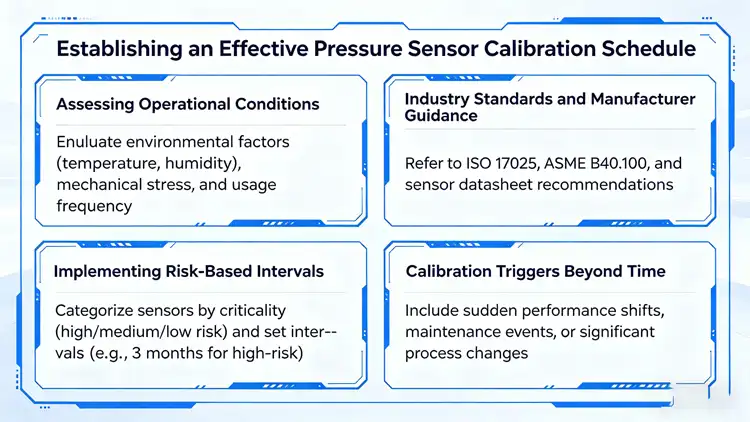
The environment has a big effect on the tuning frequency. Sensors that work in places with high vibrations, extreme temperatures, or acidic atmospheres break down faster than sensors that work in controlled conditions. Applications that change pressure often or are exposed to contamination need to be checked more often. When advising clients from a wide range of businesses on calibration intervals, we take these operating stresses into account.
Industry Standards and Manufacturer Guidance
Most sensor makers give advice on how often to calibrate their products based on how they were made and how well they should work. Most of the time, these suggestions range from checking every three months for important apps to doing this once a year for stable settings. Industry-specific standards give more information. For example, because regulators keep a closer eye on pharmaceutical operations, they need to be calibrated more often than water treatment plants.
Implementing Risk-Based Intervals
Risk-based thinking is used in modern quality management to plan when to do calibrations. Critical data points that affect safety or following the rules are checked more often and more thoroughly. Monitoring apps that aren't as important may be able to lengthen intervals without hurting quality overall. This method makes the best use of resources while keeping measuring processes under control. During audits, ISO 9001 compliance is shown by supporting documentation for timing choices.
Calibration Triggers Beyond Time
Event-based monitoring and time intervals are both important parts of effective plans. When process measures become questionable, after being hit physically, being exposed to overpressure, or during repair, sensors should be checked again. Setting clear cues makes sure that measurements are accurate no matter what time they are taken.
Step-by-Step Pressure Sensor Calibration Process
Using the right pressure sensor calibration method has a direct effect on the accuracy of measurements and the truth of documents. The methodical steps below will give the same results no matter what sensor technology or program is used.
Preparation and Equipment Setup
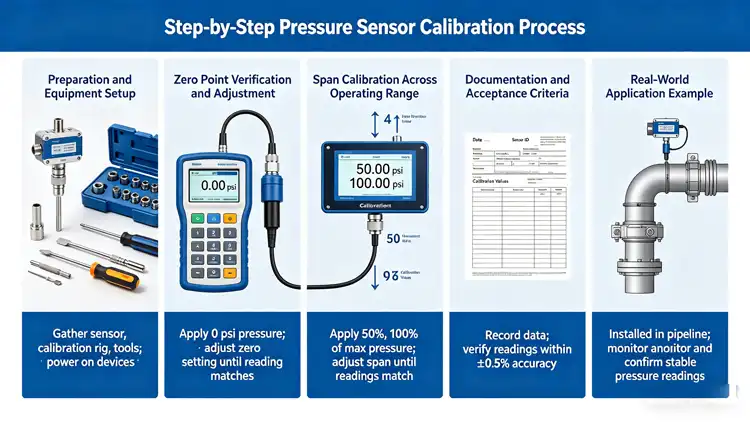
The first step in calibration is to get reliable reference standards. These are usually approved pressure gauges, deadweight testers, or precision calibrators whose accuracy is at least four times that of the sensor being tested. Temperature and humidity can change the security of a measurement, so the environment must match normal working conditions. We make sure that reference standards have up-to-date calibration papers that can be tracked back to national metrology bodies. This meets the paperwork requirements of ISO 9001.
Zero Point Verification and Adjustment
If there is no pressure on the sensor, it should send out its zero signal, which is usually 4 mA for current loop devices or the lowest value for analog outputs. Deviations show movement that needs to be fixed. Most sensors have ways to set the zero point, like mechanical trim potentiometers or software-configurable shifts. This fix sets the baseline that all future data will be compared to.
Span Calibration Across Operating Range
Span calibration checks the sensor's accuracy at several places along its range. There were standard practice tests at 25%, 50%, 75%, and 100% of full scale, and the real result was compared to a reference pressure that was applied. By comparing these readings, linearity mistakes can be found and it can be seen if adjusting the span makes the accuracy good again. Modern sensors with digital adjustments let you calibrate at multiple points, which fixes reactions that aren't linear.
Documentation and Acceptance Criteria
For each calibration, records are made that show the conditions as they were found, the changes that were made, and the end result as it was left. These records need to have the name of the sensor, the reference standards that were used, the conditions of the surroundings, the name of the worker, and the date of calibration. Acceptance standards set the biggest mistakes that are allowed. If a monitor goes over these limits, it needs to be fixed or replaced instead of just being adjusted.
Real-World Application Example
A pharmaceutical client was recently questioned by the FDA about how to control the air in an autoclave. The yearly calibration plan they were using wasn't good enough for high-cycle sterilizers. We set up statistical process control tracking for quarterly checks. This found patterns of slow drift, which let sensors be replaced before they stopped working properly. The new plan got rid of failed sterilizations and met regulatory standards. This shows that proper calibration protects both quality and compliance.
Comparing Pressure Sensor Calibration Methods and Services
Depending on the needs of the application, the resources that are available, and the level of accuracy that is needed, each method of testing has its own benefits.
Manual Calibration Techniques
Using portable test tools for manual testing gives you the freedom to check in the field. Technicians use hand pumps or controls to apply known pressures while keeping track of sensor outputs. This method works well for regular checks, but it depends a lot on how skilled the worker is and how well the surroundings is controlled. Manually recording data for documentation causes typing mistakes and makes trend analysis more difficult.
Automated Calibration Systems
By controlling the pressure that is applied and recording the results automatically, automated calibrators get rid of the unpredictability that comes from people. These systems instantly go through test points, figure out mistakes, and make certificates of calibration. Automation shortens the time needed for testing, makes it easier to repeat, and makes keeping records easier. Even though they cost more at first, automated options are very helpful for organizations that manage big groups of sensors.
Software-Assisted Methods for Smart Sensors
Software-based pressure sensor calibration testing is possible with modern digital sensors that have tools built in. Technicians connect computers with calibration software that talks to the electronics in the sensors. The software stores calibration data and compares it to reference inputs. This method speeds up proof and gives detailed diagnostic information about the health of the sensor. Honeywell, Emerson, Yokogawa, and Siemens are some of the biggest names in the industry, and their sensor systems come with their own calibration tools.
Evaluating Service Providers
Companies that can't do their own testing often hire expert service providers to do it for them. Checking for ISO/IEC 17025 accreditation, reading through measuring uncertainty standards, and making sure of turnaround times that cause as little business impact as possible are all things that need to be done before evaluating potential partners. Providers should show that they have experience with the monitor systems you need and that they know what the market needs. Companies like WIKA, Omega, and ABB offer full testing services that combine the accuracy of a lab with the ease of field service.
Procuring Pressure Sensor Calibration Services and Tools: A B2B Buyer's Guide
Long-term operations efficiency and quality system performance are greatly affected by strategic procurement choices made about pressure sensor calibration capability.
Defining Your Calibration Needs
When OEM makers add sensors to equipment, they need different solutions than when repair teams work on systems that are already in place. For customer service, distribution partners need portable verification tools. Engineering workers who are in charge of project launching can benefit from automated calibration systems that speed up startup. When procurement choices are based on practical needs, both capacity gaps and wasteful investments are avoided.
In-House Capability vs. Outsourced Services
To make internal testing possible, you need to spend money on reference standards, environmental controls, and training for technicians. Even though they cost more up front, internal programs are often more cost-effective for organizations that manage a lot of monitors in a lot of different places. Outsourcing may be a better way for smaller businesses or businesses with a lot of different types of sensors to save money by trading higher per-event costs for lower capital costs and training needs.
Selecting Calibration Equipment
There are many types of portable calibration kits, from simple ones with digital scales and manual pressure sources to more complex ones with built-in pumps and computers that handle them. Starting prices for basic tools that can be used for field testing are around $2,000. Automated systems made for laboratories cost at least $15,000. Key decision factors include the pressure range it covers, its accuracy, how well it works in harsh environments, and its software's record-keeping features.
Supplier Evaluation Criteria
There are a few important traits that all reliable testing service providers share. The current ISO/IEC 17025 accreditation shows that the person is technically competent and that measurements can be tracked. Schedules for operations must match up with turnaround times; longer testing periods require expensive spare sensor stock. Having technical support helps figure out what's wrong with results that are on the edge and suggest what should be done to fix them. Geographic access is important for businesses with spread-out sites that need the same level of service everywhere.
Conclusion
Systematic pressure sensor calibration according to ISO 9001 guidelines protects the accuracy of measurements, which is important for quality control, process safety, and following the rules. Setting up the right calibration plans means finding a balance between operating conditions, regulation requirements, and cost, all while keeping track of everything that has been done. Whether companies run their own testing programs or work with service providers, they need to be very careful when choosing who to work with to make sure their capabilities match their needs.
The step-by-step calibration method described here can be used with a wide range of sensor systems and in a wide range of business settings. Because the accuracy of measurements has a direct effect on both product quality and operational safety, calibration can't just be seen as a load on the staff. It's an important part of supporting operational success in global markets that are very competitive.
FAQ
How often should pressure sensors be calibrated according to ISO 9001?
ISO 9001 doesn't say how often pressure sensor calibration needs to be done, but it does say that it needs to be done at rates that make sure measurements are accurate. Usually, verification happens every three months for important safety purposes and calibration happens once a year for stable monitoring settings. The right time between checks for each application is decided by a risk-based analysis that takes into account operating conditions, manufacturer suggestions, and government rules.
What risks arise from neglecting scheduled calibration?
When sensors aren't calibrated, they slowly move away from giving accurate results. This creates hidden measurement mistakes that lower the quality of the product, lead to safety issues, and break the law. Drift usually happens slowly enough that workers don't notice problems until big differences start to show up. When you do regular testing, you catch shift early and avoid expensive problems.
Should organizations perform calibration in-house or outsource services?
This choice is based on the number of sensors, their technical abilities, and the cost. Companies that are in charge of many sensors in many locations often support their own projects, even if they need to spend money on capital investments. Smaller businesses or those that use a lot of different sensor technologies may find that outsourcing is cheaper because they don't have to pay for tools or training and can still get access to specific knowledge.
Partner with GAMICOS for Precision Calibration Solutions
Global B2B manufacturing and industrial automation needs can be met by GAMICOS's full range of pressure sensor calibration services. Our engineering team gives you expert advice on how to make sure that testing plans work with your operations and are in line with ISO 9001. We make high-precision pressure sensors, liquid level sensors, and wireless tracking systems that are sent to more than 100 countries. We can also fully customize OEM and ODM orders.
Our technical experts are ready to help whether you're an instrument distributor looking for calibration tools, an engineering contractor in charge of project commissioning, or a maker needing help making a calibration plan. For more information on how GAMICOS can help you with your pressure sensor calibration needs, please email us at info@gamicos.com. We offer reliable tools, expert advice, and quick service that builds stronger ties in your supply chain.
References
1. International Organization for Standardization. (2015). ISO 9001:2015 Quality Management Systems—Requirements. Geneva: ISO Press.
2. NIST Special Publication 1297. (1994). Guidelines for Evaluating and Expressing the Uncertainty of NIST Measurement Results. National Institute of Standards and Technology.
3. American Society for Testing and Materials. (2019). ASTM E2877-19 Standard Guide for Digital Contact Thermometers. West Conshohocken: ASTM International.
4. International Electrotechnical Commission. (2017). IEC 61298-2:2017 Process Measurement and Control Devices—General Methods and Procedures for Evaluating Performance. Geneva: IEC Publications.
5. Instrument Society of America. (2018). ISA-51.1-1979 (R2018) Process Instrumentation Terminology. Research Triangle Park: ISA Standards.
6. Henry, M.P. & Clarke, D.W. (2020). Industrial Pressure Measurement: Principles and Practice. London: Professional Engineering Publishing.

Peter
Peter, Senior Sensor Technology Consultant, has 15-year industrial sensor R&D experience. He specializes in the end-to-end development of high-accuracy pressure and level sensors and he firmly believe, precision isn’t just a spec—it’s a promise.
We're here to help — submit your request anytime!
Let us know how we can help solve your pressure level measurement challenge.
_1757930850792.jpg)
Recommended Blog
Advantages of Using Pressure Sensors in Industrial Automation
Pressure Transmitter Calibration: Field vs Bench Procedures
Wireless vs. Wired Pressure Transmitters for IIoT Applications