Field vs Laboratory Calibration: Which is Better for Your Application?
Field vs Laboratory Calibration: Which is Better for Your Application?
Introduction
- Introduction
- Understanding Pressure Transmitter Calibration
- Field Calibration – Advantages and Limitations
- Laboratory Calibration – Advantages and Limitations
- Comparing Field vs Laboratory Calibration: Which to Choose?
- Implementing an Effective Calibration Strategy for Pressure Transmitters
- Conclusion
- FAQ
- Partner with GAMICOS for Comprehensive Pressure Measurement Solutions
- References
Field or laboratory pressure transmitter calibration relies on your unique needs for accuracy, how much money you have, and how you want to spend. Field calibration is convenient and requires little downtime because changes can be made on-site. This makes it perfect for settings where equipment removal would stop work. On the other hand, laboratory testing gives you more accuracy in a controlled environment that is fully traceable to international standards. This is very important for important uses in the chemical, pharmaceutical, and energy sectors. A hybrid method, which includes regular field checks and regular lab calibrations to keep things accurate over time and in line with regulations, works best for most industrial sites.

Introduction
Pressure transmitter calibration is one of the most important maintenance tasks in industrial automation because it has a direct effect on the accuracy of process control, the quality of the product, and the safety of operations. Taking accurate pressure readings is important whether you're in charge of a food processing plant, a pharmaceutical production line, or a petroleum factory. This will help you avoid mistakes that cost a lot of money, equipment breakdowns, and compliance violations.
There are two main types of calibration used in industry: field calibration, which is done at the installation site, and laboratory calibration, which is done in a controlled measurement setting. Each method has its own benefits that make it better for different operating situations, budgets, and accuracy needs.
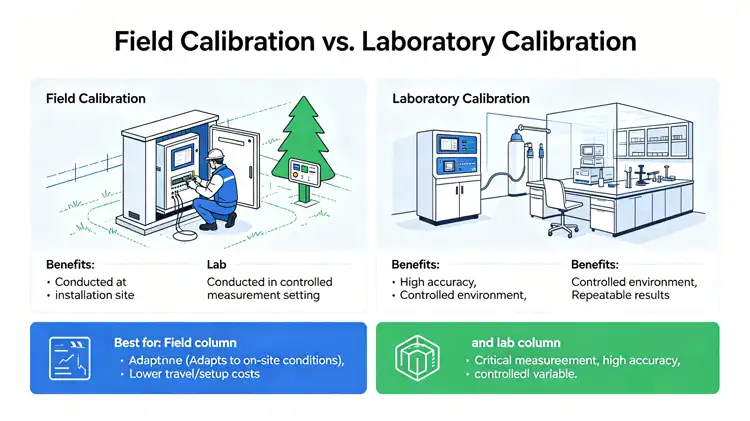
This complete guide was made just for buying managers, engineering pros, and R&D teams that need to make decisions about calibration. We'll help you figure out which method—or a mix of the two—gives the best results for your pressure measurement tools by looking at both through the lens of real-world industrial uses. This study looks at not only technical correctness but also things like the cost of downtime, the availability of technicians, and the long-term investment in calibration.
Understanding Pressure Transmitter Calibration
What Calibration Entails
Pressure transmitter calibration means systematically comparing the output of the device to known reference standards and making changes to get rid of measurement mistakes. To do this, you have to set the zero point (the number at which no pressure is applied), change the span (the full-scale range), and make sure that the measurement is straight across the whole range. Sensor drift happens naturally over time because of changes in temperature, mechanical stress, process media exposure, and the aging of electrical parts. This is why modern transmitters need to be re-calibrated from time to time.
Why Accuracy Matters
In chemical processing plants, a measurement mistake of just 0.5% can waste thousands of dollars' worth of raw materials or make lots of products that don't meet specifications. Pharmaceutical companies are closely watched by regulators, and FDA warning letters are sent when there are breaks in calibration that are not recorded. Power plants need accurate pressure data to keep turbines from breaking down in terrible ways. If you don't calibrate often enough, you risk change that you can't see, and if you do it too often, you waste time and money on maintenance that isn't needed.
Calibration Procedures and Tools
In all fields, there are three main ways to do calibration. Technicians use hand pumps or pressure devices to apply known pressures while recording output signals during manual testing. Using software-controlled pressure sources and data logging, automated calibration systems speed up this process and cut down on human mistake and documentation time. The newest method is online calibration, in which transmitters check themselves against internal references without stopping the process. However, this technology is still only available on high-end gadget types.
Choosing the right calibration tools has a big effect on the quality of the results. Professional-level pressure calibrators from companies like Fluke and Beamex offer accurate reference standards that can be tracked back to the devices being tested. Portable testing kits let you work in the field, but they might not be as accurate as laboratory-grade dead weight tests. The way documentation is done must be in line with ISO/IEC 17025 standards. This makes audit trails that show measurements can be tracked back to national metrology centers.
Field Calibration – Advantages and Limitations
On-Site Calibration Benefits
Pressure transmitter calibration in the field has clear benefits for places that use ongoing processes where taking out equipment would mean losing output. When technicians get to the transmitter site with portable calibrators, they do the necessary checks and adjustments within hours, and the instrument is back in service without having to be taken apart. This method works especially well for sites that are far away, like offshore platforms, pipeline monitoring posts, or distributed tank farms, where getting equipment to labs would be hard to do and cost a lot of money.
Another useful feature is that it lets you fix problems in real time. When problems happen in the process, field calibration lets you check right away to see if the accuracy of the measurements has dropped. During a single repair window, engineering teams can check multiple transmitters spread out across a production area. They can look for trends that point to systemic problems, such as electrical interference or damage from vibrations.
Environmental and Technical Constraints
Because the surroundings can't be managed, field calibration has its own problems. When measuring outside, changes in the ambient temperature can cause mistakes, especially when tight tolerances are used for high-accuracy transmitters. Both the calibrator and the transmitter being checked can be harmed by humidity, dust, and electromagnetic interference from nearby equipment. This makes the measurements less accurate.
Field testing quality is affected by differences in how skilled the technicians are. In a lab, there are standard processes and skilled metrologists, but in the field, maintenance workers with different levels of experience are more common. When plants are turned over quickly, calibrations may skip important verification spots or make documentation that isn't full. Most portable testing equipment isn't as accurate as tools used in a lab, which limits how much accuracy can be improved.
Cost and Service Provider Considerations
Field calibration lowers the cost of downtime, but service costs can change depending on how far the technician has to drive, how much tools they have to rent, and their hourly rate. Regional service provider supply varies a lot. For example, big industry hubs have access to a wide range of vendors with low prices, while remote areas may have to pay more or wait longer for services. Procurement teams should think about whether buying movable calibration equipment for their own use is better in the long run than hiring field services, especially for places with a lot of transmitters that need to be checked often.
Laboratory Calibration – Advantages and Limitations
Controlled Environment Precision
Pressure transmitter calibration in lab testing facilities is always the same because temperature, humidity, and cleanliness are controlled, so there are no external error sources. Metrologists use standard tools like dead weight testers and precise pressure controllers to make sure that measurements are accurate to within 0.025% of the number or higher. This controlled method lets high-precision differential pressure transmitters be calibrated. These transmitters are used in custody transfer, clean rooms for pharmaceuticals, or flight tests, all places where measurement error has a direct effect on the acceptance of the product.
Equipment Removal Challenges
Lab calibration comes with full traceability paperwork, such as papers that link to national standards kept up to date by groups like NIST. During regulatory checks, quality system certifications, or customer qualification processes, these documents are very important. An independent check of their scientific knowledge and testing skills is provided by ISO/IEC 17025 accreditation, which many labs have.
For laboratory testing, transmitters have to be taken out of service, which causes problems with operations. Before an instrument can be removed, the process line may need to be shut down, depressurized, and isolated. Sensitive devices are at risk during shipping because shock, pressure, or water can change the calibration state or damage the device physically. Depending on how busy the lab is and how the packages are shipped, the turnaround time can be anywhere from a few days to a few weeks. To keep production going, extra transmitters may be needed.
Supplier Selection Criteria
Field services have very different cost models. Laboratory calibration costs a set amount per instrument plus the cost of shipping. This makes it a good option for bulk calibration of many devices but pricey for emergency calibration of a single unit. Long wait times make it harder to respond quickly to unexpected calibration failures that are found during regular checks.
Calibration labs with a good reputation have ISO/IEC 17025 certification for measuring pressure, make measurement error budgets public, and take part in programs that let other labs compare their results. Managers of procurement should make sure that the approval includes the types of transmitters and pressure ranges that you need. The main differences between basic and paid services are turnaround times, the content of certificates, and the availability of technical help. Some labs offer extra services that are worth paying for, like fixing transmitters, updating software, or making testing procedures that are specific to an application.
Comparing Field vs Laboratory Calibration: Which to Choose?
Accuracy and Reliability Comparison
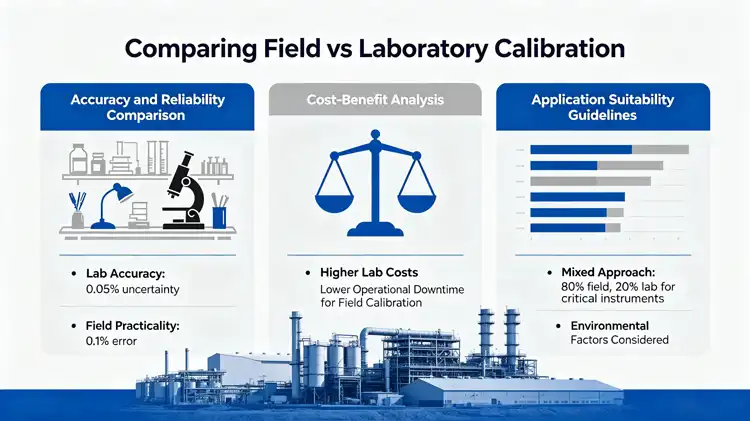
The accuracy of measurements is always better in the lab, with pressure transmitter calibration uncertainties of 0.05% or less. In the field, on the other hand, even with high-quality portable tools, errors rarely go above 0.1%. This difference in accuracy is very important for uses like custody transfer, pharmaceutical validation, or aircraft tests where strict measurement performance levels are needed by law.
The whole testing process must be taken into account when evaluating reliability. Calibration in the lab lets you check multiple points across the whole measurement range, finding problems with nonlinearity or drift trends that quick checks in the field might miss. Field calibration, on the other hand, records performance in the installed state and shows issues like blocked pressure taps, problems with impulse lines, or electrical grounding faults that testing on separate transmitters in a lab cannot find.
Cost-Benefit Analysis
To find out how much calibration really costs, you have to add up the direct service fees and the secondary effects on operations. Even though it costs more per calibration, field calibration is better for ongoing processes because it cuts down on production downtime that could be worth thousands of dollars per hour. Lab calibration works for planned repair windows, extra transmitter cycle programs, or situations where longer downtime is okay.
Application Suitability Guidelines
A petroleum plant with 200 transmitters could use a plan to calibrate 80% of them in the field during three-month maintenance visits and rotate the most important and safety-instrumented transmitters through a laboratory calibration once a year. This mixed method finds a good balance between saving money and getting things right, putting accurate resources where they will do the most good.
Frequencies that are matched with risk ratings should be used to calibrate important process control transmitters that protect people's safety or expensive equipment. Field-only calibration works well with tracking points that aren't very important and have wide error bands. Methodology is often set by the rules that need to be followed. For example, FDA-regulated pharmaceutical processes may need to be calibrated in a lab and have a full uncertainty analysis done, while general industrial tracking can accept proof in the field.
The environment affects the choice of approach. Places with a lot of vibration, high temperatures, or corrosive atmospheres can benefit from laboratory testing that lets you check for damage carefully when you take the instrument off. In contrast, installations in dangerous areas that allow hot work and require long separation processes along with transmitter removal tend to favor field calibration to lower safety risk exposure.
Implementing an Effective Calibration Strategy for Pressure Transmitters
Developing Calibration Schedules
Effective pressure transmitter calibration plans start with figuring out which pieces of tools are the most important. Safety-critical transmitters that feed emergency shutdown systems need to be calibrated every 6 to 12 months and their accuracy must be checked in a lab. Process control devices that have an effect on the quality of the output should usually be replaced every 12 to 18 months. Based on past stable data, non-critical tracking points may go up to 24 months without being calibrated.
Making calibration forms makes sure that all expert teams follow the same rules and that all the paperwork is complete. Checklists should include places to check across the measurement range, the allowed range of errors, the conditions that need to be recorded, and what needs to be done when devices don't meet the acceptance standards for calibration. Digital calibration management systems make organizing easier, keep records of past calibrations, and make compliance reports that meet audit standards.
Leveraging Advanced Calibration Technologies
Modern smart devices that use digital transmission protocols let more complex calibration methods be used. Devices that are compatible with HART, Foundation Fieldbus, or Profibus can make zero and span changes through handheld communicators without using physical force. This makes field calibration processes more efficient. Some high-end transmitter types have reference sensors that let them self-diagnose and find calibration drift before it affects process control. This means that there are longer gaps between formal calibrations.
Automated tuning tools make labs that manage big groups of transmitters much more efficient. These systems combine signal measurement, pressure generation, and documentation into software-controlled processes. This cuts the time it takes to calibrate each device from hours to minutes and gets rid of transcription mistakes. When measuring more than 50 devices a year, the return on investment numbers often show that automation is the best way to go.
Troubleshooting Common Calibration Issues
The most common problem with calibration is signal drift, which can be caused by sensors getting old, process temperatures changing, or pressure spikes that are higher than the sensor's stated capacity. Systematic drift in one way means that the sensor material is moving, while numbers that change all the time mean that there is electrical interference or moisture getting in. Usually, changes in the outdoor temperature cause zero shifts without changes in the span. On the other hand, proportional mistakes across the range show that the span needs to be adjusted.
When calibration fails, root cause studies are started. Failures that happen over and over may mean that the wrong transmitter was chosen for the job, like using general-purpose transmitters in places with a lot of vibration or not providing enough overpressure safety. Changes in process conditions, such as media fouling, impulse line blockages, or installation direction errors, can affect the accuracy of measurements regardless of the transmitter's calibration state. These errors must be fixed before tries to recalibrate the transmitter.
Maintaining Standards Compliance
International standards like ISO 9001 require calibration methods to be written down, reference standards to be able to be tracked, and set times for calibration based on a risk assessment. Additional rules are set by industry-specific standards, such as ASME PTC 19.2 for power generation, FDA 21 CFR Part 11 for making drugs, or API 2634 for measuring ownership transfers. These needs must be written into calibration programs' processes, paperwork forms, and training materials.
To keep the accuracy of the testing system, the reference standards must be checked on a regular basis. Portable calibrators need to be recertified every year to make sure they meet repeatable standards. The time between calibrations for lab equipment depends on how often it is used and how stable it needs to be. Calibration equipment stays accurate between certification rounds as long as it is stored, handled, and maintained properly.
Conclusion
When choosing the best pressure transmitter calibration method, it's important to think about the accuracy needs, practical limitations, and cost factors that are specific to each business application. Field calibration works best in settings with a constant process where the costs of downtime are higher than the small accuracy trade-offs that need to be made. On the other hand, laboratory calibration is best for critical applications that need the highest level of accuracy and full traceability.
The most advanced businesses use a mix of tactics, using each way where it gives the most benefit. Regular testing, whether in the field, the lab, or both, is still necessary to keep measurement systems working properly, make sure they follow the rules, and avoid expensive process failures. Engineering teams can keep measurements accurate over time even as industry needs change by working with experienced testing service providers and buying the right tools.
FAQ
How often should pressure transmitters be calibrated?
How often you need pressure transmitter calibration depends on how important the application is, what the regulations say, and how well it has worked in the past. IEC 61511 standards say that safety-instrumented system transmitters need to be checked every 6 to 12 months. For process control purposes, testing should be done once a year. For non-critical tracking points, however, 24 months may be enough if stability is shown to be stable. In harsh settings with high or low temperatures, vibration, or corrosive media, testing needs to be done more often. By keeping track of calibration histories, data-driven interval optimization can be used to make intervals longer for devices that are typically stable and shorter for setups that are having problems.
Can field calibration completely replace laboratory methods?
Field testing is the main way that most industrial applications check their work, but it can't completely replace lab work. Calibration in a lab gives control transfer transmitters, reference standards, and paperwork for regulatory compliance better accuracy. Calibration in the lab on a regular basis makes sure that field equipment is working correctly and finds systematic mistakes that regular checks in the field might miss. A balanced approach uses field calibration for regular checks and lab calibration at longer times for important devices or when results from the field point to possible problems.
What equipment is essential for field calibration?
Minimum field calibration equipment includes a portable pressure calibrator or hand pump capable of generating pressures across your transmitter ranges, a multimeter or process calibrator to measure transmitter output signals, and appropriate fittings to connect calibration equipment to transmitter test ports. Professional setups include HART communicators for setting up smart transmitters, documenting process calibrators that automate testing methods and store results online, and pressure modules that cover a range of pressures. To make sure the correction is useful, the reference accuracy should be at least four times better than what the transmitter specifies.
Partner with GAMICOS for Comprehensive Pressure Measurement Solutions
GAMICOS specializes in manufacturing high-precision pressure transmitters and level sensors designed for demanding industrial applications across petroleum, chemical, pharmaceutical, food processing, and energy sectors. Our extensive product portfolio includes pressure sensors, liquid level sensors, ultrasonic and radar level meters, and wireless IoT-enabled monitoring systems exported to over 100 countries worldwide.
We understand that effective pressure transmitter calibration requires not only quality devices but ongoing technical support throughout equipment lifecycles. Our engineering team provides consultation on calibration strategy development, helping procurement managers select appropriate methodologies based on application criticality and operational constraints. Whether you're establishing new calibration programs or optimizing existing procedures, GAMICOS delivers the expertise and instrumentation quality that measurement accuracy demands.
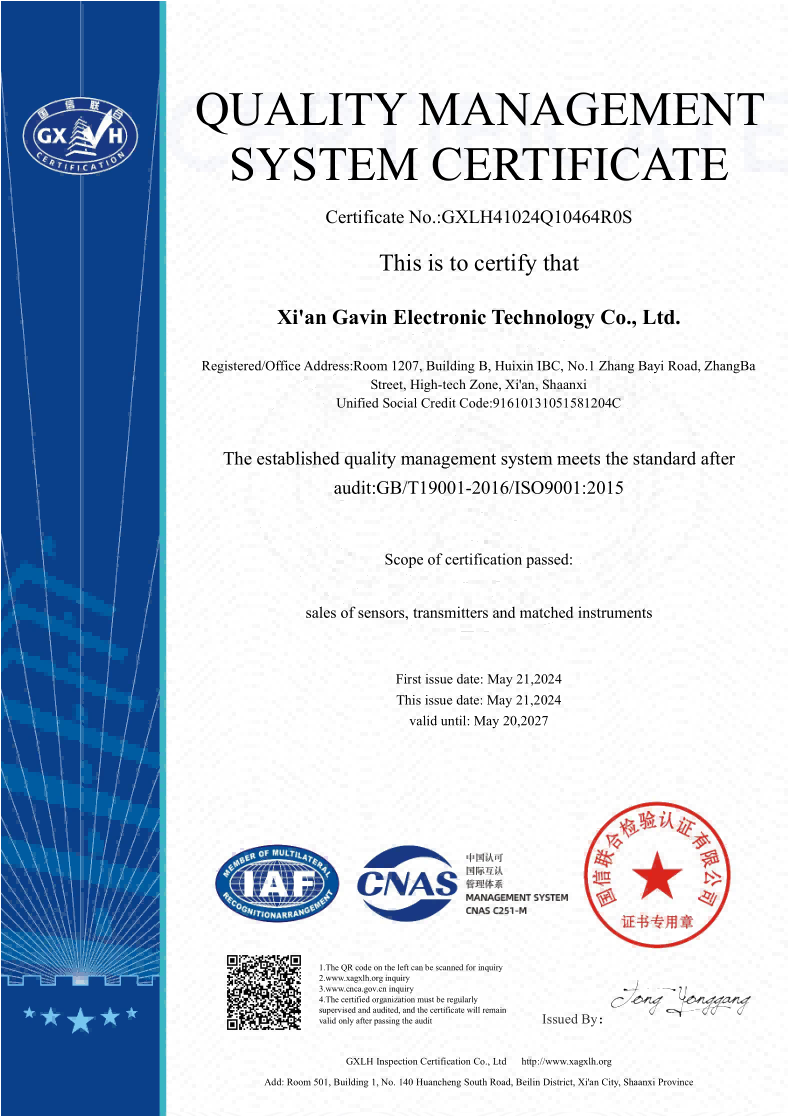
As a dedicated pressure transmitter calibration supplier, we offer comprehensive OEM/ODM customization services including sensor type selection, interface configuration, communication protocol integration, and documentation tailored to your specifications. Our manufacturing facilities maintain strict quality control aligned with international certifications, ensuring consistent performance that simplifies calibration management and extends verification intervals.
Contact our technical specialists at info@gamicos.com to discuss your pressure measurement challenges and calibration requirements. We'll help you develop cost-effective solutions that balance accuracy, reliability, and operational efficiency across your facility's instrumentation systems.
References
1. International Society of Automation (2018). Pressure Transmitter Calibration: Field and Laboratory Best Practices. ISA Technical Report.
2. Johnson, M.R. & Chen, L. (2020). Comparative Analysis of Field versus Laboratory Calibration Methodologies for Industrial Pressure Measurement. Journal of Process Control Engineering, 45(3), 178-195.
3. National Institute of Standards and Technology (2019). Guidelines for Pressure Measurement Traceability in Industrial Applications. NIST Special Publication 1200-8.
4. Petroleum Equipment Institute (2021). Calibration Requirements for Custody Transfer and Safety Applications. PEI RP1400 Recommended Practice.
5. Schmidt, H. & Patel, R.K. (2019). Economic Optimization of Pressure Transmitter Calibration Programs. Industrial Maintenance & Plant Operation, 80(7), 42-51.
6. World Metrology Organization (2022). Pressure Calibration Uncertainty Budgets: Laboratory and Field Comparison Study. International Metrology Congress Proceedings, 234-249.

Peter
Peter, Senior Sensor Technology Consultant, has 15-year industrial sensor R&D experience. He specializes in the end-to-end development of high-accuracy pressure and level sensors and he firmly believe, precision isn’t just a spec—it’s a promise.
We're here to help — submit your request anytime!
Let us know how we can help solve your pressure level measurement challenge.
_1757930850792.jpg)
Recommended Blog
4-20mA Signal Jumping or Unstable? Complete Diagnostic Flowchart

How to Install a Pressure Transmitter: 7 Best Practices
Process Connections: G1/4, NPT, SAE for Pressure Sensors
4-20mA Signal Jumping or Unstable? Complete Diagnostic Flowchart
How to Install a Pressure Transmitter: 7 Best Practices
Process Connections: G1/4, NPT, SAE for Pressure Sensors