Millivolt vs. Amplified Output Pressure Transducers
Understanding Pressure Transducer Outputs
- Understanding Pressure Transducer Outputs
- Millivolt vs. Amplified Output: Key Comparison Factors
- How to Choose the Right Pressure Transducer Output for Your Industrial Needs?
- Installation, Calibration, and Maintenance Best Practices
- Advantages of Analog vs. Digital Pressure Transducer Outputs in Modern Industry
- Conclusion
- FAQ
- Partner with GAMICOS for Premium Pressure Measurement Solutions
- References
It is very important to know the differences between millivolt and amplified pressure transducer output choices when choosing pressure measurement solutions for commercial use. Low-level analog signals are sent straight from the sensor's bridge circuit to millivolt outputs, which usually produce 30–100 mV full scale without any internal electronics. On the other hand, amplified outputs have built-in signal conditioning circuits that boost these signals to normal ranges like 0-10 V or 4-20 mA. This makes them less susceptible to electrical interference and better for longer wire runs. Picking one of these output types has a direct effect on the accuracy of measurements, the difficulty of installation, and the long-term dependability of the system in harsh settings.
Understanding Pressure Transducer Outputs
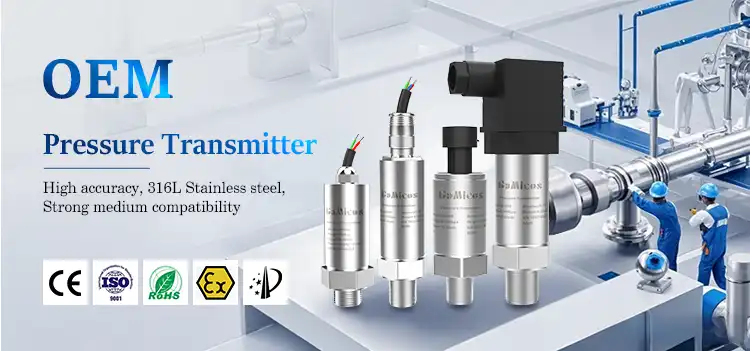
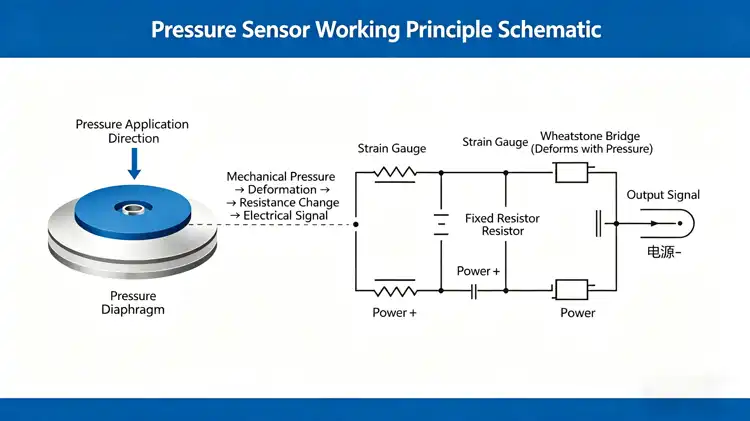
Pressure sensors are the most important part of many industrial measurement systems because they turn mechanical pressure into electrical signs that can be understood. A pressure sensor is made up of piezoresistive elements that are attached to a detecting diaphragm that changes shape when pressure is applied. This change in shape changes the electrical resistance of the detecting elements, which are usually set up in the shape of a Wheatstone bridge. The bridge gives off a voltage that is equal to the pressure that is being applied. This is what measurements are based on.
How Millivolt Outputs Work?
The most basic type of signal used to measure pressure is a millivolt output sensor. The electrical output of these devices comes straight from the detecting element's Wheatstone bridge; they don't do any signal processing or amplification on the inside. At full scale pressure, the output usually falls between 30 and 100 mV, and the sensitivity is generally given in mV/V, which stands for millivolts per volt of excitement. In other words, a sensor with a 2 mV/V rating and a 10 V source of excitation would make 20 mV when it was fully charged. The ease of this design has some benefits, but it also limits the signal transfer distance and the ability to block out noise.
Amplified Output Signal Types
Pressure transducers that are amplified have electronics built in that clean up and boost the raw sensor data to normal industrial levels. Voltage outputs of 0–5 V or 0–10 V and current loop outputs of 4–20 mA are the most popular amplified versions. Because the measurement is based on current size instead of voltage level, current outputs have very low noise. This makes them perfect for sending over lengths greater than 1000 feet. When more than one sensor shares the same power supply, voltage outputs work well in shorter-range situations. Both types of amplified equipment work well with current programmable logic controllers, remote control systems, and data gathering equipment that is common in petrochemical plants, drug factories, and food processing plants.
Compatibility with Industrial Systems
When selecting the appropriate output signal, it’s important to carefully consider the existing control system architecture. Matching the pressure transducer output—whether analog (e.g., 4–20 mA, voltage) or digital—with system requirements ensures seamless integration, reliable data transmission, and accurate process control. A lot of older systems, especially those in factories that have been around for a long time, were built around millivolt sensors and have extra amplifiers, signal processors, or special instruments.
It's possible that adding amplified transducers to these devices would only require minor changes to the control software and wires. Modern automatic systems, on the other hand, usually need uniform amplified signals and might not be able to handle millivolt inputs without extra interface hardware. System compatibility is more than just matching electrical components. It also takes into account grounding methods, the availability of power supplies, and electromagnetic interference settings that can have a big impact on the quality of measurements.
Millivolt vs. Amplified Output: Key Comparison Factors
Knowing the real differences between millivolt and amplified output sensors helps engineering teams make choices that balance the need for performance with the need to stay within budget. These differences show up in a number of areas, such as signal strength, environmental robustness, and upkeep issues.
Signal Integrity and Noise Susceptibility
Millivolt signals can be affected by electrical noise because they have a low volume. This noise can come from motor drives, welding tools, and switching power supplies. Electromagnetic radiation, even small amounts, can cause measurement mistakes that lower the accuracy of process control. Millivolt sensors need protected twisted-pair wire, careful grounding, and being kept away from power lines. This makes cable routing very important. The higher signal levels of amplified outputs keep good signal-to-noise ratios even in electrically harsh settings, making them much more resistant to noise. Current-based measurement automatically ignores voltage drops along wire runs and ground potential differences, which are problems with voltage-based systems. This makes the 4-20 mA current loop configuration very reliable.
Accuracy and Calibration Characteristics
It is possible for both millivolt and amplified sensors to meet high accuracy standards, but they have very different tuning needs. To work as accurately as they need to, millivolt devices usually need precise power sources and external instruments that have been carefully adjusted. The sensor bridge is made more complicated by the fact that changes in temperature can cause the millivolt output to drift if they are not corrected by electronics outside the sensor.
Temperature compensation circuits and controlled power supplies are built into the housing of amplified sensors. This means that they work reliably across their stated temperature range without any help from outside sources. This self-contained design makes placement easier in the field and lowers the number of times that the sensor needs to be calibrated. However, the extra electronics add failure modes that passive millivolt sensors don't have.
Response Time and Dynamic Performance
Response time is a measure of how quickly a pressure sensor responds to changes in pressure. This is an important factor to consider when tracking systems with fast pressure changes, like combustion processes or hydraulic systems. Because they don't have any technology inside, millivolt sensors have the fastest response times, which are only limited by the way the measuring diaphragm and pressure port are configured mechanically.
If you build your millivolt sensors correctly, you can get response times of less than 1 millisecond. Signal filtering circuits in amplified sensors add small delays, but newer designs try to keep this effect to a minimum so response times are still good for most industrial uses. The practical difference doesn't have much of an effect on tracking a process in steady state, but it does matter when measuring pressure at high frequencies.
Cost Considerations and Application Suitability
Most of the time, millivolt sensors are cheaper than their amplified versions because they are made with fewer parts and are easier to put together. At first glance, this price advantage seems appealing for big sites that need a lot of sensors. The total cost of ownership, on the other hand, needs to include external signal conditioning equipment, more complicated wiring installs, and maybe even higher upkeep costs.
Although amplified transducers cost more up front, they are easier to install with normal two- or three-wire connections, take less time to commission, and usually have lower long-term running costs. The economic equation changes based on the application. For example, millivolt sensors can still be used for short cable runs in electrically quiet areas, while amplified outputs are a better choice for installing sensors in large buildings that are spread out.
How to Choose the Right Pressure Transducer Output for Your Industrial Needs?
To find the best pressure measurement option, you need to carefully consider a lot of different factors, such as technical needs, weather conditions, and budgetary limitations. This method for making decisions helps procurement workers and engineering managers make good choices during the choosing process.
Defining Application Requirements
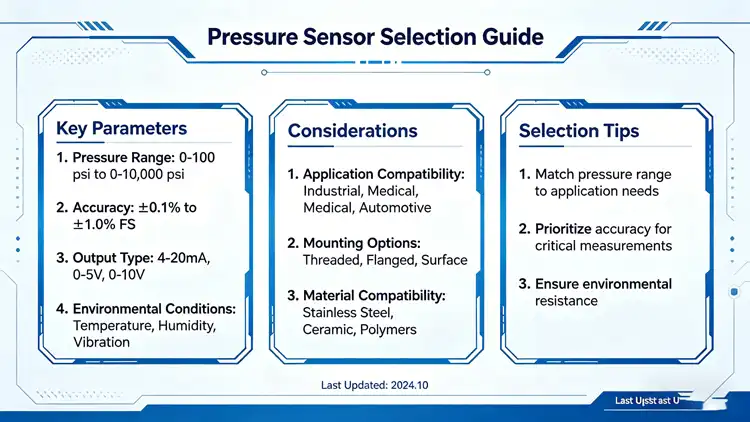
To choose the right monitoring device, you must first clearly define the required measurements. Understanding the expected pressure transducer output—such as voltage, current, or digital signals—is essential to ensure compatibility with control systems and accurate data acquisition. The basis is the pressure range and precision requirements. Other factors that are just as important are the compatibility of the media, the extremes of temperature, the level of vibration, and the fitting limitations. tracking clean gases or liquids in controlled settings gives you more options than tracking harsh chemicals, abrasive slurries, or high-temperature steam.
The level of accuracy needed for measurements determines the type of monitor and output that is used. Many industrial processes work well with an accuracy of ±0.5%, but for important safety uses or custody transfer metering, an accuracy of ±0.1% or better is needed. Knowing these needs keeps you from defining too many complicated answers when simpler ones would do, and on the other hand, it makes sure you get good performance when accuracy is important.
Integration with Control Systems
The features of your tracking and control system have a big impact on the output you choose. Looking at the following things gives you more information:
- Available Input Types: Check to see if your control system can handle millivolt signals or needs inputs that have been amplified. Also, find out what voltage or current levels are handled by the different analog input units that are on the market.
- Transmission Distance: Find out how far away the sensor mounting places are from the control boxes. Keep in mind that millivolt signals get weaker after 10 to 20 feet, but 4-20 mA signals can safely reach 3000 feet or more.
- Power Supply Architecture: Check to see if there are special stimulation supplies for millivolt sensors or if normal 24 VDC industrial power is available. Most amplified instruments use this type of power.
- Grounding Infrastructure: Look at how well the building is grounded. Bad grounding can cause ground loops that mess up voltage readings but don't have much of an effect on current loop systems.
These technology issues have a direct effect on how much it costs to install and how reliable it is in the long run. Modern facilities are using amplified 4-20 mA receivers more and more because they are reliable and flexible. This makes it easier to keep track of extra parts and train technicians. Millivolt sensors may be a better choice for straight replacement uses in places that are keeping old systems running, as they avoid having to make expensive changes to the control system.
Total Cost of Ownership Analysis
The purchase price is only one part of the total costs over the life of the product. An in-depth economic analysis looks at things like installation work, setup time, calibration regularity, spare parts inventory, and the expected service life. Most of the time, amplified sensors lower installation costs by making wires easier and running on their own. Their built-in tests often let you plan repair ahead of time, which cuts down on unplanned downtime. Millivolt sensors may need to have both the transducer and the instruments that go with it re-calibrated every so often. Amplified units, on the other hand, usually stay calibrated for a long time. Costs for downtime change a lot from industry to industry. For example, process interruptions in the pharmaceutical or petroleum industries could cost thousands of dollars an hour. In these kinds of settings, dependability and ease of maintenance often matter more than the original price.
Customization and OEM Requirements
There are a lot of industry uses that need custom pressure measurement options that work with certain electrical links, mechanical interfaces, or pressure ranges. OEM equipment makers often put pressure sensors in their machines, valves, or control systems. This means that the sensors have to be able to fit into small areas or be mounted in specific ways. It is very helpful to be able to change the sensor's features, like the type of output signal, the arrangement of pressure ports, and the electrical connections. Suppliers that offer both OEM and ODM services let design engineers get the most out of the combination of sensors while still keeping control of branding and paperwork. Digital sensors' transmission methods can also be customized. Modbus, HART, and other industrial fieldbus standards make it easy to integrate them into distributed control architectures.
Installation, Calibration, and Maintenance Best Practices
Whether pressure measurement systems work as expected over long service lives depends directly on how well they are installed and maintained. Following well-known best practices cuts down on measurement mistakes and the need for fixing.
Installation and Wiring Guidelines
The right way to install something starts with fixing the sensor in a way that keeps the transducer from shaking too much and allows for good thermal conductivity for uses that need it. The direction of the pressure port is important, especially when reading liquids or gases that condense, where mistakes can be caused by trapped air or sediment. There are big differences in how millivolt and boosted sensors are wired. For millivolt setups, you need protected twisted-pair wire. To avoid ground loops, the shields should only be grounded at the instrumentation end. Because cable capacitance changes high-frequency response, dynamic tests need wires with low capacitance. Millivolt signal wires should be kept under 20 feet long and should be run away from power lines and other sources of electromagnetic interference.
Calibration Procedures and Tools
To establish measurement transparency, measurements must be calibrated against approved reference standards on a regular basis. The amount of time between calibrations relies on how important the application is, the working conditions, and government rules. Usually, calibrations are done once a year in safe settings and every three months in demanding ones. Using a deadweight tester or precision pressure calibrator to apply known pressures and a high-impedance digital voltmeter to measure the output voltage is how millivolt sensors are calibrated. To find the real mV/V sensitivity, write down both the sensor result and the stimulation voltage. For temperature compensation proof, the device may need to be tested at different temperatures within its working range.
Preventive Maintenance and Troubleshooting
Systematic repair practices help extend sensor lifespan and prevent unexpected failures. Maintaining stable pressure transducer output is essential in this process, as consistent and accurate signal performance indicates proper sensor health and reliable operation. Visual checks should show if the pressure ports and electrical links have any physical damage, rust, or contamination. Check to see if the wire glands and pipe systems are still sealed against the environment. Check the output signals for drift, noise, or strange behavior that could mean the sensor is failing or there are problems with the placement. Sudden signal losses usually mean that the wiring or power source is broken, while slow drift means that the sensor is getting old or that the media is having an effect on the detecting element.
Troubleshooting begins with isolating whether problems originate in the sensor, wiring, or receiving equipment. For millivolt sensors, check the output impedance and record the excitation voltage at the transducer ports. To check for ground loops, temporarily separate the wire shields and watch for changes in the signal. Checking the source voltage, reading loop current or output voltage at several points, and making sure that the termination resistor values in current loops are correct are all examples of amplified sensor diagnostics. To support predictive maintenance strategies and guarantee claims, keep thorough maintenance logs that record calibration results, fix actions, and performance trends.
Advantages of Analog vs. Digital Pressure Transducer Outputs in Modern Industry
The world of industrial sensors is always changing. Along with well-known analog output formats, digital transmission methods are becoming more important. Figuring out how analog and digital sensors work together helps businesses make smart purchasing decisions that meet their current needs and plan for the future.
Analog outputs, encompassing both millivolt and boosted voltage or current signals, dominate industrial pressure measurement due to their simplicity, universal compatibility, and proven reliability. Analog sensors integrate seamlessly with existing control infrastructure without requiring protocol converters or configuration software. Their constant signal output lets you handle a process in real time with very little delay, which is very important for closed-loop applications that need to keep process parameters tight. The simple data path from sensor to controller makes setup easier and makes troubleshooting with regular electricity meters easier.
Digital pressure transducers communicate pressure readings along with diagnostic data using protocols such as HART, Modbus, or proprietary digital buses. These devices offer advantages including higher resolution, built-in diagnostics, and the ability to transmit multiple process variables over single cable pairs. Digital sensors support asset management systems that check the health of the sensors, keep track of when they need to be calibrated, and predict breakdowns before they affect operations. Changes to the configuration can be made virtually, without having to physically touch the device. This is useful in installations that are dangerous or hard to get to.
When Analog Outputs Remain Optimal?
Even though digital has come a long way, analog outputs are still very useful in many situations. Their passive operation uses very little power, which lets battery-powered systems or designs that are naturally safe work in dangerous places. Because analog sensors don't have microprocessors or firmware, they don't have any software weaknesses. This makes it easier to meet the safety standards that are being more closely looked at in key infrastructure. The two-wire topology of the current loop makes installation cheaper than digital networks, which need special connection units or network hardware. Analog signals make it easy to see how a process is working because techs can use simple meters to see signal levels while setting up or fixing problems without needing any special training or tools.
Future Trends in Pressure Measurement Technology
The equipment used to measure pressure keeps getting better in many ways. For remote monitoring, wireless devices that use LoRa, NB-IoT, or 4G cellular connection get rid of the need for cables. Energy harvesting methods could lead to monitors that don't need to be charged or replaced. MEMS technology makes it possible for medical and travel tools to use tiny pressure sensors. Edge computing in smart devices lets them handle signals and make decisions locally, which cuts down on the need to send data and lets them work on their own.
Conclusion
When choosing between millivolt and boosted pressure transducer output types, you need to think about how well they work technically, how easy they are to install, and how much they cost for your specific industrial application. Millivolt sensors are easy to use and respond quickly, making them good for short-distance placements in electrically clean areas. On the other hand, amplified outputs make them more resistant to noise and make it easier to connect them to current control systems. To choose the right monitor, you need to know exactly what you need to measure the pressure, what your control system can do, and how the surroundings will be used. Working with experienced providers that offer both standard goods and customization options guarantees access to the best solutions that improve measurement accuracy while keeping the total cost of ownership low throughout the lifecycle of the sensor.
FAQ
What factors most significantly affect pressure transducer accuracy?
Accuracy varies on the type of sensor used, how well it compensates for temperature, how it is installed, and the properties of the media. High-quality piezoresistive elements that are properly temperature-adjusted keep specs the same across all rating ranges. Stability of the measurement is affected by things like mounting stress, vibration separation, and pressure pulse dampening during installation. Temperature, viscosity, and acidic potential are some of the media qualities that affect how long a sensor lasts and how stable its reading is. Regular checks of the calibration against standards that can be tracked ensure that the accuracy stays high throughout the service life.
Can I convert millivolt output to amplified signals in existing systems?
To change millivolt signals to increased signals, you need signal conditioning units that are outside of the sensor and can excite it, boost the low-level output, and make standardized voltage or current signals. There are simple amplifier circuits in these units as well as more complex emitters that can handle changes in temperature and linearization. Think about whether putting amplified sensors directly is more valuable in the long run than adding external conditioning equipment. You should think about how much it will cost to install, how often it needs to be calibrated, and where it might go wrong.
Which output type offers better reliability in harsh environments?
In harsh industrial settings with electrical noise, temperature changes, vibration, and long wire runs, amplified 4-20 mA current output sensors usually work better and last longer. Voltage drop and electromagnetic interference can't affect current loops, and their internal signal filtering keeps performance stable. Millivolt monitors don't have any technology inside that could break, but they need to be installed carefully to keep the signal strong. It turns out that the right choice of sensors for the surroundings is more important than just the output type.
Partner with GAMICOS for Premium Pressure Measurement Solutions
When you work with makers who have experience and are aware of the difficulties involved in industrial measurement, choosing the pressure transducer output becomes simple. Precision pressure sensors are what GAMICOS does best. They offer both millivolt and amplified output options to fit a wide range of industry needs. Our engineering team works with clients in the energy, food and beverage, pharmaceutical, chemical, and oil and gas industries to create custom solutions that meet their unique measurement needs and integration limitations.
Contact our applications engineering team at info@gamicos.com to discuss your pressure measurement requirements. We provide detailed technical consultation, application-specific product recommendations, and sample units for evaluation, ensuring you select optimal solutions that enhance operational efficiency and measurement reliability.
References
1. Webster, J.G. (2017). The Measurement, Instrumentation and Sensors Handbook: Spatial, Mechanical, Thermal and Radiation Measurement. CRC Press.
2. Johnson, C.D. (2016). Process Control Instrumentation Technology (8th ed.). Pearson Education.
3. Liptak, B.G. (2018). Instrument Engineers' Handbook: Process Measurement and Analysis (5th ed.). CRC Press.
4. Morris, A.S. & Langari, R. (2020). Measurement and Instrumentation: Theory and Application (3rd ed.). Academic Press.
5. Bently, D.E. & Hatch, C.T. (2015). Fundamentals of Rotating Machinery Diagnostics: Pressure and Flow Measurement. ASME Press.
6. Dunn, W.C. (2019). Introduction to Instrumentation, Sensors, and Process Control. Artech House Publishers.

Ivy
Ivy, product consultant, has focused on sensor consultation for ten years, is proficient in providing pressure and level measurement solutions for customers.
We're here to help — submit your request anytime!
Let us know how we can help solve your pressure level measurement challenge.
_1757930850792.jpg)

Recommended Blog



What industries are pressure transmitters commonly used in?
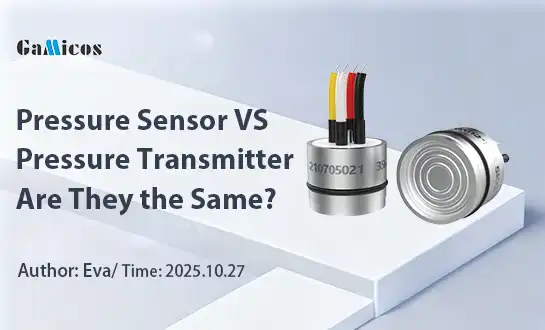
Pressure Sensor VS Pressure Transmitter: Are They the Same Thing?