Pressure Sensor Cleaning Guide for Contaminated Media
Understanding Pressure Sensor Contamination and Its Impact
- Understanding Pressure Sensor Contamination and Its Impact
- Comprehensive Pressure Sensor Cleaning Methods and Best Practices
- Comparing Pressure Sensor Cleaning Solutions and Tools
- Procurement Guide: Selecting and Buying Pressure Sensor Cleaning Products
- Troubleshooting and Maintaining Pressure Sensor Performance Post-Cleaning
- Conclusion
- FAQ
- Partner with GAMICOS for Reliable Pressure Sensor Solutions
- References
Pressure sensor cleaning is important for keeping measurements accurate and making sure they work reliably in dirty industrial settings. Sensors' diaphragms and sensing elements can get clogged up when they come in contact with harsh chemicals, thick oils, particles, or biological growth. This can cause signal drift, reaction delays, and catastrophic measurement failures. Using cleaning methods that are specific to the type of contamination and the design of the sensor will protect your investment and keep the process safe and the data accurate in oil, chemical, pharmaceutical, and food processing settings.

Understanding Pressure Sensor Contamination and Its Impact
Industrial pressure sensors are constantly exposed to rough materials that hurt their performance. We've seen that patterns of pollution are directly linked to operating problems in factories around the world.
Common Contamination Sources in Industrial Environments
Depending on the purpose, pressure sensors come into contact with different types of contaminants. Acids and bases that eat away at metal parts and break down rubber seals are used in chemical processing plants, where sensors are exposed to them. Petroleum plants leave behind asphaltene and hydrocarbon leftovers that cover sense diaphragms. Biological fouling is caused by proteins, sugars, and bacteria growth in food and beverage processes.
While pharmaceutical making needs to be sterile, powdered chemicals can contaminate the work with tiny particles. Abrasive slurries with sand, silt, and dissolved solids are made in mining and wastewater treatment. For each type of contamination, there are different ways to clean it that are best for the fouling process and the materials used to build the sensor.
Performance Degradation Symptoms from Dirty Sensors
Maintenance teams should be able to spot early on when contaminated sensors start to fail in certain ways. Measurement drift happens when deposits change the stiffness of the diaphragm or put up walls that keep the sensing element from communicating with the process media. Response time slows down when thick films stop pressure waves from getting to the sensor. As particles block electrical paths or physically mess with sensitive or piezoresistive elements, signal noise gets worse.
When leftover deposits put steady mechanical stress on sensing diaphragms, zero-point shift happens. When heavy fouling completely stops pressure ports, there is no signal at all. A pharmaceutical company said that 23% of their batch rejections were due to pressure sensor drift, which was caused by protein buildup on the sensor surfaces. This cost them about $340,000 a year before they started using pressure sensor cleaning.
Operational and Safety Consequences of Neglected Maintenance
Industrial activities are hampered by problems that spread when sensors are not kept clean. Process control systems make bad choices when they have bad pressure data, which can cause changes in product quality, batch fails, and problems with following the rules. When pressure release systems don't work because of wrong readings, they can damage equipment by breaking vessels or breaking down mechanically. When fans, pumps, and heating systems don't work well because of bad pressure feedback, more energy is wasted.
When people believe wrong readings during important activities, safety problems are more likely to happen. Unplanned downtime to replace emergency sensors messes up production plans and promises made in the supply chain. A chemical company kept track of the unplanned 14 hours of downtime that happened every quarter because of neglected sensor maintenance. The costs of missed production, emergency labor, and fast replacement parts added up to more than $180,000 per year.
Comprehensive Pressure Sensor Cleaning Methods and Best Practices
To maintain sensors well, you need to know which pressure sensor cleaning methods work best for the type of dirt and the design of the sensor. We suggest methodical methods that strike a balance between being careful and protecting the parts.
Mechanical Cleaning Techniques for Different Contamination Types
Physical methods of cleaning are good for getting rid of soft deposits and small particles. Nylon or natural fiber soft-bristle brushes gently clean sensor housings and pressure ports of dirt and grime without scratching smooth surfaces. Compressed air or nitrogen purges can get rid of dust and other particles stuck in threaded connections and sense holes. However, the pressure should stay below 30 psi so as not to damage the diaphragms.
Plastic scrapers are better than metal tools for getting rid of thicker layers from surfaces that aren't important. Metal tools could scratch stainless steel or make galvanic corrosion sites. Wipe down outside surfaces with clean, lint-free cotton cloths that have been dampened with the right lubricants. When contamination is low and hasn't chemically attached to sensor surfaces, these mechanical methods work best for regular repair in between production runs.
Chemical Cleaning Agents and Compatibility Considerations
When choosing the right cleaning agents, you need to pay close attention to the materials used to build the sensor and the chemistry of contamination. Isopropyl alcohol (70–99% concentration) dissolves oils, greases, and many organic leftovers well. It also works well with most sensing materials, such as ceramics, stainless steel, and fluoropolymers. Mild alkaline cleaners (pH 8–10) get rid of protein clumps that are common in food and medicine without hurting metal parts. Solutions of 2% to 5% citric acid can get rid of mineral scales and light rust without being too harsh.
Manufacturers like Emerson and Honeywell make specialized cleaning products for sensors that have surfactants and chelating agents that are made to get rid of certain kinds of dirt. Strong acids (hydrochloric and sulfuric) should not be used on aluminum sensors. Chlorinated liquids should not be used on polymer seals, and ammonia-based cleaners should not be used on copper metals. Before you use something on your sensor, you should always check the material building data sheet to make sure it is chemically compatible.
Ultrasonic Cleaning for Stubborn Deposits
Ultrasonic cleaning technology cleans deeply without having to scrub by hand. High-frequency sound waves (usually 40–80 kHz) are used to make tiny cavitation bubbles in the cleaning solution. These bubbles then burst on dirty surfaces, removing dirt from cracks and holes that brushes can't reach. Before ultrasound treatment, sensors must be taken apart fully and their electronics must be taken out.
The cleaning bath should have the right chemicals for the type of contamination. Treatment usually lasts between 5 and 15 minutes, based on how bad the fouling is. Controlling the temperature between 50°C and 60°C makes cleaning oil-based contaminants more effective. This method is great at getting rid of baked-on residues, polymerized oils, and particles that are set in complicated shapes. Ultrasonic washing, on the other hand, needs special tools and trained workers, so it works best in repair shops rather than in the field.
Step-by-Step Cleaning Procedure for Optimal Results
There is a set way to restore sensors that works every time. First, take pictures and, if possible, write down standard readings to show how the sensor looked at first. Use the correct lockout-tagout methods to separate the sensor from the process. Then, let it depressurize and hit room temperature. Carefully separate the electrical connections, making sure to keep the wires dry. Take the sensor off of its mounting point and make a note of its position and any seals or covers that need to be replaced. Check the sensor for technical damage, rust, or seal wear that might mean it needs to be replaced instead of being cleaned.
Use the chosen cleaning method, starting with the gentlest methods and working your way up only if necessary. To get rid of all toxic remains, rinse well with deionized water. Use clean nitrogen or compressed air to dry it all the way through, making sure there is no moisture left in the electrical links or sense holes. All O-rings, gaskets, and seals should be replaced with new ones that are the same as the originals. Put the sensor back in place with the right torque numbers and make sure it is facing the right way. Reconnect the electrical wires and make sure they are properly sealed. Check the setting against known pressure levels before putting it back into service.
Maintenance Scheduling Based on Application Intensity
How often you should clean depends on the factors of the process and how much pollution there is. High-fouling uses in wastewater treatment, food preparation, or mines may need to be inspected every month and cleaned every three months. Moderate-fouling places like chemical processing or oil refining usually benefit from inspections every three months and cleaning every six months. In clean environments like making medicines or gadgets, preventative upkeep may only need to be done once a year.
To set standard cleaning intervals, you need to keep an eye on sensor performance measures like zero drift, span shift, and reaction time decline. Instead of using random time frames, change plans based on how often fouling is seen. Trending upkeep data shows that pollution rates change with the seasons or when processes are changed. Through predictive analytics and performance tracking, we've helped customers set up condition-based maintenance plans that cut down on service that wasn't needed and stop failures caused by contamination.
Comparing Pressure Sensor Cleaning Solutions and Tools
When deciding between in-house repair and professional services, you need to look at a number of factors that affect the running costs and long-term reliability of the sensors.
Manual Versus Ultrasonic Cleaning Methods
Cleaning by hand with brushes, liquids, and compressed air is quick, doesn't require a lot of tools, and can be used in emergencies and field service. Technicians can see how bad the pollution is and make changes to their methods in real time. Manual methods are great at getting rid of small deposits and surface contamination, but they have trouble getting rid of baked-on leftovers in complicated shapes. For easy pressure sensor cleaning, the amount of work needed is moderate, but it goes up a lot for serious fouling.
Ultrasonic devices clean deeper than human methods can, getting to places that are hard to reach. Once the equipment is set up, the automated method gives reliable results with little work. Ultrasonic cleaning is better at getting rid of heavy contamination, but it costs a lot to buy tanks, engines, and room. The central position of the tools makes it less useful in the field. Assembling and drying still need to be done by hand. Ultrasonic systems make maintenance shops that work with various sites more efficient, while field service teams have to rely on manual methods to make repairs quickly.
Essential Features of Quality Cleaning Kits
Professional-grade cleaning kits have parts that are made just for maintaining sensors. Some good kits come with different soft-bristle brushes that are the right size for different port widths so that they don't get dirty while being used for different things. Precision scrapers made from plastics that work well together remove deposits without hurting the surface. Lint-free brushes can get to places inside sensor bodies that are hard to reach. Spray bottles that can handle chemicals are used to control how much cleaning solution is released.
Replacement O-rings and seals in standard sizes cut down on the time it takes to get them. Torque drivers make sure that the parts are put back together correctly without overtightening them. Magnifying lenses help look at small details and make sure that the cleaning is done all the way. Storage boxes keep things organized and protect parts. Brands like 3M, Honeywell, Siemens, and Fluke sell kits that are designed to work with certain sensors and come with safety information and application guides. Kits made for specific industries come with chemicals and tools that are matched to common patterns of pollution. This makes the process and results better.
Professional Cleaning Services Versus In-House Capabilities
Having specialized service providers take care of sensor repair gives sites access to knowledge, tools, and certifications that they might not be able to afford to keep up on their own. Technicians working for professional services are trained to work with a variety of sensor types and have access to manufacturer-specific cleaning methods and specialized tools for the job, such as ultrasonic tanks, calibration standards, and diagnosis instruments. Service contracts set upkeep funds and ensure turnaround times, and loaner sensors are available while the originals are being fixed. Traceability documentation helps with legal compliance and quality control systems.
This method works well for groups that don't have a lot of expert staff or that have to manage a lot of different kinds of sensors. When there are problems with output, in-house repair lets you fix them faster and improves the technical skills of your employees. Companies that have a lot of sensors and repair teams can lower the cost per unit through their own programs. Hybrid methods that combine regular cleaning done in-house with expert deep cleaning and recertification every so often are good for many operations because they balance cost, capability, and dependability.
Procurement Guide: Selecting and Buying Pressure Sensor Cleaning Products
Finding the right pressure sensor cleaning materials means looking at a lot of factors that affect how long sensors last and how well the repair program works.
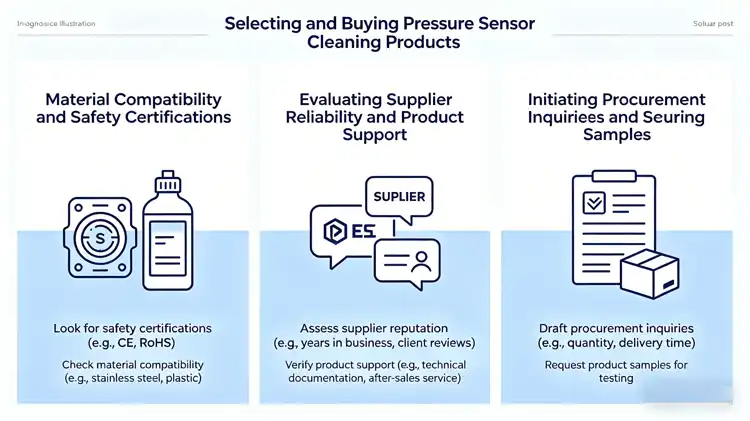
Material Compatibility and Safety Certifications
Before choosing a cleaning product, it's important to make sure that the chemical agents and sensor building materials are compatible. Most cleaning agents are safe for stainless steel sensors, but chlorides in high amounts should be avoided. Cleaners that are neutral or slightly alkaline are best for aluminum parts; strong acids and alkalis should be avoided. Ceramic sensor elements can handle strong poisons, but the glue that hold them in place might not. Most liquids can't get through fluoropolymer seals, but ketones can make them grow.
Check that cleaning products have all the necessary safety licenses, such as OSHA compliance for workplace exposure limits, EPA registration for environmental release, and, if necessary, FDA approval for use on food. Products that meet NSF/ANSI standards can be used in places that make food and drugs. Read safety data sheets to find out how to handle emergencies and what kind of personal protective equipment is needed. Products that are good for the environment, have biodegradable ingredients, and fewer volatile organic substances are in line with companies' environmental goals and meet performance needs.
Evaluating Supplier Reliability and Product Support
Reliable suppliers give you more than just goods; they also give you expert tools that help your maintenance plans work. Well-known companies like ABB, TE Connectivity, Omega, GE, Bosch, and Emerson keep large files of paperwork that contain application guides, compatibility charts, and resources for fixing problems. For help choosing a device and using it, technical support teams are there to help. Through testing and licensing, quality assurance programs make sure that each batch is the same.
Supply chain dependability means that goods will always be available and wait times will be known ahead of time. Local access is made possible by global delivery networks, which lowers shipping costs and makes customs procedures easier. Warranty programs protect you from buying broken items. Training materials help maintenance teams get better at following safety rules and cleaning routines. Long-term ties with vendors allow for the creation of special formulations to solve specific contamination problems.
Initiating Procurement Inquiries and Securing Samples
To do effective procurement, you must first express your clearly stated needs to possible suppliers. kinds of sensors, building materials, kinds of contamination, cleaning regularity, and volume needs must be listed. Ask for safety information, application case studies, and product data sheets that are important to your business. Sample amounts let you try something out for yourself before committing to buying a lot of it. Claims about compatibility and effectiveness are backed up by testing samples in real-world working circumstances.
Write down the cleaning results, including how well the contaminants were removed, what the dust looked like, and if there were any bad effects on the sensor parts. Use standard evaluation criteria to compare several providers, making sure to balance performance, cost, availability, and support services. When negotiating prices, you should think about bulk discounts, contract terms, and the total cost of ownership, which includes the costs of shipping, handling, and getting rid of the item. Set clear requirements for an ongoing supply, such as acceptance standards, required packaging, and shipping times.
Troubleshooting and Maintaining Pressure Sensor Performance Post-Cleaning
Verification steps make sure that pressure sensor cleaning returns its usefulness and find any damage that needs to be fixed.
Calibration Verification and Signal Testing
Calibration checks against known pressure standards are the first step in post-cleaning proof. Using a calibrated pressure source or deadweight tester, set a number of pressure points across the reading range of the sensor. Check the output from the sensor against the standard numbers and write down the zero offset, span accuracy, linearity, and hysteresis. Deviates from the manufacturer's specs mean that the cleaning wasn't completed, a part was damaged, or the setting shifted and needs to be fixed.
In dynamic response testing, step changes in pressure are used to check the speed of a sensor, and the response time to reach a stable output is measured. Compare the results to maker specs or baseline performance data. Using oscilloscopes or data loggers, signal quality testing checks the output for steadiness, noise levels, and effects of temperature. These tests show if there is any remaining contamination, diaphragm damage, or decay of electrical components. Sensors that fail verification need to be cleaned more often, re-calibrated, or replaced, based on the type of flaw.
Identifying and Resolving Common Post-Cleaning Issues
After cleaning, a number of problems may arise. If the zero offset stays the same after recalibration, it means that the sensing element is under mechanical stress from being put back together incorrectly, having broken diaphragms, or still having contamination in the detecting cavities. To check the gasket placement and torque numbers, take the sensor apart and put it back together again. Moisture getting into electrical lines or wire insulation wearing down can cause more signal noise. Thoroughly dry all the connections, and check the wires for any damage.
Less sensitivity or range shift means that the diaphragm is getting stiffer because of a chemical attack or because stiffened deposits are not being removed all the way. These problems can be fixed by using mechanical cleaning or replacing the diaphragm. If the results aren't stable, it could be because of electromagnetic interference, loose electrical links, or broken sensing elements. Check the shielding and soundness of the wires. Zero return mistakes mean that the diaphragm has become deformed from being under too much pressure while it was being cleaned. Replace parts that are broken. Taking care of these problems right away keeps sensors from failing early and keeps measurement accuracy high.
Safety Protocols During Maintenance Activities
Maintaining sensors includes risks that need to be handled safely. Personal protective equipment includes safety glasses that shield your eyes from chemical splashes, gloves made of nitrile or neoprene that don't get damaged by cleaning fluids, and protected clothing that keeps your skin from touching dirty parts. When working with toxic solvents, do your job in a well-ventilated area or use local air ventilation. Follow the instructions on the safety data sheet for how to store and handle cleaning products, making sure that materials that don't go together are kept separate. Before using ultrasound equipment, make sure it is grounded and that the electricity is safe.
Follow environmental rules when getting rid of dirty cleaning solutions and sensor parts, especially when working with dangerous process materials. Follow lockout-tagout methods when removing and installing sensors, and make sure they have no energy before you start working. When going to high sensor sites, make sure you have the right fall protection. Keep emergency reaction tools like eyewash stations, safety showers, and supplies for cleaning up spills in good shape. Maintenance workers are taught about chemical dangers, the right way to clean, and what to do in an emergency through training programs.
Conclusion
Using regular maintenance procedures to perform pressure sensor cleaning protects the accuracy of measurements, extends the life of equipment, and stops costly process interruptions. Understanding how pollution happens, choosing the right cleaning methods, and following the right testing steps all lead to reliable sensor performance in tough industrial settings. Prioritizing sensor cleanliness pays off in measured ways, such as less downtime, better product quality, and higher operating safety. This is true whether you do your own maintenance or hire professional services. Investing in the right cleaning tools, training, and methods pays off because they keep measurements accurate and help process controllers make important choices.
FAQ
How often should pressure sensors be cleaned in contaminated media applications?
How often pressure sensor cleaning is performed relies on how bad the contamination is and how the process is running. Places with a lot of dirt, like wastewater treatment or food preparation, should have checks every month and deep cleaning every three months. Chemical processes and oil uses usually need to be inspected every three months and cleaned every six months. When it comes to technology or pharmaceuticals, clean areas may only need preventative upkeep once a year. Keep an eye on sensor performance metrics like drift, reaction time, and output stability to set standard intervals. Then, change schedules based on observed fouling rates instead of making them based on random times.
Can I use general-purpose solvents to clean pressure sensors?
Don't use general cleaning products on sensor parts because they might hurt them. Use chemicals that are made especially for maintaining instruments or that have been tested to work with the materials that made your sensor. Most sensors can easily be cleaned with isopropyl alcohol to get rid of grease and light deposits. Specialized cleaning options for sensors from trusted companies get the job done perfectly without causing problems with material compatibility. Before you use any chemical on sensitive measurement devices, you should always read the material safety data sheets and the building specs of the sensors.
What indicates a sensor needs replacement rather than cleaning?
There are a few reasons why replacing is better than cleaning. Cracks or deformations that can be seen in sense diaphragms make measurements less accurate. Corrosion that goes deeper than surface decomposition means that the structure is breaking down. If sensors fail calibration verification after being cleaned thoroughly and still show drift or span errors, it's likely that they have damage inside. If an elastomeric seal hardens, cracks, or permanently sets in tension, it needs to be replaced. When the cost of cleaning and recalibrating sensors gets close to 60–70% of the cost of a new sensor, it makes financial sense to buy new ones to make sure they work reliably.
Partner with GAMICOS for Reliable Pressure Sensor Solutions
Additionally, GAMICOS knows how important it is to keep pressure readings correct in dirty industrial settings. Our engineering team made pressure sensors with advanced diaphragm materials and self-draining port designs that keep fouling from building up and make upkeep easier for you. In 98 countries, we make capacitive ceramic pressure monitors, strain gauge transmitters, and wireless pressure monitoring systems for the chemical, pharmaceutical, food processing, and oil businesses.
Our expert support staff can help you choose the right products, implement pressure sensor cleaning protocols, and plan maintenance based on the unique contamination problems you are facing. GAMICOS offers measurement options and full support after the sale, whether you need normal catalog items or OEM sensor modules that are made just for you. You can talk to our team at info@gamicos.com about your application needs, ask for product samples, or get in touch with a pressure sensor maker that values long-term relationship success through quality products and quick service.
References
1. Smith, J.R. & Thompson, M.K. (2021). Industrial Pressure Measurement: Maintenance and Calibration Practices. Technical Publishing International.
2. Anderson, P.L. (2020). "Contamination Effects on Capacitive Pressure Sensor Performance." Journal of Process Instrumentation, 45(3), 187-203.
3. Williams, C.D. & Roberts, S.A. (2022). Chemical Compatibility Guide for Industrial Sensors. Instrument Society Standards.
4. Johnson, T.E. (2019). Ultrasonic Cleaning Technology for Precision Instruments. Manufacturing Technology Press.
5. Martinez, R.F. & Chen, L.W. (2023). "Predictive Maintenance Strategies for Process Instrumentation." Industrial Automation Quarterly, 38(1), 56-72.
6. Davidson, K.M. (2021). Safety Protocols for Industrial Sensor Maintenance and Repair. Occupational Health Publications.

Peter
Peter, Senior Sensor Technology Consultant, has 15-year industrial sensor R&D experience. He specializes in the end-to-end development of high-accuracy pressure and level sensors and he firmly believe, precision isn’t just a spec—it’s a promise.
We're here to help — submit your request anytime!
Let us know how we can help solve your pressure level measurement challenge.
_1757930850792.jpg)
Recommended Blog

4-20mA Signal Jumping or Unstable? Complete Diagnostic Flowchart



How to Install a Pressure Transmitter: 7 Best Practices
4-20mA Signal Jumping or Unstable? Complete Diagnostic Flowchart
How to Install a Pressure Transmitter: 7 Best Practices
4-20mA Signal Jumping or Unstable? Complete Diagnostic Flowchart
How to Install a Pressure Transmitter: 7 Best Practices