When to Calibrate Pressure Sensors? 7 Key Signs You Need Calibration
When to Calibrate Pressure Sensors? 7 Key Signs You Need Calibration
Introduction
- Introduction
- Understanding Pressure Sensor Calibration
- 7 Key Signs You Need to Calibrate Your Pressure Sensor
- Choosing the Right Calibration Method and Tools
- How to Implement an Effective Pressure Sensor Calibration Program
- Benefits of Partnering with Trusted Calibration Solution Providers
- Conclusion
- FAQ
- Partner With GAMICOS for Precision Pressure Sensor Calibration Solutions
- References
Recognizing when pressure sensor calibration is necessary can mean the difference between operational excellence and costly system failures. In industrial automation environments—from petroleum refineries to pharmaceutical production lines—even minor measurement drift can trigger equipment malfunctions, regulatory violations, and safety hazards. Calibration restores sensor accuracy by comparing its output against traceable reference standards, ensuring your measurement instruments deliver the precision your processes demand. Whether you're managing a chemical processing facility or sourcing sensors for OEM integration, understanding calibration timing protects both your investments and your reputation.
Introduction
Pressure sensor calibration is a basic need in all fields where measurement accuracy has an effect on things like product quality, worker safety, and following the rules. When a business buys something from another business, the testing process affects more than just the accuracy of the measurements right away. It also affects the system's stability and long-term costs. When pressure monitors stray from their designated accuracy ranges, it affects whole production chains. For example, in the pharmaceutical industry, it can lead to batch rejects. In HVAC systems, it can waste energy, and in chemical reactors, it can cause dangerous pressure buildup.
Leading makers of calibration tools, such as Fluke, Omega, and WIKA, have set the standard for processes that can be tracked and repeated. These tools help purchasing managers and engineering teams make sure that measurements are accurate in a wide range of settings, from clean rooms with inductive pressure monitors to offshore drilling operations with heavy-duty transducers. As we look at the useful signs that show when calibration is needed, you'll learn how to stop measurement problems before they become working crises.
Understanding Pressure Sensor Calibration
What Calibration Actually Means for Your Sensors
Pressure sensor calibration is the process of comparing the output of a sensor to a known reference standard in a controlled environment. This process is very different from easy adjustment because calibration checks the current deviation and writes it down, while adjustment changes the sensor's output to match standard values. A lot of procurement workers get these two terms mixed up, but it's important to know the difference when giving sellers requirements or looking at sensor performance data.
Laboratory Versus Field Calibration Approaches
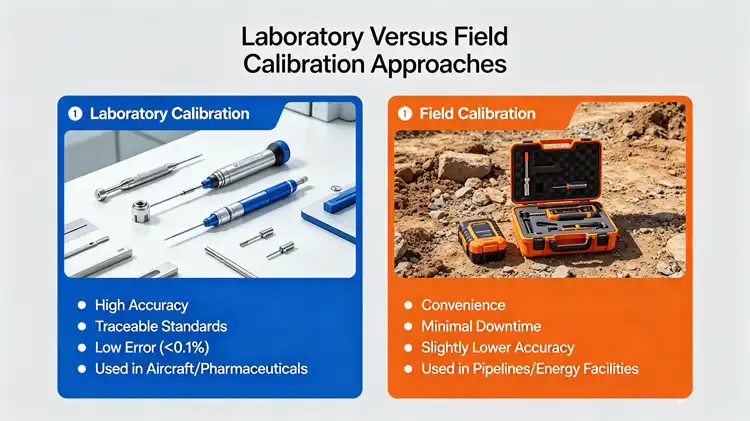
The most accurate levels of calibration can be found in laboratories, where they are done in controlled settings using primary or secondary pressure standards that can be traced back to national metrology centers. This method works well for precise tasks in the aircraft and pharmaceutical industries, where measurement error must stay below 0.1% of full scale. Field calibration, which is done at work sites with portable reference tools, focuses on making things easier and minimizing downtime. This is often the choice of engineering companies working on rural pipeline projects or energy facilities, who are willing to deal with a little more uncertainty in exchange for keeping operations running.
Primary Calibration Methods in Industrial Practice
When no pressure is applied, zero calibration sets the sensor's standard output. This makes up for any temperature drift or mechanical stress that builds up during operation. For manual calibration, workers use deadweight testers or pneumatic calibrators to apply exact pressure steps and record the results at each test point to make calibration curves. In 2026, automatic calibration systems will be more popular.
These systems use microprocessor-controlled pressure sources that move between different test places and figure out the correction coefficients without any help from a person. Capacitive pressure sensors and ceramic diaphragm types work best with automatic processes because they need to be checked at multiple points because their responses are not linear.
By understanding these basic ideas, buying managers can better judge the skills of potential suppliers, and research and development teams can set the right calibration times for brand-new equipment.
7 Key Signs You Need to Calibrate Your Pressure Sensor
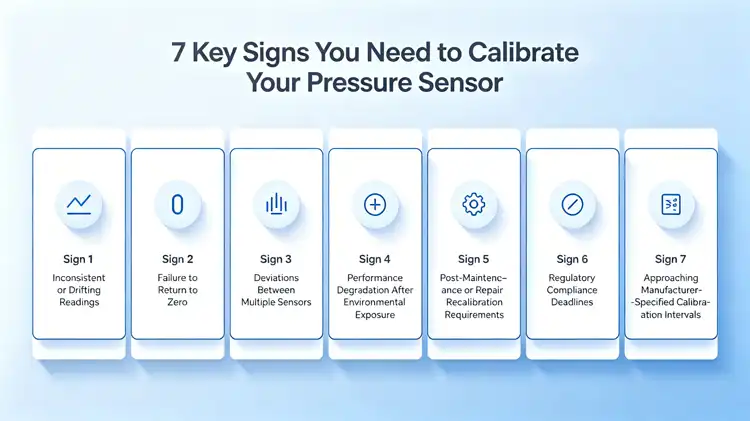
Proactive maintenance is different from reactive crisis management because it finds pressure sensor calibration needs before measurement problems happen. No matter the sensor technology or industry area, these seven signs always show up in industrial settings.
Sign 1: Inconsistent or Drifting Readings
When pressure monitors show readings that change even though the process is stable, this is probably due to measurement drift. If a capacitive pressure sensor in a pharmaceutical reactor reads 2.48 bar, then 2.52 bar, and then 2.46 bar in a matter of seconds, even though the temperature and flow stay the same, this means that the sensor's internal calibration is getting worse. This drift is usually caused by a worn-out diaphragm, an old electrical part, or dirt on the detecting element. When purchasing managers replace old sensor stocks, they often run into this problem with equipment that has passed its suggested service life.
Sign 2: Failure to Return to Zero
When pressure is released and sensors don't go back to their normal reading, it means that the mechanical structure has been permanently deformed or the electronics have been thrown off. When the fans stop running, pressure monitors that measure the difference in air flow should read close to zero. If the offset values stay at 0.15 psi or higher, it means that the sensor has been subjected to overpressure or temperature cycling that goes beyond what it was designed to handle. This sign needs to be looked at right away because it often comes before a sensor fails completely.
Sign 3: Deviations Between Multiple Sensors
When two or more pressure sensors watching the same process give different numbers, at least one of them needs to be calibrated. Chemical companies usually use more than one sensor for important data in their industrial automation systems. If Sensor A on the same stream reads 6.8 bar and Sensor B reads 7.3 bar, it is important to check the calibration. This often happens when new equipment is being set up or when system changes are being made, which shows how important it is to keep standard calibration records.
Sign 4: Performance Degradation After Environmental Exposure
Sensors that work in difficult conditions, like high temperatures, corrosive atmospheres, or high levels of shaking, break down faster than sensors that work in controlled conditions. In a food processing steam line, a ceramic capacitive pressure sensor goes through temperature cycles, which changes its calibration curve over time. In the same way, sensors used in offshore drilling are exposed to saltwater and mechanical shocks that speed up drift. When sensors are used in harsh conditions, engineering managers should plan calibration checks more often, usually every three months instead of every 12 months.
Sign 5: Post-Maintenance or Repair Recalibration Requirements
Calibration checks must be done on pressure monitors before they are used. When you replace a broken wire, tighten up a loose electrical link, or reinstall a sensor after making changes to the pipes, the measurement features can change. Cleaning the pressure port on a sensor, which might seem like a small maintenance task, can change its zero reference. OEMs that make custom sensor kits have to calibrate each unit after it has been put together to make sure it meets customer standards before it can be shipped.
Sign 6: Regulatory Compliance Deadlines
Industries that follow ISO 9001, FDA 21 CFR Part 11, or similar quality management standards have to calibrate their sensors at regular times, even if the sensors seem to be working fine. Pharmaceutical companies usually calibrate pressure sensors once a year and keep thorough records for regulatory checks. Installations in the energy industry that meet ASME or API standards must follow set calibration plans that are based on how important the equipment is. Distributors who work with these controlled businesses need to show calibration certificates that are linked to national standards and list uncertainty levels and test conditions.
Sign 7: Approaching Manufacturer-Specified Calibration Intervals
Reputable sensor makers, like GAMICOS, give advice on how often to calibrate their products based on a lot of field testing and failure mode analysis. The reliability of the measurements and the cost of upkeep are balanced by these times. A pressure monitor that is meant to be calibrated every 12 months has been built to keep its accuracy over that time period when it is working normally. If these times are extended without a written reason, operations may face measurement risks, and the guarantee may not be valid.
Monitoring these seven signs enables procurement teams and maintenance departments to implement calibration before measurement errors impact production quality or safety systems.
Choosing the Right Calibration Method and Tools
Choosing the right methods and tools for pressure sensor calibration has a direct effect on the accuracy of measurements, the cost of operations, and how well compliance works. To make the choice, you have to weigh the professional needs against the resources and skills that your company has.
Manual Versus Automatic Calibration Trade-offs
Portable pressure calibrators allow for flexible calibration and lower starting equipment costs, making this method ideal for wholesalers who manage a wide range of sensors. It takes technicians 30 to 45 minutes per sensor to physically apply standard pressures, record outputs, and figure out deviations. This method works well for places that calibrate less than 50 sensors a year. Automatic calibration systems from Fluke or Druck make high-volume tasks easier. They can do full multi-point calibrations in less than 10 minutes and are very accurate every time. Automation cuts down on mistakes made by people and creates digital records of calibration automatically, which helps OEM makers who make hundreds of sensor units every month.
Market-Leading Calibration Equipment Options
Fluke Calibration's 718 series pressure calibrators are the best for field calibration because they are accurate to 0.025% and can communicate with smart emitters through HART. These tough devices can handle pressures from 0 psi to 10,000 psi, which is enough to cover most types of industrial sensors. Druck's PACE line offers compact products with laboratory-level performance. They have automatic pump control and data logging for full calibration records. Honeywell's UDC Universal Digital Controller builds calibration features right into process control systems. This lets sensors be calibrated automatically in place without having to be taken out of service.
Professional Services Versus In-House Calibration
Hiring certified calibration labs makes sure that the results can be tracked back to national standards and gives the ISO/IEC 17025-compliant paperwork that controlled industries need. This method works for businesses that don't have specific metrology staff or specialized tools. Calibration done in-house cuts down on turnaround time and continued costs, but it costs more up front to buy reference standards, environmental controls, and trained workers. When engineering companies work on more than one project site, they often keep portable calibration tools on hand and do both basic checks in-house and lab checks on reference equipment on a regular basis.
Evaluating these options against your operational scale and compliance requirements guides effective calibration strategy development.
How to Implement an Effective Pressure Sensor Calibration Program
Creating a planned pressure sensor calibration program changes reactive maintenance into proactive quality assurance, which helps factories and supply lines run more efficiently.
Defining Calibration Frequencies Based on Risk
Calibration times should take into account how important the sensor is, how it is used, and how well it has worked in the past. Safety-critical sensors in oil plants that watch over emergency shutdown systems need to be calibrated every three months. Less important tracking points may go up to once a year. Environmental factors have a big impact on interval choices. For example, sensors that are exposed to temperatures above 150°C or chemicals that break down metal need to be checked more often than sensors that are in controlled environments. By looking at calibration records over time, you can see patterns of drift that allow data-driven interval improvement that balances cost-effectiveness with dependability.
Integrating Calibration Into Maintenance Workflows
Adding calibration jobs to regular preventive maintenance plans makes sure that everything stays the same and causes less harm to operations. When repair teams check the valves on a chemical processing line every three months, they can also adjust the pressure sensors that are connected to them at the same time. This avoids having to schedule separate downtime events. This way of integrating works especially well for engineering firms that are in charge of big industrial projects that need planned shutdowns to keep client production losses to a minimum.
Documentation and Traceability Best Practices
Full records of calibrations are both proof of quality and tools for fixing problems. Each certificate of calibration should list the name of the sensor, the date of calibration, the reference equipment that was used, the environmental conditions, the data that was collected, the data that was left, and the error estimates. Modern calibration management software, such as Fluke's DPCTrack, keeps records automatically, reminds users when calibrations are due, and makes audit reports that show compliance. This paperwork is very helpful during regulatory reviews, and it also helps purchasing managers check what suppliers say about how stable the sensors are.
Troubleshooting Common Calibration Challenges
Calibration problems usually happen because the reference equipment isn't connected correctly, the pressure ports are dirty, or there isn't enough time for the system to stabilize before readings. If a capacitive pressure sensor drifts too much during testing, check the diaphragm for damage or growth of process material. Electronic problems can show up as numbers that don't repeat or devices that don't respond to pressure. Systematic repair methods cut down on the need to re-calibrate and find sensors that need to be replaced instead of being serviced.
These implementation practices transform calibration from a compliance checkbox into a strategic tool for maintaining measurement integrity across your operations.
Benefits of Partnering with Trusted Calibration Solution Providers
Working with well-known companies that make and service pressure sensor calibration equipment has benefits that go beyond just getting accurate measurements. This is especially helpful for business-to-business ties that need to be reliable over the long run.
Trustworthy companies like Fluke, Omega, and WIKA put a lot of money into metrology research to make sure that their standards and calibration tools can still be traced back to international measurement centers. This makes it possible to track your calibration records, which is important for legal audits and customer quality reviews. When a pharmaceutical plant uses Fluke-traceable standards to calibrate pressure sensors, FDA officials can trace the measurement chain back to NIST main standards. This takes away any doubts about the integrity of the data.
Aside from being able to track things, trusted testing partners also offer technical knowledge that in-house teams rarely have. They have application engineers who know how to calibrate different types of sensors, such as capacitive pressure detectors that need special low-pressure references and ceramic diaphragm sensors that don't respond linearly. This information is especially useful for OEM makers who are making custom sensor solutions and need to plan calibration processes at the same time as making the products.
Custom calibration services for OEM and dealer clients offer solutions that can be scaled up or down depending on the amount of production. GAMICOS has contract calibration services that take care of arriving sensor batches, checking them at multiple points and making paperwork just for the customer before sending them out. Because of this deal, wholesalers can sell fully calibrated sensors that are ready to be installed without having to keep up expensive in-house calibration infrastructure. When routines are simplified so that calibration is part of the production process instead of being a separate step, delivery times are shortened.
The extended product life cycles achieved through professional calibration services reduce total ownership costs significantly. Sensors maintained within calibration specifications through regular professional verification often exceed their nominal service life by 30-50%, delaying replacement capital expenditures. This longevity particularly benefits industrial automation equipment manufacturers who specify sensors for long-term installations where replacement costs include not just component prices but also labor and downtime expenses.
Partnering with calibration solution providers transforms a necessary maintenance task into a competitive advantage, supporting quality differentiation in crowded industrial markets.
Conclusion
The cascading failures that measurement drift causes across production systems are avoided by timely pressure sensor calibration in industrial settings. The seven signs we looked at—ranging from readings that don't match up to regulatory deadlines—can be used as useful checkpoints for putting proactive calibration plans into action. Whether you're looking for capacitive pressure sensors for pharmaceutical labs or overseeing maintenance for chemical processing plants, noticing these early warning signs keeps your processes running smoothly and ensures the accuracy of the measurements they need. Calibration isn't just a legal requirement; it's also a smart investment in the safety, stability, and long-term cost control of the system.
FAQ
How often should we calibrate pressure sensors in industrial applications?
The frequency of calibration relies on how important the sensor is, where it is used, and any rules or regulations that apply. For safety-critical uses, calibration is usually needed every three months, while general tracking points may go up to once a year. Harsh environments, like high temperatures, toxic atmospheres, or extreme vibrations, make drift worse and require more frequent checks. Manufacturers like GAMICOS give suggested times based on the design of the sensor and its intended use. However, these should be changed based on your unique working conditions and data from past performance. No matter how stable the sensors are, industries that are regulated by FDA, ISO, or ASME must stick to the plans that have been set.
What's the difference between onsite and laboratory calibration?
Using main reference standards in a controlled environment, laboratory calibration gives better accuracy and is perfect for precision tasks that need error below 0.1%. On-site calibration uses portable equipment at the construction site, which cuts down on downtime and shipping risks but means that measurements are a little less accurate. For practical reasons, engineering contractors who are in charge of remote sites often choose field calibration. On the other hand, pharmaceutical companies usually need laboratory approval to meet regulatory requirements. The choice relies on how accurate you need to be, how much space you have, and how much paperwork you need.
What happens if we skip regular calibration?
If you don't do calibration, measurement drift can build up over time without being noticed. This can cause process inefficiencies, quality problems, and safety risks. In HVAC systems, pressure sensors that aren't set properly use too much energy and make it hard to control the temperature. When chemical makers guess wrong about the pressure, they risk rejecting batches and damaging equipment. When regulations are broken, work may be stopped and fines may be given. When you add up the costs of missed output, rework, and responding to incidents, the financial effects of not doing your calibration are usually many times higher than the cost of calibration itself.
Partner With GAMICOS for Precision Pressure Sensor Calibration Solutions
Industrial automation demands measurement instruments you can trust without hesitation. GAMICOS specializes in manufacturing high-precision pressure monitors that are calibrated in the plant to meet international standards. They work with over 100 countries in the energy, food and beverage, pharmaceutical, chemical, and oil and gas industries. Our engineering team works closely with sourcing managers and project engineers to create unique pressure sensor calibration protocols that are perfect for your needs, whether you need ceramic capacitive pressure sensors for cleanroom processing or ruggedized transducers for installations offshore.
We not only send you calibrated sensors that are ready to be installed, but we also offer full technical help that includes checking the calibration, fixing problems, and planning upkeep. Custom calibration paperwork is part of our OEM and ODM services. This way, you can be sure that the pressure sensors your supplier sends you will work well with your quality control systems. Get in touch with our team at info@gamicos.com to talk about how our production and testing skills can improve the accuracy of your measurements while lowering the total cost of ownership. Let's work together for a long time to make sure that your operations run smoothly.
References
1. Liptak, B.G. (2018). Instrument Engineers' Handbook: Process Measurement and Analysis (5th ed.). CRC Press.
2. International Society of Automation (2022). ANSI/ISA-51.1-1979 (R2022): Process Instrumentation Terminology. ISA Standards and Practices Department.
3. National Institute of Standards and Technology (2021). Guidelines for Pressure Calibration. NIST Special Publication 250-1087.
4. Webster, J.G., & Eren, H. (2020). Measurement, Instrumentation, and Sensors Handbook: Spatial, Mechanical, Thermal, and Radiation Measurement (2nd ed.). CRC Press.
5. Morris, A.S., & Langari, R. (2021). Measurement and Instrumentation: Theory and Application (3rd ed.). Academic Press.
6. ISO/IEC 17025:2017 (2021). General Requirements for the Competence of Testing and Calibration Laboratories. International Organization for Standardization.

Peter
Peter, Senior Sensor Technology Consultant, has 15-year industrial sensor R&D experience. He specializes in the end-to-end development of high-accuracy pressure and level sensors and he firmly believe, precision isn’t just a spec—it’s a promise.
We're here to help — submit your request anytime!
Let us know how we can help solve your pressure level measurement challenge.
_1757930850792.jpg)
Recommended Blog
Overpressure & Burst Pressure Ratings for Pressure Sensors
Upgrading Reactor Monitoring with Smart Pressure Transmitters
Mitigating Pulsation, Water Hammer & Overpressure in Pumps
Wireless vs. Wired Pressure Transmitters for IIoT Applications
Overpressure & Burst Pressure Ratings for Pressure Sensors
Upgrading Reactor Monitoring with Smart Pressure Transmitters
Mitigating Pulsation, Water Hammer & Overpressure in Pumps
Wireless vs. Wired Pressure Transmitters for IIoT Applications