Pressure Sensor Signal Conditioning Techniques
Understanding Pressure Sensor Signal Conditioning
- Understanding Pressure Sensor Signal Conditioning
- Types of Pressure Sensor Signal Conditioning Techniques
- How to Choose the Right Signal Conditioning Technique
- Troubleshooting and Maintaining Signal Conditioning Systems
- Future Trends in Pressure Sensor Signal Conditioning
- Conclusion
- FAQ
- Partner with GAMICOS for Superior Signal Conditioning Solutions
- References
Signal processing for pressure sensors is the most important link between raw measurement data and useful business information. Millivolt-level signals from sensing elements are turned into standard outputs that can be used in monitoring tools, control systems, and data collection platforms by this process. Even the most accurate sensors can give inaccurate data if they are not properly calibrated.
This puts process control and safety at risk. It includes amplification to boost weak signals, filtering to get rid of electrical noise, linearization to fix nonlinearities in the sensor, and temperature adjustment to keep accuracy across all working ranges. Strong filtering circuits are needed in industrial settings because of the electromagnetic radiation, temperature changes, and vibrations that happen there. Using the right conditioning method protects the accuracy of measurements, increases the life of sensors, and lowers the total cost of ownership for buying teams in charge of automation projects.
Understanding Pressure Sensor Signal Conditioning
Signal conditioning turns raw sensor outputs into types that can be used by coordinating a number of important functions. The main problem is turning weak electrical signals, which are usually only a few millivolts, into strong signals that can move long distances without losing their quality.
Core Components of Conditioning Circuits
These days, conditioning systems have operating amplifiers built in that let you precisely control the gain. These amplifiers usually boost signals from 10mV to 4-20mA or 0-10V, which are the normal ranges in the industry. High-quality amplifiers keep linearity across the whole test range and block common-mode voltages that could cause mistakes. Analog-to-digital converters (ADCs) separate these boosted signals so they can be processed digitally. The sensitivity of an ADC can be anywhere from 12 bits for general use to 24 bits for lab-level accuracy. Excitation circuits give the sense element a steady voltage or current, and filter networks get rid of the high-frequency noise that comes from power lines, motors, and switching equipment that is common in factories.
Signal Processing Functions
Temperature adjustment circuits change the output of sensors based on the temperature of the environment. This fixes the problem that piezoresistive and capacitive sensors are sensitive to temperature changes. Temperature changes of 50°C can cause measurement mistakes of more than 5% of full scale if they are not corrected. There is a lot of nonlinearity in many sensor designs, especially at the very ends of the pressure range. Linearization methods fix this. To get predictability better than ±0.25% across the whole span, these techniques use either polynomial corrections or lookup table methods.
Integration with Industrial Systems
Galvanic isolation is a feature of well-designed filtering circuits that keeps sensitive control systems safe from voltage spikes and ground loops. Surges of up to 2500V RMS can't damage isolation barriers that use optical or magnetic coupling. This is very important in places where big tools and electrical equipment are used. The output stage needs to be able to handle high currents and low output impedance so that it can drive long wire runs—sometimes more than 1000 meters—without signal loss. It can easily work with HART, Modbus, PROFIBUS, and other industrial communication standards thanks to its protocol switching features.
Types of Pressure Sensor Signal Conditioning Techniques
Conditioning methods are very different depending on the needs of the product, the available budget, and the expected performance. Knowing about these groups helps people who work in procurement find answers that meet the needs of unique operations.
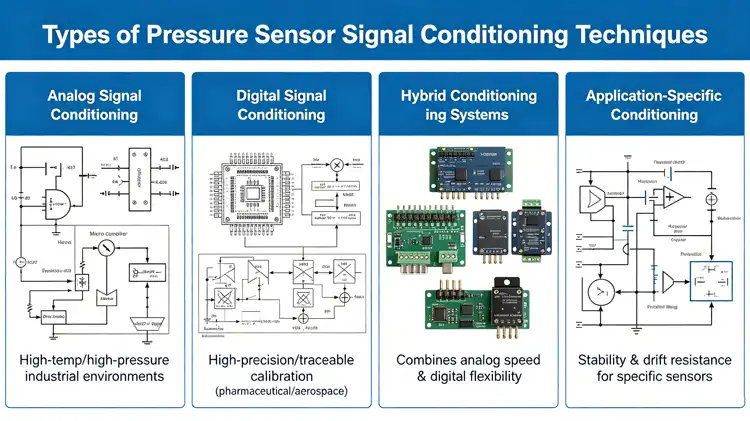
Analog Signal Conditioning
Discrete parts or integrated circuits are used in analog methods to work with voltage-based data without converting them to digital form. These circuits work great in situations where reaction times need to be less than 1 millisecond and when temperatures are very high or low, where digital parts might not work. For very little money, simple operating amplifier setups let you change the gain, fix the offset, and do some basic filtering.
Analog conditioning works well for simple measurement jobs in industries like power generation, chemical processing, and refining oil. These industries have thousands of measurement points that need cost-effective solutions. The method is naturally simple and doesn't require any complicated software. However, it doesn't allow for changing gains or using complex adjustment techniques without making hardware changes.
Digital Signal Conditioning
Microcontroller-based conditioning digitizes the sensor data early on in the processing chain. This lets complex algorithms work that wouldn't be possible with analog methods. Digital systems can calibrate multiple points, adjust temperatures dynamically using polynomial equations, and have self-diagnostic methods that find pressure sensors failures before they affect operations. These platforms hold calibration factors in non-volatile memory, so the accuracy stays the same over the life of the device without having to be adjusted by hand every so often.
This method is used in the GPT200 general pressure transmitter, which has a diffused silicon sensing element and special processing circuits that turn millivolt data into normal voltage and current outputs. Advanced features are very helpful for making medicines, testing aircraft, and preparing food, all of which need to show that their calibrations are accurate and traceable in order to follow government rules.
Hybrid Conditioning Systems
Hybrid designs take the best parts of both analog and digital processes and put them together in one package. The analog stage handles signal amplification at high speeds and anti-aliasing filtering. The digital part, on the other hand, handles linearization, temperature adjustment, and managing communication protocols. With this setup, measurement bandwidths are higher than 10kHz, and digital calibration and diagnostics are still flexible. Hybrid cooling is being used more and more in HVAC systems to balance the fast changes in pressure that happen when the compressor cycles with tracking that the system is running efficiently. This method works especially well for OEM uses that need small form factors and performance parameters that can be changed.
Application-Specific Conditioning
To deal with their bridge circuit properties and temperature sensitivity, piezoresistive sensors need to be specially condition. Bridge stimulation has to be very stable because changes in supply have a direct effect on output. To avoid loading effects, capacitive sensing elements need high input impedance amplifiers. They also need AC stimulation methods to stop DC drift. Knowing these specific needs for each sensor stops uneven training that lowers the quality of measurements. The GPT200 uses piezoresistive technology and high-performance electronics that was designed to make it as stable as possible and less likely to drift. It has been through thorough design testing, cyclic loading tests, and environmental modeling to make sure it will work reliably in harsh industrial settings.
How to Choose the Right Signal Conditioning Technique
To choose the right conditioning, you need to carefully look at the factors of the application, the surroundings, and the long-term goals of the operation. Buying choices made during the design phase have a huge effect on how well the system works and how much it costs to maintain over many years of use.
Accuracy and Resolution Requirements
Different businesses need different levels of accuracy for pressure sensors, which directly affects how hard and expensive conditioning is. For pharmaceutical batch processing, accuracy of 0.1% or higher may be needed to make sure the result is always the same. This calls for an ADC precision of 16 bits or higher with multi-point linearization. In contrast, ±1% accuracy is usually fine for general HVAC uses, which means that conditioning circuits can be easier and cost less per unit.
Check to see if the importance of your process calls for high-end cooling features or if cheaper options will suffice for working needs. To make sure the whole system works the way it's supposed to, you should think about measuring uncertainty estimates that take into account sensor error, conditioning error, and environmental factors.
Environmental Operating Conditions
The amounts of electromagnetic radiation, ambient temperature ranges, and humidity have a big impact on the conditioning needs. Chemical plants have temperature changes from -40°C to +85°C, which means they need parts that can work in a wide range of temperatures and strong temperature correction. Motor drives and switching tools in refineries make a lot of electrical noise, so they need very good common-mode rejection and insulation.
To solve these problems, the GPT200 has a strong anti-interference circuits and a separation diaphragm made of 316L stainless steel that is resistant to corrosive media. Check to see if your project has to deal with explosive environments that need naturally safe designs or clean environments that need sanitary standards.
Output Format and Communication Needs
Standardized communication methods are what modern robotic systems expect instead of simple analog outputs. Find out if the systems you're controlling need 0-10V voltage signals, 4-20mA current loops, or digital protocols such as HART or Modbus RTU. Because they are better at blocking noise, current outputs work well in noisy places and over long wire runs. Voltage outputs, on the other hand, make wiring easier in control cabinets with short links.
Digital protocols let you do online diagnostics, changes to the setup, and interaction with SCADA systems that make operations more visible. The GPT200 has micro amplifier outputs that can be either voltage or current. This makes it easy to connect to different instruments and send signals over long distances without any problems.
Supplier Support and Customization Capabilities
Product specifications alone don't always decide how well a project turns out. Quality technical help and the ability to make changes are often more important. Check to see if suppliers are quick to answer technical questions, have application engineers who know your business, and are ready to make changes to their products to meet your needs, for example by integrating a pressure sensor into their designs. When it comes to OEM projects, providers who offer customized sensor configurations, electrical connections, and communication methods are especially helpful.
Make sure that potential sellers give you full datasheets with details on how to condition the goods, testing certificates that can be tracked back to national standards, and promises of long-term availability. The GPT200 is a great example of flexible design because it has a number of electrical interface choices, is small and light, and can be customized by OEMs in a wide range of areas, such as pressure levels (absolute, gauge, and sealed gauge) and physical configurations.
Troubleshooting and Maintaining Signal Conditioning Systems
Systematic troubleshooting and preventative maintenance cut down on unexpected downtime that hurts safety and production plans. Understanding typical failure types helps with quick analysis and repairs that don't cost too much.
Common Signal Conditioning Issues
Signal drift shows up as small changes in measurements that aren't tied to changes in real pressure. This can happen because of parts wearing out, moisture getting in, or heat stress. If the drift rate is more than 0.5% per year, it means that the cooling circuit is breaking down and needs to be replaced. Noise interference shows up as random changes on top of the measurement signal. It can be caused by bad grounding, electromagnetic coupling, or not enough insulation. Offset errors cause measurements to be off all the way across the range.
These errors are usually caused by amplifier input bias currents or reference voltage shift. Temperature-induced mistakes show changes in measurements that are related to changes in the ambient temperature. This could mean that the temperature monitors aren't working properly or that they need more compensation. Using calibration tools and oscilloscopes for a systematic analysis makes it easy to find the root reasons.
Calibration Procedures and Best Practices
During the service time, regular testing keeps the accuracy of the measurements. Set calibration intervals based on what the maker suggests, what the government requires, and how well the device has worked in the past. For general monitoring, check it once a year, and for important uses, every three months. Using accurate pressure standards that can be traced back to national metrology institutes, zero and span changes fix offset and gain mistakes.
Multi-point calibration checks that the measurement range is linear and finds nonlinearity that needs a new sensor. To show compliance during checks, write down all calibration actions along with the date, the name of the expert, the equipment's serial number, and the values that were found and those that were left. Digital conditioning systems make tuning easier by walking you through steps with software and figuring out coefficients automatically.
Preventive Maintenance Strategies
Preventive repair makes equipment last longer and keeps it from breaking down when you least expect it. Set up regular checks to see if the electrical connections are corroding, the wire insulation is damaged, and the housing seals are still intact. Statistical process control methods that flag decline before measures go beyond tolerance limits can be used to keep an eye on drift trends for pressure sensors.
Digital conditioning systems should have their software updated to include maker fixes and security patches. Keep extra, well-conditioned sensors on hand for important measurement points so that they can be quickly replaced if one fails. During production, the GPT200 goes through a lot of tests, including thorough workpiece screening, process verification, cyclic loading aging, and weather testing. This makes it reliable, so it needs less upkeep than lower-quality options.
Future Trends in Pressure Sensor Signal Conditioning
As technology changes, conditioning skills for pressure sensors change too, opening up chances for better performance and greater operating efficiency. Keeping up with new trends helps buying pros predict what will be needed in the future and keep products from becoming outdated too soon.
IoT Integration and Remote Monitoring
When transducers are connected to the internet, they become clever data nodes that let you see the performance at all times. Cloud-based systems collect data from multiple spread sensing networks and allow for centralized tracking of many sites and areas of the world. Wireless conditioning units get rid of the need for expensive wire connections in repair projects and allow battery-powered operation in places that don't have access to electricity.
Over-the-air software updates and changes to the setup can be made remotely, which cuts down on the need for site visits and greatly lowers the cost of maintenance. These features are especially useful for keeping an eye on pipeline networks, platforms in the ocean, and pump stations that are far away and hard to get to, which raises the cost of service.
Predictive Analytics and AI Integration
Machine learning algorithms look at past data trends to figure out when a training system will break down. Anomaly detection finds small changes in the data that mean a part is about to fail, so it can be replaced during regular maintenance instead of having to be fixed in an emergency. AI-driven diagnostics can easily tell the difference between sensor issues, conditioning issues, and process changes. This speeds up troubleshooting and lowers the need for experts. These smart systems keep improving performance by changing compensation factors based on operational conditions. This way, even if the world changes, the systems stay accurate. Implementation needs data researchers and analytics tools, which are big investments in infrastructure that will pay off in better operations.
Miniaturization and Energy Efficiency
Improvements in semiconductors have made it possible for cooling circuits to take up much smaller spaces and use much less power. Sensors, conditioning circuits, ADCs, and transmission ports can all be put on a single system-on-chip, which is less than 10 mm square. Micro-power systems work with microwatt costs, which lets batteries last for years or get power from natural sources. These changes are especially helpful for OEM uses where limited room and power make design choices harder. Small wireless receivers can be built right into machines, allowing measures that weren't possible before because of access or wiring issues.
Conclusion
When signal filtering is done right, basic sensing elements for pressure sensors can be turned into accurate, stable, and scalable industrial measurement systems that are necessary for modern automation. To make sure that purchase choices support operational excellence, it's important to understand the basics of conditioning, evaluate method categories, and choose the right solutions based on application needs. The GPT200 shows how careful engineering can meet a wide range of industrial needs by mixing piezoresistive sensors with specialized conditioning circuits.
System worth is increased over many decades of service by regular upkeep, systematic troubleshooting, and knowledge of new technologies. As Industry 4.0 projects move forward, conditioning systems that include IoT connections and prediction analytics will become more and more important for businesses that want to stay competitive in a market where measurement equipment is getting old.
FAQ
What is the main purpose of signal conditioning in pressure measurement?
Signal conditioning turns weak sensor outputs into strong, standardized signals that can be used in industrial control systems. It boosts signals at the millivolt level, removes electrical noise, accounts for changes in temperature, and gives you outputs like 4-20mA current loops or digital protocols. Without conditioning, raw pressure sensor data are too easily messed up and weakened to be sent over long distances reliably.
How does temperature affect unconditioned sensor signals?
Changes in temperature can affect the resistance of the piezoresistive element and the voltages that excite the bridge. This can cause measurement mistakes of more than 5% across industrial temperature ranges. Effective conditioning circuits have temperature monitors and use polynomial equations or lookup tables to make changes in real time. These circuits keep the accuracy standards across the rated working range without having to be re-calibrated by hand.
Can digital conditioning improve measurement accuracy over analog methods?
Digital conditioning lets you do things that analog circuits can't, like multi-point linearization, complex temperature compensation methods, and programmable gain changes. When compared to basic analog conditioning, these features usually make things two to five times more accurate. They also have self-diagnostic features that find problems and keep calibration records through saved coefficients.
Partner with GAMICOS for Superior Signal Conditioning Solutions
GAMICOS creates tailored pressure sensor measurement solutions that use cutting edge sensor technology and strong signal conditioning that work perfectly in tough industrial settings. The company that makes our GPT200 pressure emitter combines diffused silicon sensing elements with specialized processing circuits. These circuits turn low-level data into industry-standard outputs while keeping the stability and drift to a minimum.
The construction is made of 316L stainless steel, which is resistant to corrosive conditions found in chemical processing and oil refining. There are also a number of electrical input choices to fit different control system designs. Each unit goes through a lot of tests, such as cyclic loading, environmental modeling, and aging routines, to make sure it works reliably for long periods of time between service intervals. We work with OEMs and offer open customization options for pressure ranges, mounting configurations, and transmission methods that are made to fit your needs.
Our engineering team helps with all aspects of an application, from the initial design to long-term upkeep and operation. Email us at info@gamicos.com to talk about how our knowledge of conditioning and production can help you get the most out of your pressure measurement equipment. Our solutions are backed by our experience working with clients in over 100 countries.
References
1. Webster, J.G., Eren, H. (2018). Measurement, Instrumentation, and Sensors Handbook: Spatial, Mechanical, Thermal, and Radiation Measurement. CRC Press.
2. Pallas-Areny, R., Webster, J.G. (2012). Sensors and Signal Conditioning. Wiley-Interscience.
3. Fraden, J. (2016). Handbook of Modern Sensors: Physics, Designs, and Applications. Springer.
4. Bentley, J.P. (2004). Principles of Measurement Systems. Pearson Education Limited.
5. Norton, H.N. (1989). Sensor and Analyzer Handbook. Prentice Hall.
6. Wilson, J.S. (2004). Sensor Technology Handbook. Elsevier/Newnes.

Peter
Peter, Senior Sensor Technology Consultant, has 15-year industrial sensor R&D experience. He specializes in the end-to-end development of high-accuracy pressure and level sensors and he firmly believe, precision isn’t just a spec—it’s a promise.
We're here to help — submit your request anytime!
Let us know how we can help solve your pressure level measurement challenge.
_1757930850792.jpg)
Recommended Blog