What Is Total Error Band (TEB) in Pressure Sensors
Introduction
- Introduction
- Understanding Total Error Band (TEB) in Pressure Sensors
- Key Applications and Importance of TEB in Measurement and Quality Control
- Choosing the Right Pressure Sensors Based on Total Error Band
- How to Minimize Total Error Band in Pressure Sensor Systems
- Conclusion
- FAQ
- Partner with GAMICOS for Precision Pressure Measurement Solutions
- References
When looking for pressure monitors for important business uses, it's important to know what the total error band is. This metric tells you the biggest difference in measurements that can happen across the sensor's whole working range. It does this by mixing linearity mistakes, hysteresis, repeatability problems, and temperature effects into a single, useful number. Total error band gives a real range for measurement error, unlike vague claims of precision. This helps engineers and purchasing managers decide if a sensor meets their quality, safety, and process control needs. When B2B workers understand this idea, they can make choices that balance accuracy, cost, and long-term dependability.
Introduction
Accuracy in measuring pressure has a direct effect on operating safety, product quality, and following the rules in fields such as oil refining, medicine manufacturing, food processing, and energy production. The total error band is a full accuracy standard that takes into account all the error sources that can affect a pressure monitor while it is working. Linearity, hysteresis, and repetition are all types of error, but TEB combines them into a single clear performance limit that tells you the biggest difference that is likely to exist between the measured and actual pressure values.
When sourcing managers, engineering managers, and research and development teams understand TEB, they can compare sensor choices in a fair way, set the right safety gaps, and make the best use of their procurement strategies. TEB knowledge helps you choose devices that stay accurate in the real world, even when they're subjected to changes in temperature, shaking, and long-term drift. This is true whether you're choosing sensors for new automation projects, replacing old equipment, or customizing OEM modules. This guide breaks down the basics of TEB, how it can be used in real life, how to choose the right TEB, and how to reduce errors so that you can make smart, data-driven buying choices that meet strict industry standards.
Understanding Total Error Band (TEB) in Pressure Sensors
What TEB Represents and How It Differs from Other Accuracy Metrics
The total error band shows the biggest difference between what the pressure sensor says and what the real pressure is. It can be shown as a percentage of the full-scale span or in absolute units like psi or bar. There are several types of errors that can happen with this specification. They are non-linearity (deviation from the ideal straight-line response), hysteresis (difference in readings when pressure increases versus decreases), repeatability (difference in readings taken at the same pressure), and temperature-induced errors across the compensated range.
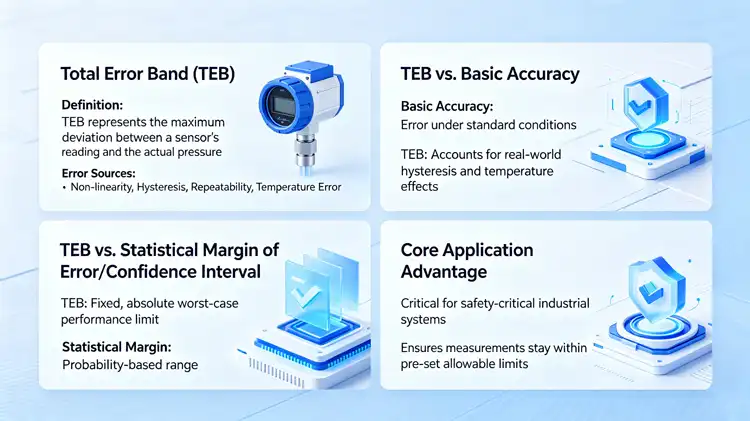
TEB is not the same as easier metrics like "accuracy" or "linearity." Accuracy might say that a value is within 0.25% of full scale under standard conditions. TEB, on the other hand, measures performance in the real world by taking into account hysteresis and temperature effects. In statistics, "margin of error" refers to the range of trust around repeated readings, while "TEB" gives us a clear idea of what the worst-case scenario could be. While confidence intervals need to be interpreted probabilistically, TEB gives a single, absolute limit. This is helpful when building safety-critical systems that need to make sure readings stay within certain limits.
Calculating and Interpreting TEB Values
Most of the time, manufacturers figure out TEB by using the root-sum-square (RSS) method or adding up each mistake component algebraically. The RSS method takes separate mistakes into account and blends them as There are five types of errors in TEB: linearity, hysteresis, repetition, and temperature.
The algebraic method gives a more careful estimate because it only adds absolute numbers. The thermal error shows how well the sensor works across the adjusted temperature range, which is the temperature range where it stays accurate without any outside adjustment. When you go outside of this range, different temperature factors apply, which makes the error band bigger.
Putting total error band into perspective is important. If a sensor is listed at ±0.5% total error band over 0-100 bar, it means that any measurement could be off by up to 0.5 bar from the real pressure. This might be fine for pharmaceutical batch reactors that need to precisely control the pressure, but for flight altimetry, tighter bands are needed. When you compare total error band numbers from different datasheets, you can see which sensors give you the accuracy you need for your application.
Practical Examples Using Real Sensor Data
Look at a pressure sensor that can measure up to 1000 psi and has a TEB of ±0.25%. Across the range, the biggest mistake that can happen is 2.5 psi. For safety reasons, if your process needs to keep 500 psi ±5 psi, this sensor gives you enough room. The 2.5 psi TEB, on the other hand, doesn't work in a pharmaceutical filtration system that needs 50 psi ±0.5 psi. This means that a sensor with stricter requirements or a smaller measurement range is needed.
Temperature changes are another example. When tracking oil pipelines outside, where the temperature can change a lot, a sensor that is stated to work with ±0.1% TEB from -40°C to +85°C does its job reliably. A competing sensor that was rated ±0.1% TEB but only from 0°C to +50°C would make mistakes that aren't acceptable during the winter. This shows why TEB standards need to match real-world working conditions. These examples show how important TEB is for matching sensor powers to real-world application needs. This keeps expensive field failures and measurement arguments from happening.
Key Applications and Importance of TEB in Measurement and Quality Control
TEB's Role Across Critical Industrial Sectors
In many different types of businesses, safety and efficiency depend on pressure sensors with clear total error band specifications. In oil plants, sensors check the pressures in storage tanks, distillation columns, and pipes. In these places, mistakes in measuring can cause false alarms, equipment damage, or dangerous leaks. When making medicines, it's important to keep the pressure just right during clean filtration and bioreactor operations. TEB has a direct effect on batch stability and meeting FDA and EMA standards.
Accurate pressure readings are needed to keep reaction dynamics stable and stop runaway situations in chemical processing plants. Sanitary pressure monitors are used in the pasteurization, carbonation, and clean-in-place systems of food and drink production. TEB affects the quality of the products and the food safety approvals. From natural gas pipelines to hydraulic power generation, the energy industry needs accurate pressure measurements to keep equipment safe and increase efficiency. In every case, TEB gives a number value to measurement reliability, which helps engineers set the right safety boundaries and interlocks.
How TEB Informs Calibration and System Monitoring
TEB standards have a big impact on calibration intervals and processes. To keep their accuracy, sensors with narrow error bands need to be calibrated more often, while devices with wider TEBs might be able to go longer between calibrations. Knowing TEB helps set drift budgets: if a sensor's TEB is ±0.2% and the accepted process error is ±0.5%, you have 0.3% room for drift before you have to recalibrate. Monitoring systems compare sensor outputs to TEB limits and send out repair alerts when numbers get close to the limits.
TEB is used by quality assurance teams to check the functionality of measurement systems during process qualification and ongoing improvement projects. Statistical process control charts use TEB as a guide to tell the difference between real process change and sensor noise. Regulatory checks look closely at TEB paperwork to make sure that measurements can be tracked and that the company is following ISO 9001, ISO/IEC 17025, and industry-specific standards such as ASME B31.3 for piping systems and API 670 for machinery safety. Documenting TEB data correctly helps with legal defense and getting ready for audits, which lowers compliance risks.
TEB Performance Variations Across Sensor Technologies
The TEB patterns of different pressure sensing systems are different. Industrial receivers often use piezoresistive silicon sensors that get ±0.25% to ±1% TEB, which is a good balance between price and performance. The TEB performance of thin-film strain gauge sensors on stainless steel diaphragms is strong in tough settings, with values of about ±0.5%. Capacitive sensors are very stable and have low hysteresis, achieving ±0.1% TEB in precise uses. However, they can be affected by mounting stresses.
Resonant silicon sensors have very good total error band values (often ±0.05%), which make them good for demanding aircraft and measurement uses but cost more. MEMS sensors, which are becoming more common in cars and consumer electronics, can measure a wide range of total error band values, depending on how complicated the design is and how well it is calibrated. When buying teams know about these technology-specific traits, they can find solutions that meet application needs and stay within budget. This way, they can avoid over-specification, which drives up costs, and under-specification, which compromises performance.
Choosing the Right Pressure Sensors Based on Total Error Band
Balancing TEB with Other Critical Specifications
When choosing pressure sensors, you need to look at their TEB, as well as their working range, output signal (analog, digital, or fieldbus), reaction time, and environmental ratings. A sensor that has great TEB but not enough pressure range or outputs that don't work with each other is useless. On the other hand, adding too much TEB adds cost that isn't needed when process tolerances allow for bigger error bands.
It is more cost-effective to match TEB to real needs than to try to meet the strictest specifications possible. Look at the control needs for your process. How much measurement error can your system handle while still keeping quality and safety? Figure out the total budget for loop accuracy, taking into account the transmitter's TEB, wiring mistakes, the controller's resolution, and the deadbands of the actuators. This systems-level method shows if spending money on ±0.1% TEB instead of ±0.25% TEB really makes things better or just raises the cost of buying things without adding any value to the process.
Evaluating Manufacturers and Supplier Reliability
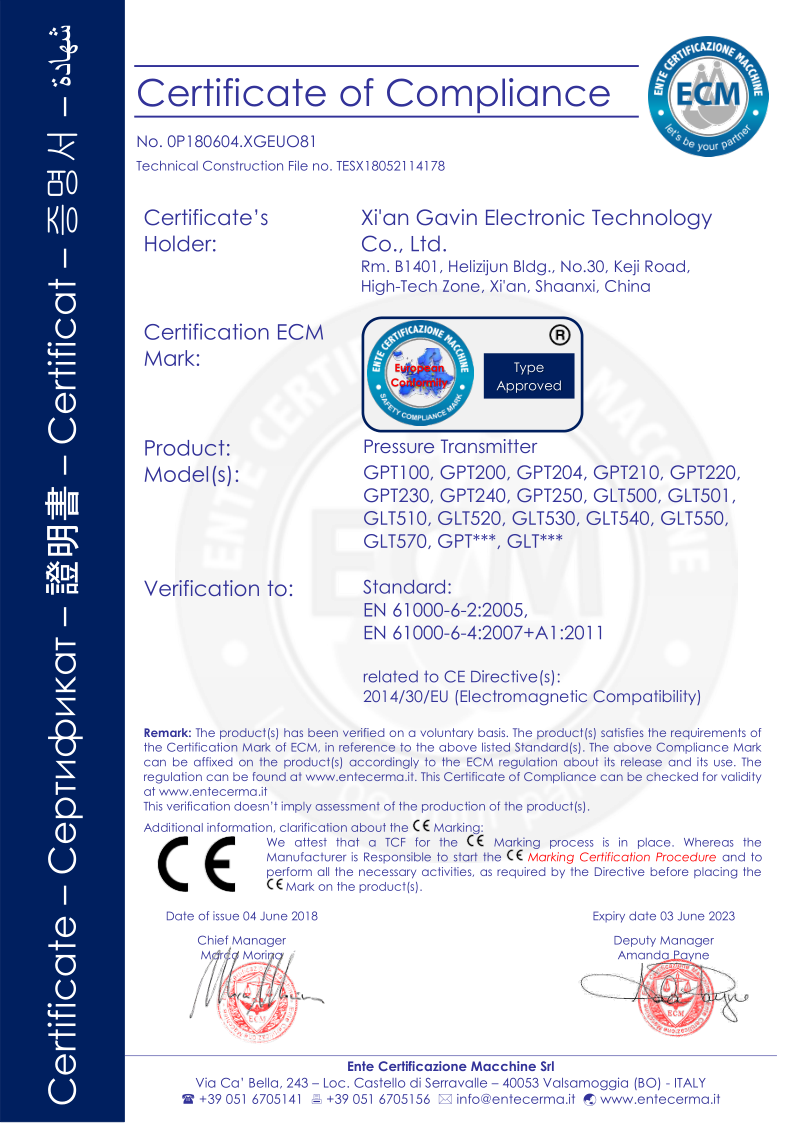
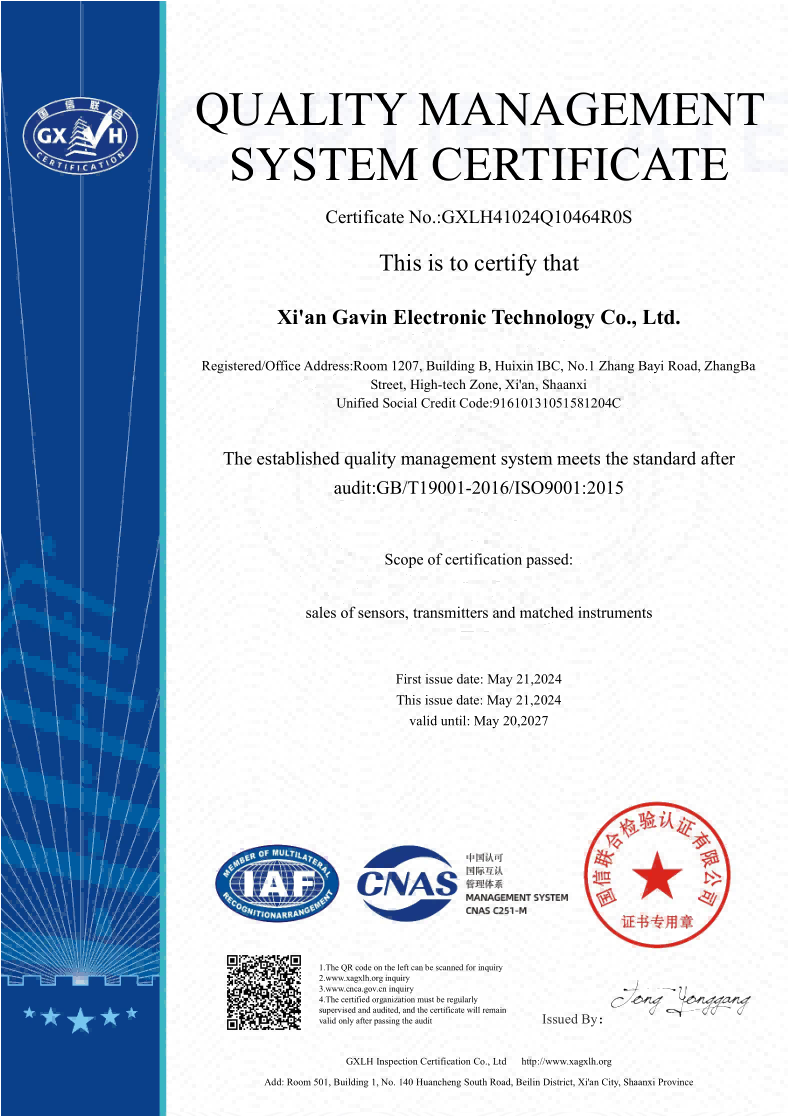
Leading pressure sensor makers set themselves apart by using strict TEB testing, detailed paperwork, and long-term stable data. Not only should you look for providers who give you nominal reference values, but also thorough TEB specifications that cover a wide range of temperature ranges, proof pressure cycles, and vibration conditions. Certifications such as ISO 9001 for quality management, ISO/IEC 17025 for testing laboratories, and ATEX or IECEx for dangerous areas show a dedication to accurate measurements.
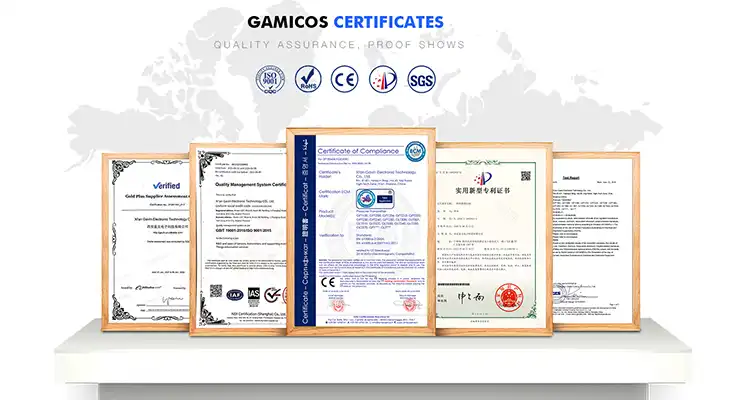
Our specialized research and development (R&D) department at GAMICOS shows this commitment by having multiple patents in sensing technology and working with research institutes to turn new ideas into solutions that can be used in production. Our pressure monitors go through strict testing procedures and are backed by certifications from national metrology institutions.
This makes sure that TEB standards are based on real-world performance and not just optimistic claims. We have made products for 98 different countries, so we know how to deal with a wide range of industrial problems. We also know how to create sensor solutions, such as communication protocols and mounting configurations, so that TEB works well in a wide range of working conditions. This knowledge leads to a reliable supply chain, which is important for meeting project deadlines and building long-term relationships.
Market Trends and Purchasing Guidance
As of now, the market prefers digitally adjusted sensors that use microprocessors to fix non-linearity and temperature effects. This makes the TEB tighter without using any special sensing elements. Wireless pressure devices with LoRa, NB-IoT, and 4G connectivity are becoming more popular for remote tracking. However, to keep TEB during wireless transmission, strong signal processing and error-checking procedures are needed.
When you buy pressure sensors, make sure you ask for TEB data in all of your working settings, not just at room temperature and mid-scale pressure. Check to see if the reported TEB includes or leaves out rising stress effects, which can have a big effect on how well installations work in real life. You might want to look for providers who offer factory calibration certificates that can be traced back to national standards and show the exact TEB readings of the units they deliver. Professionals in procurement should also look at how well a seller handles large orders, customization, quick technical support, and service after the sale. These are all things that go beyond TEB standards but have a big impact on the total cost of ownership and the ability to keep operations running.
How to Minimize Total Error Band in Pressure Sensor Systems
Common Contributors to Elevated TEB Values
Environmental factors are one of the main things that break down total error band. Extreme temperatures outside of compensated ranges cause mistakes in sensing elements and electrical parts due to thermal expansion. When temperatures change quickly, materials expand and shrink at different rates, which leads to hysteresis, further widening the total error band.
Mechanical shaking causes short-term noise and speeds up the wear and tear on structures, while shock loads can forever change the calibration, directly affecting the total error band. Noise that spreads error bands is caused by electromagnetic interference from motors, drives, and wireless emitters. This is especially true for analog output sensors with long cable runs.
The way TEB is installed has a huge effect on it. When process parts are over-torqued, they put stress on sensor diaphragms, which causes offset mistakes. If something isn't oriented correctly, fluid or condensation can build up and change how pressure is transmitted. Pulses of pressure from pumps or blowers wear out sensing elements and make it harder to repeat. When process media like toxic chemicals, particles, and high temperatures are not properly isolated, they damage seals and electronics, which leads to drift. Inconsistencies in calibration, like using reference standards that aren't approved or making the wrong zero and span changes, cause TEB to rise without showing what's really going on.
Best Practices for TEB Reduction
Keeping the working conditions stable saves the TEB's performance. Place pressure monitors in places that won't change temperature much, away from direct sunlight, radiant heat sources, and cold drafts. When changes in the environment are bigger than what the monitor can handle, use temperature transmitters or temperature compensation methods. To keep mechanical disturbances to a minimum, mount sensors on hard platforms that have vibration isolators built in. To get rid of pressure pulses without adding reaction lag, use snubbers or dampeners. Electrical grounding and protected wiring keep electromagnetic pickup to a minimum, which protects the purity of the signal.
Adopting strict testing plans that are in line with TEB requirements makes sure that measurements are accurate. Set calibration intervals based on what the maker says, how important the measurement is, and any shift trends that have been seen. Use reference standards that can be tracked back to NIST or that are known across the country and have error ratios of at least 4:1 compared to sensor TEB. Instead of just checking one point, do multi-point calibrations that cover the whole working range to get non-linearity and hysteresis effects. Systematically write down the results of the testing and keep track of the TEB's performance over time to figure out when it needs repair and when to do it.
Advanced Techniques and Real-World Success Stories
Smart transmitters have compensation systems that fix systematic mistakes, which makes TEB tighter. Non-linearity is fixed by polynomial curve fitting, and direction-dependent errors are taken away by hysteresis models. Built-in temperature monitors in emitter housings allow for real-time thermal adjustment, which keeps TEB stable over a wide range of ambient temperatures. Using Kalman filtering or weighted averaging to cut down on random mistakes and boost total system accuracy, sensor fusion either combines multiple pressure measurements or combines pressure with temperature and flow data.
Systematic recalibration programs show increases in TEB that can be measured. A pharmaceutical company set up quarterly calibration rounds for reactor pressure monitors. This cut TEB drift from ±0.4% to ±0.15%, which made batches more consistent and cut product rejections by 18%. A petrochemical company replaced old analog receivers with digitally adjusted units that had a TEB of ±0.25%.
This allowed for better process control, which raised yield by 2.3% and decreased energy use by 5%. An offshore oil platform used wireless pressure monitors with automatic diagnostics to find TEB degradation before it caused major failures. This cut the number of unplanned shutdowns by 40% per year. These examples show how knowing and handling TEB can lead to real operational and financial benefits.
Conclusion
The total error band is the best way to measure how accurate pressure sensors are in harsh industrial settings. It combines linearity, hysteresis, repeatability, and heat errors into a single, usable standard. For people who buy things from businesses to businesses, like buying managers, engineering teams, and project leads, knowing about TEB lets them compare sensors objectively, set the right safety margin, and make the best choice that balances accuracy with cost-effectiveness. Knowing how TEB is affected by environmental pressures, placement methods, and the accuracy of the calibration gives you the power to keep measurements accurate throughout their working lifetimes.
You can lower operating risks, improve regulatory compliance, and secure long-term supply chain partnerships by giving priority to sensors whose TEB performance has been well-documented and whose makers are known for their commitment to quality assurance. Learning about TEB ideas changes buying things from a one-time thing to a smart way of making money. This way of doing things makes sure that your pressure measuring systems give you accurate, reliable data that supports safe, efficient, and profitable activities in markets around the world.
FAQ
How does TEB differ from simple accuracy specifications?
Most of the time, accuracy specs only talk about how well something works in perfect conditions, like room temperature and mid-scale pressure, without taking into account things like hysteresis, repeatable variation, or heat effects. These error causes are all included in the total error band, which covers the whole working range and compensated temperature span. This gives a reasonable worst-case limit. TEB provides buying teams with a complete tool that measures performance in the real world instead of just lab-bench ideals. This makes it easier to choose sensors and build systems that work better.
How often should TEB be recalculated or sensors recalibrated?
Recalibration times rely on the TEB specs of the sensor, how important the application is, and the drift patterns that have been seen. Pharmaceutical batch reactors and aircraft instruments are two examples of high-precision uses that may need to be calibrated every three or six months. Annual rounds might be okay for less important tracking, like checking the levels of storage tanks and HVAC systems. Keep an eye on TEB performance over time. If drift stays within 25% of the stated TEB, intervals should be shortened. If drift gets close to TEB limits, cycles should be shortened or root causes like external stresses or component aging should be looked into.
Does TEB affect safety margins in critical engineering contexts?
Of course. TEB is part of safety margin calculations for safety instrumented systems (SIS) and pressure release calculations. If a rupture disk needs to work at 1500 psi ±50 psi and your sensor TEB is ±15 psi, you have enough room. A sensor with ±75 psi TEB, on the other hand, would use up the whole safety window, which means it could activate too soon or too late. Knowing about TEB makes sure that safety devices work properly, stopping overpressure events and reducing the number of fake trips that stop production.
Partner with GAMICOS for Precision Pressure Measurement Solutions
Accurate pressure measurement with a small total error band is important for safety, quality, and effectiveness in all industrial activities around the world. At GAMICOS, we make high-performance pressure sensors that meet the strict TEB requirements that the oil, chemical, pharmaceutical, food processing, and energy industries around the world need. Our wide range of products, from thin-film sputtered sensors to wireless IoT-enabled emitters, goes through strict quality control that is checked by national measurement institutions. This makes sure that TEB performance matches what the datasheet says it will do.
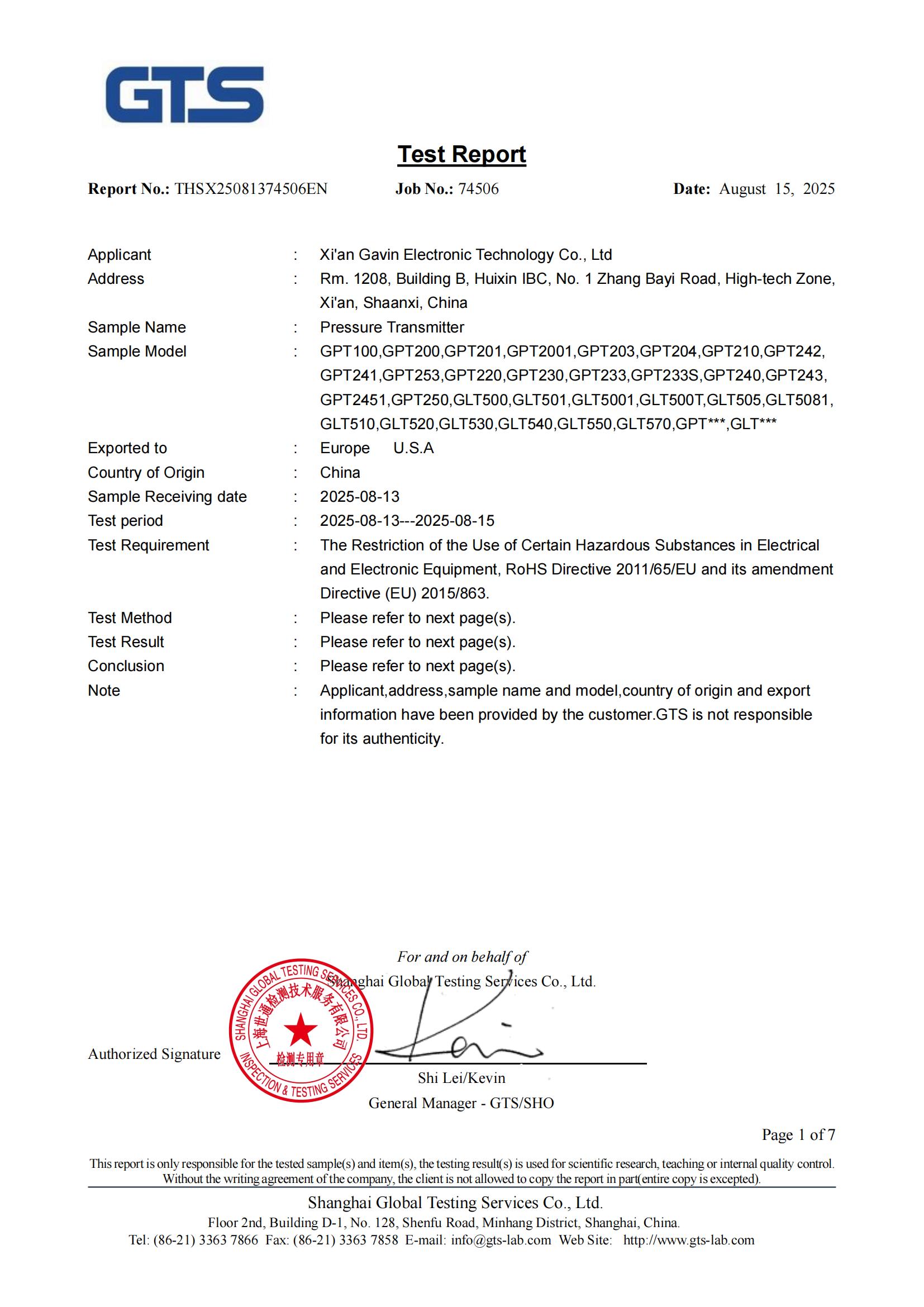
We focus on the needs of our customers and start by learning about the problems you're having with your application. This could be changing sensor ranges, output protocols, or certifications to meet foreign standards like CE, RoHS, and ISO. We offer flexible OEM and ODM services that let you change models, packing, and paperwork to make your brand stand out and make integration easier.
Our professional technical support team helps you choose the right product, install it correctly, and fix any problems that come up so that your sensors work at their best for the whole time they are in use. GAMICOS offers top-notch pressure sensing systems that lower total error band risks and improve supply chain reliability. They do this by working with R&D partners and having a lot of experience serving 98 countries.
Get in touch with our tech team at info@gamicos.com to talk about how you need to measure pressure. As a reputable total error band provider, we offer thorough TEB paperwork, calibration certificates, and application-specific suggestions that are tailored to your specific needs, whether you are buying for new automation projects, upgrading equipment, or increasing your distributor's inventory. Let GAMICOS help you with your mission-critical measurement needs with accuracy, dependability, and top-notch service around the world.
References
1. Figliola, R. S., & Beasley, D. E. (2015). Theory and Design for Mechanical Measurements (6th ed.). John Wiley & Sons.
2. Liptak, B. G. (2018). Instrument Engineers' Handbook, Volume One: Process Measurement and Analysis (5th ed.). CRC Press.
3. ISO/IEC Guide 98-3:2008. Uncertainty of measurement — Part 3: Guide to the expression of uncertainty in measurement (GUM:1995). International Organization for Standardization.
4. ASME B40.100-2013. Pressure Gauges and Gauge Attachments. American Society of Mechanical Engineers.
5. Webster, J. G., & Eren, H. (2014). Measurement, Instrumentation, and Sensors Handbook: Spatial, Mechanical, Thermal, and Radiation Measurement (2nd ed.). CRC Press.
6. Bentley, J. P. (2005). Principles of Measurement Systems (4th ed.). Pearson Education Limited.

Spring
Spring, With 5 years of experience in sensor technology and product development, Mark specializes in helping clients identify the optimal pressure and level sensor solutions for demanding industrial environments。
We're here to help — submit your request anytime!
Let us know how we can help solve your pressure level measurement challenge.
_1757930850792.jpg)

Recommended Blog
Vibration Causing Early Pressure Sensor Failure? Anti-Vibration Mounting
Wrong Pressure Range Selected? How to Choose & Replace Correctly