Temperature Compensation in Pressure Sensors
Understanding Temperature Effects on Pressure Sensors
- Understanding Temperature Effects on Pressure Sensors
- Principles and Methods of Temperature Compensation in Pressure Sensors
- Types of Pressure Sensors and Their Temperature Compensation Approaches
- Selecting the Best Pressure Sensor with Temperature Compensation for Industrial Applications
- Implementing and Maintaining Temperature Compensation in Pressure Sensors
- Conclusion
- FAQ
- Partner with GAMICOS for Precision Pressure Measurement Solutions
- References
Temperature adjustment in pressure sensors fixes the errors in measurements that come from changes in temperature in industrial settings. A pressure sensor picks up the force that is acting on a surface and turns it into electrical data. If you don't properly compensate for temperature changes, things like thermal expansion, changes in material properties, and signal drift can make measurements less accurate, which can cause problems with quality and process control. Using good temperature compensation ensures accurate readings even when temperatures change. This is why it is essential for businesses that need steady accuracy, like oil refining, chemical processing, pharmaceutical manufacturing, and energy production.
Understanding Temperature Effects on Pressure Sensors
Changing temperatures make it very hard to measure pressure accurately in commercial settings. When sensing elements are heated or cooled, the materials inside them grow or shrink, changing their size and electrical properties. This event has a direct effect on the sensor's ability to give accurate results.
How Thermal Variations Compromise Measurement Accuracy?
Changes in temperature have more than one effect on the sensing element. The materials that make up the diaphragm change sizes, and the resistance of the internal circuits changes. When these factors work together, they cause output shift that gives wrong pressure readings. Sensors in high-temperature industrial boilers may show pressure levels that are several percentage points higher than they really are. On the other hand, sensors in cold storage facilities often show pressure levels that are much lower than they really are.
Real-World Impact in Industrial Environments
When temperatures change during production cycles, it can be hard for chemical plants that use constant reactors. In some cases, uncompensated sensors in pharmaceutical processing lines led to batch rejections because they got the pressure wrong when the temperature changed. In the same way, oil plants that keep an eye on pipeline pressures in desert areas need strong adjustments to keep their accuracy between hot days and cool nights.
Material Properties and Electrical Response Changes
When the temperature changes, different types of sensor materials react in different ways. When the temperature changes, silicon-based sensing elements show expected but noticeable changes in resistance. Even though diaphragms made of stainless steel grow at known rates, even small changes in size can cause output mistakes that can be measured. Knowing how these materials behave helps engineers guess what kind of adjustments they will need when choosing sensors and designing systems.
Principles and Methods of Temperature Compensation in Pressure Sensors
Systematic correction methods used in effective adjustment techniques cancel out thermal effects. To get exact numbers no matter what the temperature is, the basic idea is to measure both pressure and temperature and then use math to fix the results.
Hardware-Based Compensation Techniques
In the old way of doing things, thermistors or resistance temperature monitors were built right into the sensor units. These parts keep an eye on the temperature all the time and send information to linearization circuits, which change the output signals in real time. Bridge circuits with matched resistors help smooth out voltage changes caused by temperature before the signal is amplified. This method is reliable and doesn't need a lot of complicated computer editing.
Digital Compensation and Advanced Algorithms
More and more modern devices use microprocessors that run complex compensation routines. These systems use polynomial equations to fix raw sensor data and store calibration coefficients in memory that doesn't lose its data when the power goes out. Digital signal processing makes it possible to calibrate multiple points across a wide range of temperatures, which is more accurate than traditional methods. This method is used in the GAMICOS GPT200 general pressure sensor, which has high-performance specialized circuits and diffused silicon sensing elements. The integrated processing circuit changes millivolt signals into normal voltage and current outputs. Advanced compensation methods make sure accuracy even in harsh temperature situations.
Calibration Methods for Optimal Compensation
Setting up the right measurements is the first step in making temperature adjustment work. Multi-point calibration includes trying sensors at different combinations of temperature and pressure and making lookup tables or polynomial coefficients that fully describe how the sensors behave. Sensors are moved automatically through temperature-controlled rooms with known pressures applied. The outputs are recorded so that adjustment factors can be made. This strict process makes sure that sensors stay accurate within the limits of their capabilities throughout their whole working range.
Types of Pressure Sensors and Their Temperature Compensation Approaches
Different sensing systems need different compensation methods because of how they work physically and the properties of the materials they use. Knowing these differences helps you make the best choices about what sensors to buy.
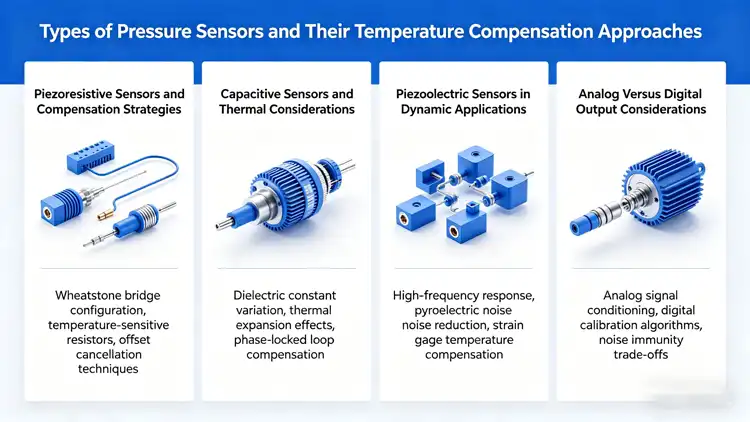
Piezoresistive Sensors and Compensation Strategies
Strain-sensitive resistors are built into silicon diaphragms that are used in piezoresistive sensors. Both the piezoresistive coefficients and the base resistance values change with temperature, so there needs to be two ways to account for these changes in sensitivity and zero offset. The GPT200 pressure sensor transmitter uses very stable piezoresistive technology and full compensation to achieve low drift, which is important for long-term industry tracking. The 316L stainless steel used to make the isolation diaphragm makes it long-lasting and stable at room temperature.
Capacitive Sensors and Thermal Considerations
Capacitive sensors figure out how much pressure there is by changing the capacitance between wires when the diaphragm bends. Temperature changes the dielectric properties and the distance between the electrodes, so compensation methods need to take both of these factors into account. Ceramic sensitive designs are naturally resistant to changes in temperature, and if they are used correctly, they can last for 10 to 15 years. Most of the time, these sensors send out 0-10V or 4-20mA data that can be used with industrial control systems. This makes integration easier.
Piezoelectric Sensors in Dynamic Applications
Piezoelectric sensors are great for measuring dynamic pressure because they produce electrical charges that are related to the amount of mechanical stress that is put on them. Their piezoelectric values change a lot with temperature, though. Adjustments to the gain that depend on temperature and special charge amplifiers that keep uniformity are used for compensation. These monitors work great in small spaces where other technologies can't because of lack of room.
Analog Versus Digital Output Considerations
The style of the output has a big effect on how compensation is implemented. For temperature correction, analog instruments that send voltage or current need signal conditioning from the outside, but many newer designs do this internally before signal conversion. Digital sensors send corrected data through I2C, SPI, or industrial standards, so there is no need for correction further down the line. The GPT200 has strong anti-interference properties for both its voltage and current signal outputs. This makes it flexible for a wide range of system designs while still keeping compensated accuracy.
Selecting the Best Pressure Sensor with Temperature Compensation for Industrial Applications
Before making a purchase choice, you need to carefully look at the technical specs, business needs, and lifecycle costs. By balancing these factors, you can get the best sensing performance within your price.
Critical Performance Specifications
The temperature coefficient of offset and span tell us how the pressure sensor data change as the temperature changes. They are usually given in percentages per degree Celsius. Specifications for accuracy should take into account mistakes in both pressure and temperature over the whole range of operation. Response time is important for dynamic processes, and stability scores show how things will move over time. A lot of tests were done on the GPT200 to make sure it was stable and didn't move. These tests included design validation, workpiece screening, process verification, cyclic loading, aging routines, and weather modeling.
Temperature Range and Environmental Compatibility
The operating temperature range needs to be big enough to cover all possible process conditions with a little extra room. Extreme temperatures usually make compensation less effective, so sensors should only be used well within their recommended limits. Temperature affects are affected by things like humidity, vibration, and chemical contact in the environment, so a full compatibility review is needed. Because it is built to last and has a number of electrical input choices, the GPT200 can work in a wide range of industrial settings without losing its accuracy.
Cost-Accuracy Trade-offs in Sensor Selection
When money is tight, you often have to choose between truth and cost. Some industrial uses may be okay with ±0.5% accuracy with basic compensation, but aircraft and pharmaceutical uses need ±0.1% accuracy or better with advanced compensation. The initial buy price, assembly costs, calibration needs, and replacement regularity are all part of the lifecycle costs. Buying better sensors with better compensation can often lower the total cost of ownership because they last longer and need less upkeep.
OEM and Custom Solutions for Specialized Needs
Customized sensor designs that are made to fit certain attachment options, pressure ranges, or output forms are useful in many situations. GAMICOS offers skilled OEM and ODM services where models, features, packaging, and paperwork can all be changed to fit your needs. Manufacturers of equipment can use this freedom to build in optimal sensing solutions that meet their exact needs. The GPT200 is small and light, which makes it easy to install and allows OEMs to make changes. It can measure all pressure ranges, including absolute, gauge, and sealed gauge pressures.
Implementing and Maintaining Temperature Compensation in Pressure Sensors
For precision to last, it needs to be installed correctly, calibrated at first, and maintained regularly. These steps keep the correction working well for as long as the sensor is used.
Best Practices for Initial Calibration
The installation should keep the difference in temperature between the monitor and the process media to a minimum. When mounting in places with stable temperatures, less correction is needed. The first adjustment should happen after the sensors have reached a stable temperature in their working surroundings. This gives the internal stresses a chance to equalize. Accurate baseline compensation values are set by multi-point calibration at typical working temperatures.
Recalibration Scheduling and Procedures
The length of time between calibrations depends on how important the application is and how it is being used. Some processes need to be checked once a year, while less important ones can be checked every two or three years. Extreme temperatures, corrosive chemicals, or mechanical vibrations in harsh settings speed up drift, which means that the correction needs to be done more often. Each GPT200 pressure sensor unit goes through a lot of tests before it is shipped. This gives it a solid baseline that lets you calibrate it more often than sensors that haven't been tested as fully.
Troubleshooting Common Compensation Issues
Rather than slow compensation decline, sudden reading changes are often caused by electronic breakdowns. In systematic fixing, sensor outputs are compared to reference standards over a wide range of temperatures to find out what kind of failure is happening. Drift in zero offset means that there is contamination or mechanical damage, and changes in span mean that the sensing element is breaking down. Professional technical support teams help with analysis and figure out whether the best option is to recalibrate, fix, or replace the device.
Ensuring Long-Term Reliability Under Harsh Conditions
Protective housings keep sensors from coming into direct contact with the surroundings while still letting them transfer heat to process media. Physical harm, rust, or contamination can be found early on by inspecting the device on a regular basis. Process problems, such as overpressure or thermal shocks, may mean that sensor function needs to be checked right away. GAMICOS focuses on constantly improving technology with the help of dedicated R&D engineering. They make sure that their products use the newest compensation methods and longevity improvements to keep working well in tough environments.
Procurement Strategies for Reliable Supply Chains
In important situations, sourcing from well-known companies with clear quality control methods lowers the risk. Full datasheets should include information on how to compensate, the required level of accuracy across a wide range of temperatures, and how to calibrate the device. Lead times for standard goods are usually between a few weeks and a few months, while development times for unique designs are longer. Building ties with responsive suppliers who offer expert help throughout the lifetime of a product makes future purchases easier. GAMICOS has a lot of knowledge in the field and can make products that are exactly what the customer wants. They have strict quality control and approvals from metrology organizations to back up their work. Every year, they serve thousands of customers in 98 countries.
Conclusion
In industrial settings, temperature correction is a very important part of choosing and using pressure sensors. When procurement workers know how changes in temperature affect the accuracy of measurements, they can choose the right pay methods for their needs. Different technologies, such as piezoresistive designs like the GPT200 with built-in digital adjustments and capacitive sensors that are naturally stable, can be used for different tasks. For execution to go well, the right sensors must be chosen, and strict calibration rules and ongoing upkeep must be followed. As industrial processes need more and more accuracy, buying good temperature-compensated sensors from reputable companies gives you trust in your measurements, which helps improve process optimization, product quality, and operating safety.
FAQ
Why is temperature compensation necessary in industrial pressure sensors?
When the temperature changes, the materials used in sensors change their electrical and physical properties. This leads to measurement mistakes that make process control less reliable. These thermal effects are fixed by compensation, which keeps the accuracy the same across all working temperature ranges. Without it, results could change by a few percentage points, which could cause problems with quality or safety in important situations.
How often should temperature-compensated sensors be recalibrated?
How often you calibrate depends on how important the application is and how bad the operation is. In normal industrial settings, verification is usually needed every one to two years. But in harsh situations with high temperatures or contact to corrosives, testing may need to be done once a year. In the pharmaceutical and food processing industries, regulations often require strict calibration plans that don't depend on the surroundings.
Can temperature compensation eliminate all thermal errors?
Temperature-related mistakes can be greatly reduced with compensation, but they can't be completely eliminated. Accuracy levels of ±0.1% to ±0.5% are reached across quoted temperature ranges by high-quality sensors with advanced correction. Residual mistakes happen because the compensation method is limited and material properties change in ways that can't be avoided. The right choice of sensor combines how well compensation works with cost and application needs.
Partner with GAMICOS for Precision Pressure Measurement Solutions
For industrial processes that need to measure pressure accurately when temperatures change, sensors must be designed with strong temperature correction. GAMICOS specializes in creating and producing high-tech measuring tools, such as the GPT200 pressure sensor, which is made to work in tough industrial settings. Our piezoresistive sensors have advanced compensation circuits built in, so they are always accurate whether they are watching over energy systems, chemical labs, or pharmaceutical processes.
We know how hard it is for businesses to find the right balance between technology performance, delivery reliability, and lifetime costs. That's why we offer full OEM and ODM customization, which includes different types of sensors, connections, communication methods, and mechanical setups. Our engineering team works with project engineers and sourcing managers to come up with the best solutions for each application.
We've learned how to solve measurement problems in the oil, chemical, pharmaceutical, food and beverage, and energy businesses by working with users in North America, Europe, the Middle East, and other places. Every GPT200 unit goes through a lot of tests, such as environmental simulations and aging routines, to make sure it is stable and reliable enough for long-term relationships.
GAMICOS provides excellent expert support for all of your needs, whether you're upgrading current systems, starting new automation projects, or looking for a reliable pressure sensor provider for your distribution channels. Please email our team at info@gamicos.com to talk about your unique needs and find out how our temperature-compensated sensors can help you get more accurate measurements and confidence in your operations.
References
1. Webster, J.G., & Eren, H. (2018). Measurement, Instrumentation, and Sensors Handbook: Electromagnetic, Optical, Radiation, Chemical, and Biomedical Measurement. CRC Press.
2. Wilson, J.S. (2005). Sensor Technology Handbook. Newnes Publications.
3. Fraden, J. (2016). Handbook of Modern Sensors: Physics, Designs, and Applications. Springer International Publishing.
4. Bao, M.H. (2000). Micro Mechanical Transducers: Pressure Sensors, Accelerometers, and Gyroscopes. Elsevier Science.
5. Pallas-Areny, R., & Webster, J.G. (2001). Sensors and Signal Conditioning. John Wiley & Sons.
6. Liptak, B.G. (2003). Instrument Engineers' Handbook: Process Measurement and Analysis. CRC Press.

Ivy
Ivy, product consultant, has focused on sensor consultation for ten years, is proficient in providing pressure and level measurement solutions for customers.
We're here to help — submit your request anytime!
Let us know how we can help solve your pressure level measurement challenge.

_1757930850792.jpg)






Recommended Blog

Guide to Intrinsically Safe & Explosion-Proof Pressure Transmitters
Pressure Transmitter Calibration: Field vs Bench Procedures
Guide to Intrinsically Safe & Explosion-Proof Pressure Transmitters
Pressure Transmitter Calibration: Field vs Bench Procedures
