Pressure Sensor Nonlinearity: Linearization & Calibration Tips
Comprehending Pressure Sensor Nonlinearity and Its Impacts
- Comprehending Pressure Sensor Nonlinearity and Its Impacts
- Linearization Techniques to Minimize Nonlinearity Errors
- Practical Calibration Tips to Ensure Pressure Sensor Linearity
- How to Choose Pressure Sensors with High Linearity for Your Procurement Needs
- Procurement Considerations: Buying Pressure Sensors with Required Linearity
- Conclusion
- FAQ
- Partner with GAMICOS for Superior Pressure Sensor Linearity Solutions
- References
To get accurate readings in industrial robotics, you need to know about pressure sensor linearity. Nonlinearity is the difference between what a sensor actually sends out and how it should respond in a straight line across a pressure range. When buying pressure sensors for important tasks, people in charge of procurement need to know that even small nonlinearities can add up to big measurement mistakes that can affect safety, quality, and process control. These problems can be solved directly with the right linearization methods and calibration processes, which turn raw sensor outputs into accurate data. We've worked with engineering teams in oil refineries, drug factories, and food processing plants, and we've seen how improved pressure sensor linearity results in better operations and less expensive downtime.
Comprehending Pressure Sensor Nonlinearity and Its Impacts
What Pressure Sensor Linearity Actually Means
The accuracy of a pressure sensor tells us how closely the link between the applied pressure and the sensor output is like a straight line. If there was perfect pressure sensor linearity, the resulting voltage or current would rise in a straight line with the pressure across the whole measuring range. In real life, things are not like this; sensors deviate from this ideal reaction curve in different ways. This difference is measured as nonlinearity error, which is usually shown as a percentage of full-scale output (%FSO). Knowing this measure helps you tell the difference between what makers say they will do and what actually happens in the field.
Common Misunderstandings Between Linearity and Accuracy
A lot of procurement workers mix up linearity and general accuracy, but they are two different types of performance. Linearity only measures the departure from the ideal straight-line reaction, while accuracy measures all error causes, such as linearity, hysteresis, repeatability, and temperature effects. It's possible for a sensor to have great precision but bad accuracy because of calibration shift or temperature sensitivity.
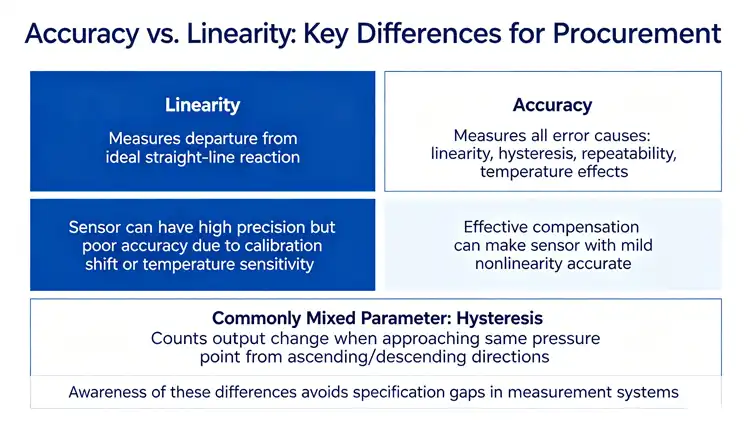
On the other hand, effective compensation methods can still make a sensor with mild nonlinearity very accurate. Another parameter that gets mixed up a lot is hysteresis, which counts the change in output when approaching the same pressure point from directions that go up or down. Specification gaps that cause measurement systems to not work well can be avoided by being aware of these differences.
Root Causes of Sensor Nonlinearity
Pressure sensor efficiency is not linear because of a number of things. The environment is the most important factor. Changes in temperature can affect the material qualities of sensor elements, leading to changes in resistance and thermal expansion that throw off output curves. Adding to the difficulty are humidity and mechanical stress. Different sensor technologies have different nonlinearity patterns because of changes in how they are built. When silicon diaphragms are stressed, piezoresistive sensors measure changes in resistance.
These sensors often have different nonlinearity properties than capacitive sensors, which measure changes in capacitance to see when the diaphragm bends. Unit-to-unit variety is caused by manufacturing errors in the width of the diaphragm, the alignment of the electrodes, and the quality of the bonding. Even the conditions of installation, such as mounting force, pressure port orientation, and media compatibility, can cause mechanical stresses that hurt linearity.
How Nonlinearity Degrades Industrial Processes
Pressure sensor nonlinearity has real-world effects that can be felt throughout industries. When sensor outputs deviate from linear response, it makes process control systems less stable when they use pressure input to move valves or control flow. In pharmaceutical batch processing, where exact pressure control is needed to make sure that the product is always the same and that regulations are followed, nonlinearity causes differences between batches that could lead to quality problems.
Due to inaccurate measurements, quality assurance teams have to deal with higher reject rates when pressure-dependent factors like coating thickness, extrusion dimensions, or reaction tank conditions change. It becomes necessary to increase the regularity of testing in order to keep performance at a satisfactory level. This uses up maintenance resources and stops production. When nonlinear sensor outputs cause false warnings or hide problems that are already happening, they waste time and energy in the energy sector. This is especially true in pipeline tracking and compressor control.
Linearization Techniques to Minimize Nonlinearity Errors
Traditional Linearization Approaches
To fix sensor nonlinearity, engineers have been using mathematical correction methods for a long time. In polynomial fitting, second-order or higher-degree equations are used to connect sensor data to real pressure values. This straightens the response curve by using computers. This method works well for sensors whose nonlinearity patterns are smooth and easy to predict, such as those characterized by stable pressure sensor linearity. Piecewise linear approximation breaks the pressure range into parts and fixes each part in a different way.
This method works for sensors that behave in different ways at different points in their working range. Look-up tables keep fixed values at certain pressure points, and interpolation fills in the gaps between the reference values. These old methods all have the same flaws: they only work when nonlinearity patterns stay the same, and they don't work well when sensor behavior changes due to temperature, age, or working conditions. Implementation needs a lot of processing power on basic systems and could cause delays in programs that need to work quickly.
Advanced Software-Based Compensation Methods
These days, linearization uses complex formulas that change based on the features of the sensor. Multi-dimensional correction is built into software-based adjustment. It takes into account nonlinearity, temperature effects, and feedback all at the same time using built-in mathematical models. Adaptive real-time linearization algorithms keep an eye on how sensors are behaving and change the correction parameters as the working conditions change.
These systems use neural networks or machine learning to learn how sensors respond while they are working. This makes the linearization accuracy better over time. The benefits go beyond better measurement accuracy; adaptive methods also reduce the need for regular human calibration, increase the useful life of sensors by adjusting for gradual drift, and keep performance stable across a wider range of working conditions. Implementation does need powerful processing gear and careful algorithm design, but the investment pays off in lower upkeep costs and more stable processes.
Real-World Implementation Success Stories
A petroleum plant in North America replaced old pressure sensors in their distillation column control system with capacitive pressure sensors that had more advanced linearization methods built in. Within three months, the facility cut product standard errors by 23%. This was directly due to better uniformity in pressure measurements across the entire working temperature range.
A company that makes parts for cars that used software-based linearization for hydraulic press tracking was able to get 30% longer breaks between calibration rounds while also making stamped parts more consistent in size. These results show that matching the linearization approach to the needs of the application creates real business value.
Practical Calibration Tips to Ensure Pressure Sensor Linearity
Establishing Robust Calibration Protocols
Choosing the right tools is the first step to accurate testing. It is important that calibrated reference standards are at least four times more accurate than the sensors being calibrated. This makes sure that error in the reference doesn't affect the truth of the calibration. There are different uses for deadweight testers, precision pressure controls, and verified reference receivers, depending on the level of accuracy, pressure range, and media compatibility that is needed. The setting where the calibration takes place is very important.
Temperature-controlled rooms keep thermal effects to a minimum during calibration, and vibration isolation stops mechanical noises that can cause measurement mistakes. We suggest writing down calibration methods that include pressure points at zero, 25%, 50%, 75%, and 100% of full-scale, as well as both ascending and descending steps to show hysteresis. These points should be spread out over the whole working range.
Temperature Compensation Best Practices
Pressure sensor linearity is significantly impacted by temperature. Ceramic capacitive pressure sensors are very stable and work well with a wide range of media, but their capacitance changes with temperature, which affects how straight the output is. Several methods must work together for temperature adjustment to be effective. For hardware-level adjustment, temperature sensors are built into the pressure sensor assembly. These sensors feed correction algorithms that change the output based on the temperature readings in real time.
By calibrating at different temperatures across the working range, correction models are made that take into account changes in nonlinearity that are caused by temperature. When choosing sensors for places where temperatures change a lot, like outdoor installations, process streams that change temperatures, or equipment that changes with the seasons, make sure that the manufacturers offer temperature compensation across your entire range, not just at room temperature.
Industry-Specific Calibration Frequency Guidelines
Calibration times depend a lot on how important the application is and how bad the operation is. Pharmaceutical and food processing plants that are regulated by the FDA or a similar agency usually adjust their pressure sensors once a year or every six months. For compliance checks, they need to show proof of this. For non-critical sensors, chemical processing and oil plants usually use 12- to 18-month cycles. But for safety-critical pressure readings, like emergency shutdown systems, pressure relief tracking, or dangerous material containment, they need to be checked every three months or even every month.
Drift happens faster in harsh settings; sensors that are exposed to corrosive media, high temperatures, or strong vibration should have shorter gaps. We've seen that setting up condition-based calibration strategies—where tracking for sensor drift only initiates calibration when performance drops below certain levels—improves the allocation of maintenance resources while ensuring the accuracy of measurements.
Documentation and Traceability Standards
Quality management systems and following the rules depend on having complete records of calibrations. Every time a sensor is calibrated, its name, the date of the calibration, the technician who did it, the reference equipment that was used along with its traceability certification number, the environmental conditions during the calibration, the readings that were taken at each test point before and after the calibration, the calculated linearity error, and any adjustments that were made should all be written down, including pressure sensor linearity as a key recorded parameter.
Modern calibration management software keeps records automatically, sends alerts when calibrations are due, and makes reports that are ready for an audit. This paperwork is very helpful for customer checks, government inspections, and internal fixing when something goes wrong with the process. Traceability to national standards groups, like NIST in the US, PTB in Germany, and NPL in the UK, makes sure that measurements are the same across the world and makes it easier to get foreign quality certifications.
How to Choose Pressure Sensors with High Linearity for Your Procurement Needs
Critical Performance Metrics for Evaluation
To choose sensors with better pressure sensor linearity, you have to look at a lot of different specs that all depend on each other. Linearity error, which is usually given as ±0.1% to ±0.5% FSO, measures how far away from the ideal straight-line reaction something is. Tougher regularity requirements cost more, but they are necessary for precise tasks. Hysteresis checks the biggest difference between values of rising and falling pressure at the same pressure point. This shows if there are any mechanical or material memory effects that make it hard to repeat.
Long-term stability is how much the sensor's output changes over long amounts of time, like months or years, when the surroundings and pressure stay the same. Specifications for thermal effects show how changes in temperature affect output. This is usually written down as the temperature coefficient of offset and spread. When you measure the same pressure more than once in the same settings, this is called repeatability. Instead of trying to meet standards that aren't needed, which drives up costs, procurement workers should base their decisions on what the application needs.
Comparing Sensor Technologies for Linearity Performance
In industrial settings that need tough building and low-cost options, piezoresistive pressure sensors are the most common choice. These gadgets put strain-sensitive resistors into silicon diaphragms, which causes voltage changes that are related to the pressure that is applied. Piezoresistive technology has good uniformity (usually ±0.25% to ±0.5% FSO), can handle high pressures well, and comes in small packages. Nonlinearity leads to polynomial shapes that can be predicted and fixed in software. Capacitive pressure sensors, such as ceramic capacitive types, measure how much the diaphragm bends by changing the capacitance between the diaphragm and a set wire.
Capacitive designs have very good linearity—often ±0.1% FSO or better—as well as very little hysteresis and great steadiness over time. The ceramic diaphragm is more resistant to chemicals and works reliably in acidic conditions where wet stainless steel parts would fail. Capacitance-type pressure sensors work best in situations that need both accuracy and reliability, but they usually cost more than piezoresistive options. When choosing between technologies, you have to weigh the need for linearity against issues like media compatibility, working conditions, and funds.
Supplier Evaluation and Support Capabilities
Beyond sensor specs, the skills of the provider have a big effect on the success of the purchase. Manufacturers who give detailed technical documents, such as datasheets with full specifications under different conditions, application notes that address common installation problems, and calibration certificates that can be tracked, show that they care about quality and customer service. Being able to talk to an engineer before choosing a sensor helps match goods to application needs and avoids costly design mistakes.
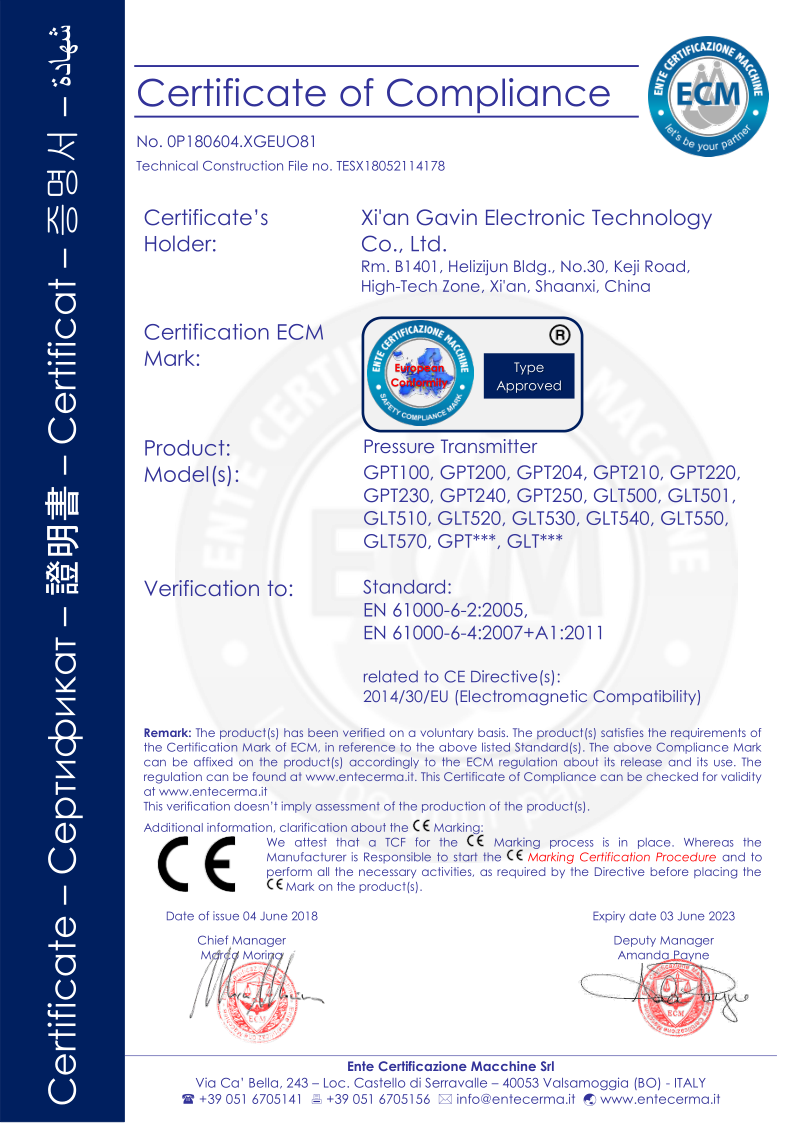
When production rests on sensor performance, quick response time for after-sales support services like technical troubleshooting help, warranty claim handling, and repair services becomes essential. To make sure that sensors meet industry standards, they are checked for certification compliance. These standards include CE marking for European markets, RoHS for environmental compliance, ISO 9001 for quality management, and application-specific certifications like 3-A Sanitary for food processing or ATEX for dangerous atmospheres. Before committing to large purchases, we suggest getting sample units to test in real-world situations. This will allow you to confirm performance that datasheets can't fully predict.
Procurement Considerations: Buying Pressure Sensors with Required Linearity
Navigating Supplier Channels and Pricing Structures
There are many ways to get high-linearity pressure sensors, such as directly from the maker, through specialized distributors, or through internet business-to-business (B2B) sites. When you work directly with manufacturers like GAMICOS, you can get access to technical tools, make changes, and get low prices for large orders. This method works well for OEM uses that need changed specs, unique communication techniques, or their own packing.
Authorized wholesalers carry more products from more makers, which is helpful for projects that need a variety of sensor types or when comparing different technologies. Online industrial marketplaces make it easier to compare prices and speed up the buying process, but they may not offer a lot of technical help. Pricing models are very different depending on the size of the order, the level of customization needed, pressure sensor linearity requirements, and the history of the relationship.
High-linearity sensors that meet the requirements for ±0.1% FSO usually cost 40–80% more than normal ±0.5% FSO units. Price tiers that are better for projects' economics can be unlocked with volume agreements. This is especially important for system integrators and original equipment makers (OEMs). We've found that open conversations about expected annual volume, even if they're spread out over several buy orders, can often lead to better prices without needing a single large-quantity pledge.
Total Cost of Ownership Analysis
When you only look at the purchase price of pressure sensors, you miss out on important costs that come up over time. The total cost of ownership includes calibration costs like tools, staff, and lost production time that happen over and over again during the sensor's useful life. Longer calibration times are possible with sensors that are more straight and stable, which cuts these ongoing costs by a large amount. Failure rates and replacement regularity have a direct effect on TCO.
High-quality sensors that have been shown to be reliable escape having to be bought quickly, shipped quickly, and maintained without planning to. When portable sensors are used, how much energy they use is important because replacing batteries is an ongoing cost. When problems happen, having access to technical help cuts down on the time needed to fix them and the damage they cause to business.
If you compare a standard piezoresistive sensor that costs less at first to a ceramic capacitive sensor that works more linearly, the lifetime study usually goes in favor of the better-performing unit because it needs to be calibrated less often, lasts longer, and has lower failure rates. This point of view is especially useful for engineering managers and research and development teams that want to make sure systems are reliable in the long term instead of just cutting costs up front.
Customization and Certification Requirements
For specialized industrial uses, sensor combinations that aren't available in a store are often needed. When OEM makers add pressure measurement to equipment, they can get custom electrical connections, changed mounting options, and pressure ranges that work with their specific application windows. GAMICOS lets you make a lot of changes, such as picking the sensor elements, the signal processing electronics, the output types (analog voltage or current, digital protocols like Modbus, CANbus, or IO-Link), and the mechanical packing that fits your specific installation needs. Material certifications must show that the wetted part is compatible with the process media for chemical processing and pharmaceutical makers.
Sanitary certifications must show that the part is cleanable and resistant to microbes for food and beverage uses. Compliance paperwork, such as material tracking, calibration certificates, and conformity statements, speeds up the process of qualifying equipment and sending it to the government. By negotiating these customizable terms when you are first talking about buying sensors, you can avoid delays and make sure that the sensors you receive work well with your systems. guarantee terms should clearly cover custom setups, protecting your investment against flaws while acknowledging that changes may affect standard guarantee terms.
Conclusion
Pressure sensor linearity is an important part of measuring accurately in tough industrial settings. We've looked at how environmental factors, design features, and differences in manufacturing can cause nonlinearity, which has a direct effect on the stability and operating efficiency of process control. Linearization methods that work, such as basic polynomial correction and more advanced adaptable algorithms, can fix these errors. Strict calibration procedures keep measurements accurate for as long as the sensor is in use.
To choose sensors with the right linearity specs, you have to weigh performance data against the needs of the application and the total cost of ownership. Strategic buying looks at more than just the specs of the sensors. It also looks at the skills of the suppliers, the ability to customize, and the support throughout the lifecycle. If engineering managers, sourcing professionals, and project leads follow these rules, they can be sure that the pressure sensors they choose will give your industrial processes the measurement accuracy they need.
FAQ
How does temperature affect pressure sensor linearity, and what compensation methods work best?
When the temperature changes, it changes the qualities of the materials inside the detecting elements. This leads to changes in resistance, thermal expansion, and mechanical stress that make the sensor output not follow a straight line. For compensation to work, temperature sensors must be built into the pressure sensor unit and correction factors must be applied by software formulas based on real-time temperature data. Instead of just using room-temperature specs, make sure that the sensors you choose are calibrated across the real working temperature range.
What distinguishes linearity error from overall sensor accuracy specifications?
Linearity error is the difference between the pressure input and the sensor output that isn't a straight line. It is usually shown as a highest variation percentage of full-scale output. All types of errors are included in overall accuracy, such as linearity, hysteresis, stability, temperature effects, and long-term drift. A sensor could say that it has a uniformity error of ±0.25% but a total accuracy error of ±0.5% because of errors coming from different sources.
What calibration intervals maintain sensor performance while minimizing production disruption?
How often you need to calibrate depends on how important the application is, how bad the working environment is, and what the rules say. Safety-critical measurements need to be checked every three months, while normal process tracking is usually done once a year or every 18 months. Shorter gaps are better in harsh settings with corrosive media, high temperatures, or a lot of shaking. Using condition-based calibration methods, in which sensors are checked only when drift tracking shows that performance is dropping, is the best way to allocate maintenance resources.
Partner with GAMICOS for Superior Pressure Sensor Linearity Solutions
GAMICOS makes capacitive pressure actuators and high-linearity pressure sensors that are designed to work in challenging industrial automation settings. Our ceramic capacitive pressure sensor technology works very well in the pharmacy, chemical processing, food and beverage, and energy sectors, keeping its accuracy within 0.1% FSO and being very stable over time. We offer full OEM and ODM customization services that are made to fit your exact needs. These include custom pressure ranges, electrical interfaces, communication methods, and mounting setups.
Our services are backed by strict quality control and international certifications such as CE, RoHS, and ISO 9001. Our expert engineering team can help you choose the best sensors for your needs, making sure that the measurements are accurate and leading to working excellence. You can talk to our experts at info@gamicos.com about your pressure sensor linearity needs, get full technical datasheets, or get quotes for projects that are coming up.
References
1. Webster, J.G. (2017). The Measurement, Instrumentation and Sensors Handbook: Spatial, Mechanical, Thermal and Radiation Measurement. CRC Press.
2. Bao, M. & Wang, W. (2020). Micro Pressure Sensors: Principles and Applications in Engineering. Springer International Publishing.
3. Norton, H.N. (2019). Sensor and Analyzer Handbook: Industrial Pressure and Level Measurement Techniques. Prentice Hall.
4. Fraden, J. (2016). Handbook of Modern Sensors: Physics, Designs, and Applications (5th Edition). Springer.
5. Wilson, J.S. (2018). Sensor Technology Handbook for Industrial Applications. Newnes Technical Books.
6. Liptak, B.G. (2021). Process Measurement and Analysis: Pressure, Level, Flow and Temperature Sensors (6th Edition). CRC Press.

Peter
Peter, Senior Sensor Technology Consultant, has 15-year industrial sensor R&D experience. He specializes in the end-to-end development of high-accuracy pressure and level sensors and he firmly believe, precision isn’t just a spec—it’s a promise.
We're here to help — submit your request anytime!
Let us know how we can help solve your pressure level measurement challenge.
_1757930850792.jpg)



Recommended Blog
Why Wireless Pressure Sensors Are Growing in Industry
Why Wireless Pressure Sensors Are Growing in Industry
Pressure Sensors for Wastewater Treatment Plants
Pressure Transmitter Uses in Water and Wastewater Treatment