How Submersible Pressure Sensors Improve Closed Chemical Tank Safety
Understanding Submersible Pressure Sensors and Their Role in Chemical Tank Safety
- Understanding Submersible Pressure Sensors and Their Role in Chemical Tank Safety
- Challenges in Closed Chemical Tank Safety and How Submersible Pressure Sensors Address Them
- Selecting the Right Submersible Pressure Sensor for Chemical Tank Safety
- Installation, Calibration, and Maintenance Best Practices
- Case Studies and Real-World Benefits of Submersible Pressure Sensors in Chemical Tanks
- Conclusion
- Frequently Asked Questions
- Partner With GAMICOS for Superior Chemical Tank Monitoring Solutions
- References
One thing that always bothers me about chemical plants is the rows of closed tanks that hold dangerous materials. How do the people who work there really know what's going on inside? A submersible pressure sensor sits directly in the liquid and continuously measures hydrostatic pressure to find dangerous overpressure or underpressure conditions before they get worse. This gives the important vision. These sensors turn risks that can't be seen into data that can be used to stop disasters and keep people and the environment safe. In a field where even small mistakes can have big effects, this real-time tracking feature is now necessary to keep activities safe and in line with regulations.

Understanding Submersible Pressure Sensors and Their Role in Chemical Tank Safety
What Makes Submersible Sensors Different?
Instead of being attached to the outside of the tank like regular gauges, submersible pressure sensors go down into the chemical medium and are placed near the bottom, where they can correctly measure pressure. This design gets rid of a lot of the measurement mistakes that come from vapor spaces, temperature differences, or changing environmental factors. The device has a sensing element—usually piezoresistive or ceramic-based—that reacts to changes in pressure, electronics that turn this physical response into electrical signals, a protective housing designed to be resistant to chemicals, and a special cable that has both signal wires and a venting capillary.
A very important job is done by the releasing capillary. It refers to the pressure in the air, so the monitor can only measure the pressure in the liquid column above it. This principle of design makes sure that measures stay correct even if the air pressure changes or the places are at different elevations.
Operating Principles and Core Components
The weight of the liquid above the measuring point is turned into pressure data by these devices. Since pressure rises in proportion to the depth of the liquid, engineers can use pressure data to get accurate level readings. The link is simple: one meter of water makes about 0.1 bar of pressure, though this can change depending on the mass of the liquid.
The choice of material affects how long a sensor will last in corrosive conditions. To keep the accuracy of the measurements, the housing must be able to survive chemical attacks, the cable must not let liquids in, and the cable entrance must be hermetically sealed. Modern models have overvoltage safety to keep you safe from lightning hits, which can happen in outdoor installations. The electronics carefully take in raw sensor data and turn them into standard industrial outputs like 4-20mA or digital protocols that work with current control systems.
Applications Beyond Basic Level Monitoring
For chemical tank safety, it's not enough to know how full a tank is. Submersible pressure sensors find leaks by noticing sudden drops in pressure. They also keep an eye on the stability of the internal pressure to keep the structure from being damaged and sound alarms when readings get close to dangerous levels. During the filling process, they keep the containers from being overfilled, which could cause leaks or breaks. When they empty the tanks, they make sure not to create vacuums that could cause the walls to fall down.
This all-around tracking feature meets the most important safety condition for chemical storage: knowing the exact state of what you can't see. When engineers and procurement managers choose these sensors, they need to think about more than just the range and accuracy of the measurements. They also need to think about how the device fits into larger safety and automation systems.
Challenges in Closed Chemical Tank Safety and How Submersible Pressure Sensors Address Them
Traditional Monitoring Limitations
A lot of places still use sight glasses, dipsticks that you have to hold by hand, or external pressure gauges, which are all unsafe and difficult to use. If you hit or damage a sight glass, it can break very badly, spilling dangerous materials. For manual measures, people have to approach tanks more than once, which raises the risk of exposure. External gauges attached to the tank walls measure the pressure of the gas space instead of the level of the liquid. This gives workers limited information that can be wrong when they need to make important decisions.
Traditional methods also have trouble with the upkeep that's needed. External sensors need to be cleaned often because the areas that are exposed to dirt and dust collect. Manual calibration steps stop activities and rely on the skill levels of technicians, which can be very different between shifts and places. These restrictions directly lead to higher costs, more downtime, and greater safety risks.
The Corrosion Challenge
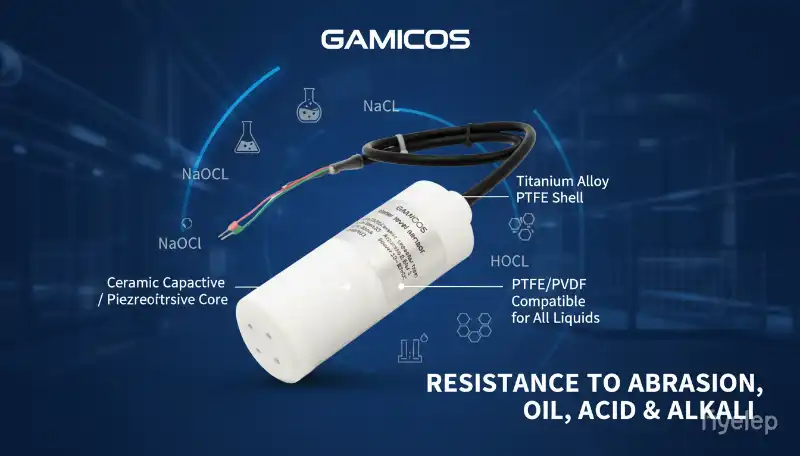
Chemical contact speeds up the breakdown of tools. Metals, plastics, and elastomers are all attacked in different ways by strong acids, acidic bases, oxidizers, and solvents. When a sensor breaks too soon, it doesn't just need to be replaced; it also leaves a hole in monitoring systems that might not be noticed until there is a safety event. Submersible pressure sensors deal with this by using materials that were made to work well in acidic conditions. PTFE housings can stand up to almost all industrial poisons and still keep their shape. Extreme pH levels don't affect ceramic sensor elements, so they don't shift or break down. Specialized cables have acid- and alkali-resistant resins that stop chemicals from getting into the core of the wire, which is a common way for standard designs to fail.
This way of building can be seen in the GLT570 corrosion-resistant submersible liquid level monitor. Its PTFE shell and ceramic core from well-known companies around the world work together to protect against corrosion in tough media. The adjustable emitter circuit makes it simple to calibrate the field and change the zero/full-scale without taking the sensor out of service. Customized vented cables—set up for resistance to wear, oil, or acid-alkali based on the field conditions—ensure long-term dependability in places where standard tools break down in months.
Precision and Stability Under Pressure
Chemical processes need measurements that are very accurate, which can't always be achieved with standard means. Errors are made because of changes in temperature, density, and placement limitations, which add up over production cycles. These problems can be solved by submersible pressure sensors, which use direct measurement methods that automatically account for many external factors.
High-precision sensors can measure things accurately to within ±0.25% of full scale, and they are stable over time so they don't need to be calibrated as often. This level of accuracy helps with process improvement efforts that cut down on wasted raw materials, stop batch rejects, and raise the quality of the finished product. Devices like the GLT570 use foreign core technology and programmable control circuits to make sure they provide accurate, drift-free data over long service times. This helps meet goals for both safety and production efficiency.
Selecting the Right Submersible Pressure Sensor for Chemical Tank Safety
Evaluating Sensor Technologies
Because they are very accurate, can work with a wide range of pressures, and can send different types of signals, piezoresistive sensors are the most common type used in industry. These tools use metal or silicon film strain gauges whose electrical resistance changes when pressure is put on them. Other options are capacitive sensors, which check for changes in capacitance between plates caused by pressure, and ceramic sensors, which use the piezoelectric qualities of some types of ceramics.
When used in chemical service, ceramic-based submersible pressure sensors are especially useful. When compared to silicon-based electronics, they can handle higher temperatures, fight corrosion better, and keep their calibration for longer. The GLT570's ceramic core shows these benefits, allowing accurate measurements in acidic gases and liquids where other sensors would fail quickly.
Output Options and System Integration
People still like analog outputs, which are usually 4-20mA current loops, because they're easy to use, stable, and work with old control systems. The sensor is powered by the current output itself, so there is no need for separate power cables. The two-wire design makes it easier to fix problems and lowers the cost of installation. Digital protocols, such as HART, Modbus, or Profibus, make it possible to diagnose problems, set up devices remotely, and send data with better clarity. These features are helpful for complicated installations where centralized tracking and planned repair plans are worth the extra money. Professionals in procurement should check to see if the current automation system supports digital messaging and if operational staff have the skills to make the most of advanced features.
Chemical Compatibility Considerations
Not a single type of sensor material can stand up to all poisons evenly. For each drug that is being stored, engineers have to find the right housing materials, diaphragm materials, and wire jackets. PTFE is more expensive than stainless steel, but it works with a lot of different things. Hastelloy is better than regular stainless steel at resisting acids and chlorides. Viton seals survive hydrocarbons but weaken in ketones. To help with these decisions, companies like GAMICOS offer thorough chemical compatibility charts and application engineering support. The PTFE shell of the GLT570 can handle strong media in sewer, chemical processing, pharmaceutical, and other areas where many corrosive substances may be present. This versatility simplifies inventory management for sites running diverse processes.
Customization and Needs of OEM
Catalog goods for a submersible pressure sensor can be used for many things, but for unique installations, they often need to be customized. For process fittings, you might need special thread types or flange shapes. The length of the cables must match the depth of the tanks plus the distances to the switch boxes. To match specific gravity and measurement lengths, output ranges need to be scaled. Customization options are very important to OEM clients and system developers. Private labeling, changed packaging, pre-configured settings, and specialty documents help them place their brand and cut down on the work needed to integrate. GAMICOS provides full OEM and ODM services that meet these needs while upholding the quality standards and delivering products reliably that long-term relationships need.
Installation, Calibration, and Maintenance Best Practices
Proper Installation Techniques
Sensor placement has a big effect on how accurate measurements are and how long the sensor lasts. If you mount it too close to the bottom of the tank, you'll see changes in pressure caused by sediment instead of the real level of the liquid. When sensors are put in close to inlet pipes, they are exposed to movement and mechanical impact. In the right way, sensors should be placed away from fill streams, agitators, and drain exits. They are usually mounted on standpipes or weighted wires that stay upright.
Cable control keeps things from breaking down too soon. Sharp bends put stress on the links between the conductors; UV light breaks down the materials in the jacket; and chemical splashes damage the wire where it leaves the liquid surface. Installation should include strain relief, safe conduit through splash zones, and the right route to keep the mechanical parts from getting damaged by repair work or car traffic. Venting capillary integrity needs to be taken very seriously. If water or chemicals get into this tube, they change the pressure reference, which leads to measurement mistakes that get worse over time. Good sensors have protection filters and desiccants built in, but the way they are installed must be done so that cables don't get damaged and junction box seals stay in place.
Calibration Protocols and Field Adjustments
Even high-quality sensors need to be calibrated the first time they are used to account for how they were installed. Zero adjustment takes into account where the sensor is in relation to the point of measurement that is wanted. The span adjustment changes the flow to match the height and density of the liquid in the tank. Modern gadgets like the GLT570 have customizable transmitter circuits that make these changes easier. This means that techs can finish calibrating using handheld communications without taking the sensors off.
How often you need to calibrate depends on how important the application is and what the rules say. For custody transfer and safety-critical uses, proof may need to be done every three months. Monitoring that isn't as important might be done once a year. Drift rates depend on the type of sensor used, the temperature range it can work in, and how much chemical contact it has. In harsh conditions, ceramic-based sensors usually have less drift than silicon-based devices, which means that correction times can be longer.
Documentation techniques help with solving and following the rules. By keeping track of the times of calibrations, the changes that were made, and the measurements that were used for verification, you can create an audit trail that shows you are following the rules and help you spot slow loss of accuracy before it drops below acceptable levels.
Maintenance Strategies That Extend Service Life
Inspections done on a regular basis find problems before they get bad enough to cause crashes. Visual checks look for damage to the cables, cracks in the case, or strange deposits. By comparing present readings to past trends, we can see drift that may need to be fixed by recalibrating or replacing sensors. Monitoring the stability of the output signal finds links that don't work all the time or electrical wear and tear. The way sensors are cleaned has to match the chemicals of the process. For some systems, removing them and cleaning them with ultrasonic waves on a regular basis works well. For others, chemical washing or steam cleaning is needed. Cleaning with rough materials hurts sensitive sensor diaphragms, and using the wrong solvents can damage housing materials or wire jackets.
Schedules for preventive maintenance weigh the costs of inspections against the chances of failure. Critical apps need to be checked on more often, while backup setups can go longer between checks. Optimal repair frequency depends on how many spare sensors are available, how long it takes for sellers to turn around orders, and how long it takes to buy things. When facilities build long-term partnerships with responsive submersible pressure sensor makers like GAMICOS, they have more options for handling their inventory and meeting emergency repair needs.
Case Studies and Real-World Benefits of Submersible Pressure Sensors in Chemical Tanks
Preventing Overpressure Incidents at Scale
A big chemical company that stored concentrated sulfuric acid in several tanks kept running into overfill problems when moving rail cars. External level switches weren't stable because of coating growth, and constant supervision by hand wasn't possible. They used submersible pressure sensors that had two alarm setpoints: one for warning at 85% capacity and another for shutting down in case of an emergency at 95%. The monitors were built right into the plant's distributed control system, so when limits were hit, the transfer pumps would stop on their own.
The results were shocking. During its three years of use, the system stopped twelve possible overfills, which kept the environment safe and avoided the fines that would have been given by regulators. Maintenance costs went down because the sensors only needed to be calibrated once a year instead of having the failed external switches cleaned every month. By getting rid of the need for human tracking during dangerous transfer operations, worker safety went up.
Reducing Downtime Through Predictive Monitoring
A company that supplied medicine ingredients had old storage tanks that were hard to keep an eye on for rust. In the past, checking thickness meant going into a small area, following a lot of safety rules, and stopping production. The facility put in submersible pressure sensors that can measure both the amount of the water and the pressure inside the building. By looking at how the pressure changed over time, we found early signs of leaks: small drops in pressure during times when the temperature stayed the same showed problems with the stability.
This method of prediction allowed for planned repair instead of responding to emergencies. Over the course of five years, the tracking system found four tanks that needed to be fixed. The fixes were done during timed outages. Not having to shut down for emergencies saved about $2.3 million in lost work time. Better tracking also helped show that regulations were followed, which improved ties with oversight agencies and customers who do supplier checks.
Optimizing Inventory Management and Logistics
A bulk chemical dealer who was in charge of dozens of storage tanks had a hard time keeping track of their supplies. Periodic readings done by hand couldn't show how the flow changed across all of their sites. They put networked submersible pressure sensors all over their tank farms and put the data into business resource planning tools so that they could see their supplies in real time.
With constant tracking, measurement accuracy went from ±5% when done by hand to ±0.5%. Just-in-time supply schedule was made possible by better data, which cut working capital held up in extra inventory by 22%. Customer service got better when arrival times were promised accurately based on the real state of the tanks instead of guesses. The ROI estimate showed that the money would be paid back in eighteen months, mostly through lower inventory and better logistics rather than direct safety gains.
Conclusion
Submersible pressure sensor technology changes chemical tank safety from tracking that happens after the fact to managing risks before they happen. These gadgets give modern factories the accurate, constant measurement data they need, solving the basic problem of keeping an eye on things that can't be seen directly. New materials, such as PTFE housings and ceramic sensing elements, make it possible for instruments to work in conditions that normally destroy them. At the same time, improved electronics make it possible for safety-critical applications to need precision and stability.
The business case is more than just following the rules. Implementations in the real world show measurable gains in avoiding incidents, improving working efficiency, lowering upkeep costs, and making the best use of inventory. Chemical processing industries are under more and more pressure to improve both safety and working efficiency. This makes the strategic value of reliable pressure measurement infrastructure even clearer.
Frequently Asked Questions
Questions people ask often about chemical tank monitoring.
What distinguishes submersible sensors from hydrostatic level sensors?
While the terms are often used interchangeably, "submersible pressure sensors" refer to devices that are made to be completely submerged, with strong housings and electronics that can handle being submerged for a long time. Hydrostatic level sensors use pressure to figure out the level, but they could also be non-submersible models that are fixed at the bottom of tanks and have their diaphragms visible to the process media.
How often do these sensors require maintenance in chemical service?
How often maintenance needs to be done depends a lot on the chemicals, temps, and how important they are. Corrosive services that use sensors made of the right materials, like the GLT570's PTFE and ceramic construction, usually only need to be calibrated once a year. Applications that aren't as pushy might be able to go to biannual plans. Visual checks every three to six months help find problems early on, before they get bad enough to affect the accuracy of measurements.
Can submersible sensors be customized for unique chemical applications?
You can change the housing material, process links, cable specs, output setups, and measurement ranges, among other things. Manufacturers that offer OEM services can change standard designs or make completely unique solutions for unique needs. Venting wires that can be changed and programmable circuits in gadgets like the GLT570 show how flexible they are for different field situations and integration needs.
Partner With GAMICOS for Superior Chemical Tank Monitoring Solutions
To meet the complicated needs of chemical tank safety, you need to do more than just buy tools. You need to work with a submersible pressure sensor provider that is dedicated to understanding your unique problems. GAMICOS has 20 years of experience in measurement technology and full research and development (R&D) skills, so it can provide solutions that are perfectly suited to harsh, high-stakes settings. This is shown by our GLT570 series: PTFE housings are resistant to almost all industrial chemicals, foreign ceramic cores ensure long-term accuracy, and different fitting needs can be met by changing the wire configurations.
Our engineering team works together with procurement managers, project engineers, and automation experts to come up with the best setups, make sure that everything works together smoothly, and offer ongoing technical support for the whole duration of a product. Because we can do both OEM and ODM, we can offer private labeling, custom packaging, and specialized paperwork that helps you reach your business and practical goals. Get in touch with us at info@gamicos.com to talk about your chemical tank tracking needs and find out how our experience in the pharmaceutical, petrochemical, and wastewater industries can help you improve your safety and business performance.
References
1. Miller, R. W. (2019). Industrial Pressure Measurement: Technologies and Applications in Chemical Processing. Technical Publishing International.
2. Chen, Y., & Rodriguez, M. (2021). "Corrosion-Resistant Materials for Submersible Sensors in Aggressive Chemical Environments," Journal of Industrial Instrumentation, 45(3), 287-301.
3. Thompson, K. L. (2020). Process Safety Management in Chemical Storage Facilities. American Institute of Chemical Engineers.
4. International Society of Automation. (2022). ISA-12.27.01: Requirements for Process Sealing Between Electrical Systems and Flammable or Combustible Process Fluids. ISA Standards.
5. Weber, H., & Patel, S. (2018). "Hydrostatic Level Measurement: Accuracy Considerations and Calibration Protocols," Instrumentation and Control Engineering Review, 12(4), 156-172.
6. National Fire Protection Association. (2021). NFPA 30: Flammable and Combustible Liquids Code – Tank Monitoring Requirements. NFPA Publications.

Halen
With over 12 years of experience in fluid sensing technology, Halen specializes in helping clients select and optimize oil level sensors for a wide range of industries—including automotive, marine, heavy machinery, and energy.
We're here to help — submit your request anytime!
Let us know how we can help solve your pressure level measurement challenge.
_1757930850792.jpg)
Recommended Blog
How Submersible Level Sensors Monitor Corrosive Liquids
Benefits of Using Submersible Diesel Level Sensors in Fuel Tanks
Smart Fuel Tank Monitoring Using Submersible Diesel Level Sensors
How Submersible Level Sensors Monitor Corrosive Liquids
Benefits of Using Submersible Diesel Level Sensors in Fuel Tanks
Smart Fuel Tank Monitoring Using Submersible Diesel Level Sensors
How Submersible Level Sensors Monitor Corrosive Liquids
Benefits of Using Submersible Diesel Level Sensors in Fuel Tanks
Smart Fuel Tank Monitoring Using Submersible Diesel Level Sensors
How Submersible Level Sensors Monitor Corrosive Liquids
Benefits of Using Submersible Diesel Level Sensors in Fuel Tanks
Smart Fuel Tank Monitoring Using Submersible Diesel Level Sensors
How Submersible Level Sensors Monitor Corrosive Liquids
Benefits of Using Submersible Diesel Level Sensors in Fuel Tanks