Benefits of Continuous Level Monitoring in Power Plants
Understanding Continuous Level Monitoring in Power Plants
- Understanding Continuous Level Monitoring in Power Plants
- Key Benefits of Continuous Level Monitoring in Power Plants
- Selecting the Right Industrial Water Level Sensor for Power Plants
- Practical Applications and Case Studies in Power Plants
- Maintenance, Troubleshooting, and Future Trends
- Conclusion
- FAQ
- Partner with GAMICOS for Proven Level Monitoring Solutions
- References
Continuous level monitoring changes how power plants work by providing accurate measurement data that is available all the time. This protects important processes and increases efficiency. By using high-tech industrial water level sensors like ultrasonic devices, radar units, submersible pressure sensors, and capacitive transducers, power plants can see what's going on in the water systems that run engines, cool equipment, and keep steam cycles going. This proactive method gets rid of the guessing and delays that come with manual checks. It also lowers the risk of catastrophic overflow or dry-run situations and makes sure that stricter safety and environmental rules are followed.
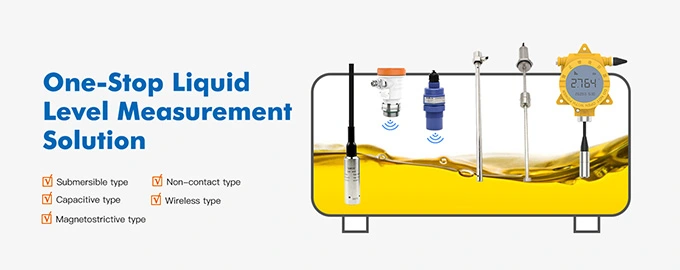
Understanding Continuous Level Monitoring in Power Plants
Power companies need to be able to accurately measure the water in their feedwater systems, cooling basins, boiler drums, and condensate tanks. When checks are done by hand, there are gaps in the data that leave workers open to sudden changes in level that could damage expensive turbines or stop the production of energy.
How Industrial Water Level Sensors Enable Real-Time Visibility
Modern sensors constantly measure the height of the water and send the information to control rooms, where workers watch for trends and act right away when they see them. Submersible pressure monitors, such as the GLT500 series, sit at the bottom of tanks and record hydrostatic pressure. They then turn this information into accurate level readings that are not affected by foam or turbulence on the top.
These sensors have silicon piezoresistive cores that can automatically adjust for temperature, digital adjustment that can be programmed, and sealed circuit technology that can work in tough conditions. The building of stainless steel protects against rust caused by high-temperature water, chemicals, and mineral deposits that are common in power plants.

Why Continuous Monitoring Outperforms Manual Methods
When gauges are checked by hand at set times, they miss sudden changes that could be caused by high demand or broken equipment. Continuous systems can pick up on changes in milliseconds and sound alarms before levels get too high. This feature keeps equipment from getting damaged, saves expensive emergency shutdowns, and helps with predictive maintenance plans that make assets last longer. Regulatory groups expect power plants to correctly record how much water they use and how much they dump. Automated devices make records with timestamps that make compliance reports easier and make administration easier.
Key Benefits of Continuous Level Monitoring in Power Plants
Uninterrupted level tracking leads to measurable gains in cost management, safety, and efficiency. Plant workers have more faith in the system's dependability, and procurement managers see long-term value in lower repair costs and longer equipment life.
Real-Time Operational Insights Prevent Equipment Failures
Instant data access lets people in the control room spot strange patterns, like level drops that happen over time to show leaks or quick rises that show valve failures, before they become problems. Turbine cavitation, boiler tube burning, and pump damage that could stop power production for days can be avoided by taking action. Standard industrial signals can be sent out by the GLT500 underwater sensor. These signals can be used with SCADA systems, DCS platforms, and wireless IoT networks. Integration with current infrastructure needs very little downtime, which means that plants can improve their tracking without stopping activities.
Superior Accuracy and Reliability Minimize Human Error
Manual readings depend on how well the user is paying attention, how bright it is, and how easy it is to get to the measurement places. When reliable data is most needed, like when shifts change, bad weather hits, or people are under a lot of stress, the rate of human mistake goes up. With automated devices, these factors don't matter, so the accuracy is always the same, no matter what the outside conditions are. Multi-layer safety structures, industrial water level sensor, and anti-clogging liquid entry designs make sure that sensors work consistently in water that is dirty with sediment, algae, or mineral scale.
Early Detection Lowers Maintenance Costs and Extends Equipment Lifespan
Continuous tracking finds sensor drift over time, calibration issues, or patterns of mechanical wear that would be missed by checks that are only done every so often. Fixing small problems during routine maintenance keeps bigger problems from happening, which would require emergency fixes, extra work, and faster part orders.
Temperature compensation units keep data accurate even when water temperature changes throughout the day without having to be re-calibrated by hand. This trait is especially useful in boiler feedwater systems where temperatures change a lot. Industry studies from the Electric Power Research Institute show that plants with continuous level systems have 30–40% fewer unexpected repair events and 20–25 % less downtime due to water.
Selecting the Right Industrial Water Level Sensor for Power Plants
To pick the right measurement tool, you need to know about the needs of the application, the challenges of the surroundings, and the needs for integration. Power plants have special situations like high temperatures, changing pressures, chemical exposure, and strict safety rules that need special sensor designs.
Critical Selection Factors for Harsh Environments
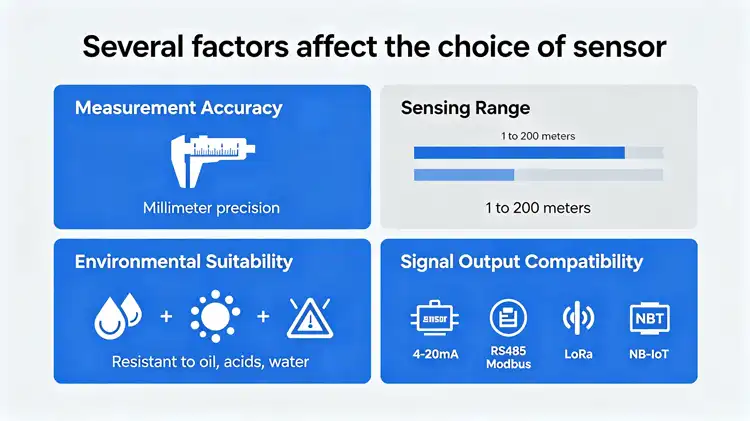
Several factors affect the choice of sensor:
- Measurement Accuracy: Millimeter-level accuracy is needed to keep the quality of the steam and avoid heat stress in processes that make electricity. Pressure-based monitors are accurate to within 0.25% of full scale, which makes them good for controlling boiler drums where mistakes could lower the efficiency of turbines.
- Sensing Range: Cooling water tanks may be deeper than 20 meters, so sensors that can measure over a wider range are needed. With ranges that can be changed from 1 to 200 meters, the GLT500 series can work with a wide range of tank shapes without the need for multiple types of sensors.
- Environmental Suitability: High-strength vented wires can handle oil, acids, alkalis, and wear from particles in the air. Fully waterproof sealed circuits keep working even when they are submerged or cleaned.
- Signal Output Compatibility: Sensors that offer this output are good for plants that use 4-20mA analog signals. On the other hand, plants that are going digital may prefer RS485 Modbus or wireless protocols like LoRa and NB-IoT for remote tracking.
Understanding Technology Differences
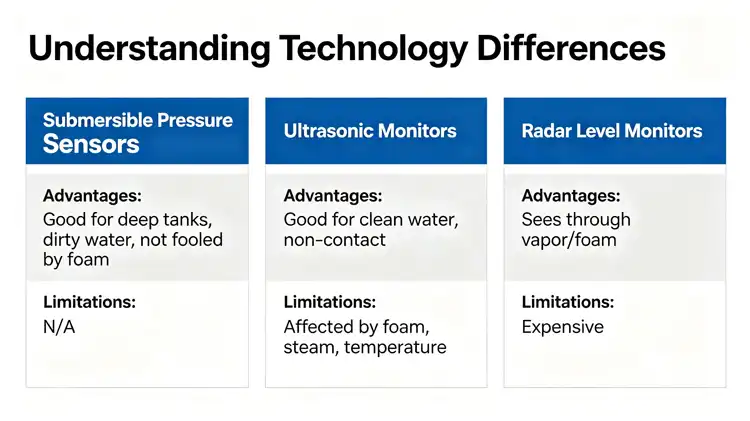
Different types of sensors are better for different tasks:
- Submersible pressure sensors work great in deep tanks, dirty water, and situations where they don't need to be mounted on the surface. Because they measure the weight of the water column instead of its place on the surface, they can't be fooled by foam or mist, which can happen with ultrasonic devices.
- Ultrasonic monitors are good for measuring things in clean water without touching them, so they don't get dirty. But chemicals that make foam, steam conditions, or very high or low temperatures make them less useful in power plants.
- Radar level monitors can see through vapor and foam, but they are much more expensive than options that use pressure. They work well for specific tasks, like tracking off-gas in closed systems.
Installation and Calibration Best Practices
When sensors are installed correctly, they work better and last longer. When putting underwater units like the industrial water level sensor in place, stay away from rough areas near the inlet pipes, where water movement can give you wrong numbers. Secure wires with strain relief to keep damage from happening from vibrations.
The first step in calibration is to measure the real size of the tank, set the zero and span points, and make sure that the output signals match what the control system expects. The working range should be reflected in the temperature compensation settings, from normal temperatures during startup to the highest temperatures during peak output. Regular checks every six months make sure that the accuracy stays within the limits. It only takes minutes to do simple two-point checks against reference gauges, but they keep process control from being compromised by slow shift.
Practical Applications and Case Studies in Power Plants
Several problems that power plants face can be solved with continuous level tracking. Knowing specific use cases helps tech managers figure out where the best returns on investment are for upgrading sensors.
Boiler Drum Level Control
Keeping the water levels in boiler drums just right keeps tubes from getting too hot and stops overflow that hurts turbines. Even small changes in the level can cause automatic shutdowns that waste energy and cost a lot of money every hour. Installing submersible pressure monitors in the lower drum connections makes readings accurate even when there is two-phase flow. Because they respond quickly, feedwater control systems can change flow rates in a matter of seconds, keeping levels at the right level even when the load changes.
Cooling Water Reservoir Management
Large pools of cold water smooth out changes in the supply and act as backups in case a pump fails. Continuous tracking makes sure that there is always enough volume and finds leaks that waste treated water and raise costs. A coal plant in the Midwest switched from doing manual checks once a week to using the GLT500 system for constant tracking. They found a slow leak that was leaking 500 gallons of water every day. Fixing the leak saved $18,000 a year in water treatment costs and cut down on environmental discharge violations.
Condensate Tank Monitoring
Using less freshwater and releasing less garbage is possible with condensate recovery systems that collect steam condensate and reuse it. Level monitors control how the condensate pump works so that the tank doesn't overflow or run dry, which can damage the pump seals. With wireless sensor choices, there are no more cable runs across plant floors, which makes repair projects easier to install. NB-IoT-enabled battery-powered units send data to cloud platforms that mobile devices can access. This lets operators keep an eye on multiple tanks from anywhere.
Return on Investment Documentation
Plants that use thorough continuous monitoring, such as with an industrial water level sensor, say they get real benefits in addition to not having to deal with downtime. Tracking how much water is used helps find processes that aren't working as well as they could. As pump spinning improves efficiency, energy use goes down, and regulatory compliance paperwork is done automatically instead of by hand. After putting 20 continuous level monitors in important water systems, a 500MW combined-cycle plant saved $120,000 a year. Savings from less upkeep work, fewer emergency fixes, less water sales, and lower fees for discharge.
Maintenance, Troubleshooting, and Future Trends
To keep a sensor's accuracy over years of use, it needs regular upkeep and knowledge of how it usually breaks down. As power plants adopt smart monitoring methods, new technologies offer even more power.
Routine Maintenance Procedures
In a normal power plant, well-maintained sensors work consistently for five to seven years. The following should be on maintenance schedules:
- Quarterly Inspections: visual checks make sure the wires are still connected, the fixing hardware is still in place, and there is no damage to the hardware. Look at the trends in the data for any strange patterns that could mean there are problems with the sensors.
- Semi-Annual Cleaning: Every six months, clean the sensors out of the tanks and flush out the deposits using the right fluids. Unlike fragile clay or polymer sensors, stainless steel design lets you clean it harshly without damage.
- Annual Calibration Verification: Check the sensor outputs against standard readings once a year as part of the annual calibration process. Units that show movement greater than 0.5% of span should be re-calibrated.
By following these simple steps, you can keep measurements accurate, which is important for good process control, and most sensor problems will be avoided.
Common Troubleshooting Scenarios
Systematic tests find the reasons why sensors give wrong results or stop working when they do:
- Sensor Drift: Loss of accuracy over time is usually caused by pressure port clogs or old electrical parts. In 80% of cases, cleaning and recalibration bring back function.
- Signal Interference: Electromagnetic noise from motors or drives close by can mess up analog outputs. If you ground your wires properly, shield them, and route them away from power lines, you won't have any interference.
- Cable Damage: Insulation fails because of wear and tear, chemical attack, or mechanical stress. Replacing the cable brings back the sensor's functionality without replacing the whole unit, which lowers the cost of repair.
Future Innovations Transforming Level Monitoring
As technology changes quickly, it opens up new possibilities that change what continuous tracking can do:
- IoT Platform Integration: Cloud-based tracking collects data from hundreds of sensors in many plants, allowing analysis and benchmarking at the company level. Remote access helps centralized tech teams serve sites that are spread out.
- AI-Driven Predictive Maintenance: Patterns in sensor data are analyzed by machine learning algorithms, which can tell weeks in advance when something will break. This feature goes beyond the devices themselves and includes the equipment they watch over. This changes the way repair plans are made forever.
- Advanced Sensor Materials: New covering technologies make it harder for dirt and grime to stick to sensors, so they don't need to be cleaned as often. Miniaturized electronics make sensors smaller while also making them more accurate and letting them connect wirelessly.
Conclusion
In conclusion, using a modern industrial water level sensor for continuous level tracking changes power plant operations from being reactive to being proactive. This stops costly failures and makes the best use of water and energy. Power generation needs submersible pressure sensors like the GLT500 series to be accurate, reliable, and resistant to the environment. These sensors can be used in a wide range of places, from boiler drums to cooling tanks.
Choosing the right sensors, installing them correctly, and keeping them in good shape will ensure years of reliable service. New IoT and AI technologies offer even more possibilities. Investing in proven continuous monitoring solutions is a smart move for sourcing managers, engineering teams, and plant workers who are committed to operational excellence. It improves safety, cuts costs, and supports long-term power generation for decades to come.
FAQ
How does continuous level monitoring enhance safety in power plants?
Continuous tracking lets you know right away what the water level is doing in all of your important systems, so you can act right away if something goes wrong before it puts people or machines at risk. When levels get close to dangerous levels, automated alarms let workers know. This sets off safety measures like shutting down pumps or activating emergency feedwater. This real-time protection stops boiler explosions caused by low water levels, cooling system failures that could overheat generators, and chemical spills from tank overflows—dangers that would be missed by human tracking when checks aren't done for a while.
What distinguishes continuous monitoring from discrete level measurement?
Continuous devices constantly measure and report the height of the water, making detailed trend data that shows both slow and rapid changes. Discrete methods, such as float switches or hand gauges, only show snapshots of the system at certain points in time and levels. They don't show the whole picture of how the system works. Continuous data makes it possible to do complex process control, predictive maintenance analytics, and regulatory compliance paperwork that would not be possible with discrete measures. The finer-grained data helps workers figure out why a process went wrong or a piece of equipment broke when they are looking.
Can sensors adapt to specific power plant environmental challenges?
Modern industrial water level sensors can be easily changed to fit the needs of each business. High-temperature rates work well for boiler feedwater, corrosion-resistant materials can handle chemically treated cooling water, and ruggedized wires don't get worn down in places with a lot of sediment. Manufacturers offer unique designs that match the measurement ranges, signal outputs, mounting styles, and safety grades to the needs of the application. This adaptability makes sure that the system works at its best whether sensors are watching clean vapor, makeup water that is high in minerals, or dirty blowdown streams.
Partner with GAMICOS for Proven Level Monitoring Solutions
Industrial-grade pressure and level measurement technology from GAMICOS is used by power plants in North America, Europe, and Asia. In our GLT500 submersible water level monitor, silicon piezoresistive accuracy is combined with stainless steel durability. It also comes in a variety of forms that can be changed to fit your unique needs. Our sensors give accurate data even in the harshest power plant settings thanks to their automatic temperature compensation, multiple signal output choices, and designs that keep them from getting clogged.
We know that procurement managers need providers who can respond quickly and give technical knowledge, uniform quality, and reliable delivery dates. Our ISO-certified production makes sure that every sensor meets international standards, and our engineering team helps with applications from the time they are chosen until they are installed and turned on. We have been making industrial water level sensors for over 20 years and have customers in over 100 countries. We offer flexible OEM and ODM services that help wholesalers and system developers give their customers full solutions.
Get in touch with us at info@gamicos.com to talk about the problems you're having with watching your power plant and find out how GAMICOS sensors can help improve safety, cut down on downtime, and make operations more efficient through proven continuous level monitoring technology.
References
1. Smith, J.R., & Anderson, T.M. (2021). Advanced Level Measurement Technologies for Thermal Power Plants. International Journal of Industrial Automation, 45(3), 127-145.
2. Wilson, K.P. (2020). Continuous Monitoring Systems in Energy Generation: Safety and Efficiency Improvements. Power Engineering Technology Press.
3. Electric Power Research Institute. (2022). Water Management Best Practices for Modern Power Generation Facilities. Technical Report 3002-019456.
4. Roberts, D.L., & Chen, H.Q. (2019). Sensor Selection and Installation Guidelines for Boiler Drum Level Control. ASME Journal of Engineering for Power, 141(8), 081302.
5. National Fire Protection Association. (2023). NFPA 85: Boiler and Combustion Systems Hazards Code. Quincy, MA: NFPA Publications.
6. Thompson, A.S., Martinez, L.F., & Kumar, R. (2021). Predictive Maintenance Strategies Using IoT-Enabled Level Sensors in Power Plants. Sensors and Actuators B: Chemical, 328, 129047.

Peter
Peter, Senior Sensor Technology Consultant, has 15-year industrial sensor R&D experience. He specializes in the end-to-end development of high-accuracy pressure and level sensors and he firmly believe, precision isn’t just a spec—it’s a promise.
We're here to help — submit your request anytime!
Let us know how we can help solve your pressure level measurement challenge.
_1757930850792.jpg)
Recommended Blog
Diesel Level Sensor Solutions for Fuel Tanks in Global Markets
Diesel Level Sensor Solutions for Fuel Tanks in Global Markets
Diesel Level Sensor Solutions for Fuel Tanks in Global Markets
How Diesel Level Sensors Improve Accuracy in Fuel Tank Monitoring
How Diesel Level Sensors Improve Accuracy in Fuel Tank Monitoring
How Diesel Level Sensors Improve Accuracy in Fuel Tank Monitoring
How Diesel Level Sensors Improve Accuracy in Fuel Tank Monitoring