Voltage vs Current Output Pressure Transmitters: Which Is Best?
Introduction
- Introduction
- Understanding Pressure Transmitter Output Types
- Key Factors to Consider When Choosing Between Voltage and Current Output
- Comparative Analysis: Voltage vs Current Output Pressure Transmitters
- Installation and Calibration Best Practices for Both Output Types
- Conclusion
- FAQ
- Partner with GAMICOS for Premium Pressure Transmitter Solutions
- References
For the majority of industrial applications, current output (4–20mA) pressure transmitters are the better option when comparing voltage and current output pressure transmitters. Longer transmission ranges, superior signal integrity in challenging conditions, and outstanding noise immunity are all provided by current signals. Current output transmitters provide the dependability and durability necessary for crucial process control systems in the chemical, pharmaceutical, and energy sectors, while voltage outputs (0–10V) can be more appropriate for short-distance, cost-sensitive applications with little electrical interference.

Introduction
The foundation of contemporary industrial process control is provided by pressure transmitters, which provide vital pressure data that guarantees operational safety, effectiveness, and regulatory compliance. These advanced instruments translate physical pressure readings into electronic signals that can be deciphered and used by control systems. A crucial option that affects system dependability, installation costs, and ongoing maintenance needs is between voltage and current output signals.
There is growing demand on OEM partners, engineering experts, and procurement managers to choose measuring systems that minimize total cost of ownership while providing reliable performance. Transmission dependability, environmental resilience, and integration difficulty with current control infrastructure are all directly impacted by the kind of signal output. Making decisions that are in line with particular application requirements and operational restrictions is made possible by having a thorough understanding of these technological intricacies.
Industrial settings provide particular difficulties, such as temperature swings, moisture exposure, and electromagnetic interference, all of which might jeopardize signal integrity. How well the pressure measuring system maintains accuracy under these challenging circumstances depends on the output signal format. Stakeholders may improve system integration results and optimize their procurement strategies by looking at the performance characteristics and operational principles of both voltage and current output technologies.
Understanding Pressure Transmitter Output Types
Using specialized sensor components and signal conditioning circuits, pressure measurement technology transforms mechanical force into electrical signals. This technique is shown by the GAMICOS GPT200 general pressure transmitter, which uses a diffused silicon pressure sensor with integrated processing circuitry to transform millivolt signals into outputs of standardized voltage and current. This advanced method maintains remarkable signal quality while allowing direct connection to computers, control devices, and display systems.
Voltage Output Characteristics
Depending on the needs of the system, some applications use 0-5V signals; however, pressure transmitter voltage output transmitters normally work in the 0-10V DC range. With the output voltage linearly matching to the measured pressure value, these devices provide electrical potential variations proportionate to applied pressure. The sensor's millivolt output is amplified to practical voltage levels by the signal conditioning electronics, which also provide linearization and temperature adjustment.
Lower power consumption and less complicated interface requirements with certain data collecting systems are two benefits of voltage signals. However, especially over long distances, voltage signals are vulnerable to electrical noise and voltage decreases across transmission lines. This feature reduces their efficiency in industrial settings where motors, drives, and switching equipment cause a lot of electromagnetic interference.
Current Output Technology
The industry-standard 4-20mA signal format is used by current output transmitters, with 20mA denoting the highest pressure measurement and 4mA denoting the minimum. This live-zero setup has built-in fault detection capabilities since signal levels below 4mA are indicative of transmitter malfunctions, power supply difficulties, or wiring concerns. The micro amplifier technology of the GAMICOS GPT200 guarantees accurate current signal production with remarkable stability and minimal drift characteristics.
Because current signals retain their integrity in the face of electromagnetic interference and wire resistance, they exhibit greater noise immunity. Since the signal flows as a current loop, it is mostly impervious to electrical noise and voltage dips, which often impact voltage-based systems. Current output transmitters are the recommended option for demanding industrial settings and long-distance signal transmission applications because of their resilience.
Key Factors to Consider When Choosing Between Voltage and Current Output
Selecting the optimal output format requires careful evaluation of multiple technical and operational parameters that influence system performance and lifecycle costs. The decision impacts not only initial equipment procurement but also installation complexity, maintenance requirements, and long-term reliability.
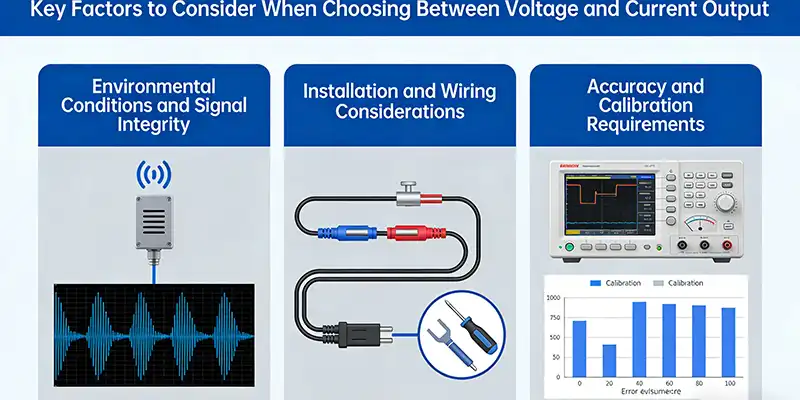
Environmental Conditions and Signal Integrity
The difficult electromagnetic conditions found in industrial facilities may have a big influence on measurement accuracy. Because of their intrinsic signal stability and noise immunity, current output transmitters perform very well in these circumstances. Even with variable frequency motors, welding equipment, and high-power electrical systems that produce significant electromagnetic interference, the 4-20mA current loop preserves signal integrity.
Grounding plans, shielding specifications, and transmission distance restrictions must all be carefully taken into account when dealing with voltage signals. Voltage outputs may be effectively used in applications with low electrical noise and short transmission lengths, especially where cost concerns exceed the possible dangers of signal deterioration. Even in generally safe settings, present signals' dependability benefits often make their adoption justifiable.
Installation and Wiring Considerations
Transmission distance is a crucial consideration when choosing an output because, although current signals remain accurate over moderate transmission distances, voltage signals deteriorate over long cable lengths. Pressure transmitter current loops provide for flexible transmitter placement and centralized control room installations since they can consistently carry signals across thousands of feet with no signal loss.
Both output kinds may be installed with freedom thanks to the GAMICOS GPT200's 316L stainless steel isolation diaphragm structure and range of electrical interface choices. In addition to enabling OEM customization needs, the lightweight and compact form makes installation simple. These capabilities solve typical procurement issues with system integration and installation difficulty.
Accuracy and Calibration Requirements
When implemented correctly, both output types may achieve good accuracy; nevertheless, current signals provide better calibration retention and long-term stability. Current loops' intrinsic properties provide superior resistance to drift brought on by age, temperature changes, and humidity influences. Over the course of the transmitter's operation, this stability results in longer calibration intervals and lower maintenance expenses.
More frequent calibration verification and modification may be necessary for voltage output systems, especially in applications that experience extensive temperature cycling or are exposed to corrosive atmospheres. When assessing output alternatives for long-term deployments, the increased maintenance needs have to be taken into account when calculating the total cost of ownership.
Comparative Analysis: Voltage vs Current Output Pressure Transmitters
Real-world performance data from chemical processing, power generation, and manufacturing applications demonstrates clear performance differences between voltage and current output technologies. These case studies provide valuable insights into practical considerations that influence procurement decisions and operational outcomes.
Chemical Industry Applications
Signal reliability has a direct influence on safety and production efficiency in chemical processing plants, which run pressure monitoring systems in very corrosive and electrically loud environments. A significant petrochemical complex reported a 75% decrease in false alarms and maintenance calls after switching from outdated voltage-output transmitters to current-output devices. Prior to the enhanced signal stability, nuisance trips that caused production halts and safety system activations were removed.
The benefits of contemporary current-output designs are shown by the GAMICOS GPT200's high-performance dedicated circuitry and piezoresistive pressure sensor technology. In challenging chemical applications where measurement failure might have major repercussions, dependable performance is ensured by the thorough testing procedure that includes cyclic loading, aging, and environmental simulation.
Power Generation Sector Experience
For vital safety systems and operational management, utility firms running nuclear and fossil fuel power plants depend on pressure monitoring. Because current output transmitters have better signal dependability and electromagnetic immunity, they often perform better in certain applications than voltage devices. For safety-critical applications, the 4-20mA live-zero signal's ability to identify damaged wires and power supply problems offers crucial diagnostic capabilities.
Another benefit of modern output technology is its interoperability with communication protocols; support for the HART protocol allows for remote setting choices and sophisticated diagnostic capabilities. By offering early warning of possible issues before they lead to measurement failures, these features save maintenance costs and increase system dependability.
Manufacturing and Automation Systems
Pneumatic systems, hydraulic controls, and process monitoring applications all use pressure measurements in discrete industrial activities. Present pressure transmitter output transmitters provide dependable data for automated decision-making processes by integrating easily with distributed control systems and programmable logic controllers. Different transmitter brands and types may be easily replaced and interchanged thanks to the signal standardization.
According to cost research, current output transmitters may cost a little more up front, but their positive total cost of ownership is due to their simpler installation, less maintenance, and increased dependability. OEM alliances and bulk purchase agreements may help reduce procurement costs even further while guaranteeing reliable performance across many installations.
Installation and Calibration Best Practices for Both Output Types
Proper installation and calibration procedures ensure optimal performance and longevity from pressure measurement systems regardless of output type selection. Understanding the specific requirements for each technology helps engineering teams avoid common pitfalls and achieve reliable operation from initial startup.
Voltage Output Installation Guidelines
For voltage output transmitters to reduce interference and guarantee precise readings, grounding, shielding, and signal routing must be carefully considered. Twisted pair construction should be used for signal cables, and the receiving end should be the sole one connected to system ground with the proper shielding. Signal contamination that might compromise measurement accuracy is avoided by keeping the device away from power lines and sources of electromagnetic interference.
To prevent loading the voltage signal and resulting in measurement inaccuracies, the receiving equipment must have a high input impedance. Verification guarantees correct system functioning, however the majority of contemporary data collection systems and controllers satisfy this need. For voltage signals sent over long distances or over regions with large temperature fluctuations, temperature correction could need further considerations.
Current Output Implementation
Simplified wiring specifications and less environmental sensitivity are advantages of current output installations. Most 4-20mA transmitters use a two-wire design, which reduces installation complexity by using the same cable pair for both power and signal transmission. The GAMICOS GPT200 is especially well-suited for challenging installation settings due to its robust anti-interference features and great stability.
By using the current signal itself as operational power, loop-powered transmitters do not need separate power supply, which lowers installation costs. To properly interpret the pressure signal, the receiving device must have precision current measuring capabilities and provide the proper loop power, which is usually 24V DC.
Calibration Procedures and Maintenance
Current output transmitters usually exhibit better long-term stability, although both output types need to be calibrated on a regular basis to ensure measurement precision. To guarantee steady performance over long working times, the GAMICOS GPT200 is put through extensive design verification, process testing, and aging processes. This rigorous quality control procedure improves operational dependability and lessens the need for field calibration.
Using traceable pressure references and suitable environmental controls, calibration methods should adhere to industry standards and manufacturer guidelines. Trending analysis made possible by the documentation of calibration data might spot any issues before they have an impact on process performance. For existing output systems, the capability of remote calibration verification using HART communication protocols lowers maintenance expenses and operating interruptions.
Conclusion
The needs of a particular application, the surrounding environment, and long-term operating goals all influence the decision between voltage and current output pressure transmitters. For the majority of industrial applications, current output transmitters are the recommended option due to their exceptional noise immunity, signal integrity, and diagnostic capabilities. The dependability and performance advantages of current signals usually make them the better choice for crucial process measurements, even if voltage outputs could be more affordable in some situations with short transmission lengths and little electrical interference. The GAMICOS GPT200 is a prime example of the cutting-edge capabilities seen in contemporary current output transmitters, providing outstanding performance via complex sensor technology and exacting quality control procedures.
FAQ
Q1: Can I convert a voltage output signal to current output?
A: Yes, signal conversion modules are available to convert voltage outputs to 4-20mA current signals. However, this approach adds complexity, cost, and potential reliability issues compared to selecting current output transmitters initially. The conversion process may introduce additional noise and accuracy limitations that negate some advantages of the current signal format.
Q2: Are current output transmitters compatible with all control systems?
A: Current output transmitters using the standard 4-20mA signal format are compatible with virtually all industrial control systems, data loggers, and monitoring equipment. The universal acceptance of this signal standard ensures broad compatibility and simplifies system integration across different equipment manufacturers.
Q3: How do environmental factors affect output type selection?
A: Environmental conditions significantly influence output type performance. Current signals demonstrate superior immunity to electromagnetic interference, temperature variations, and humidity effects compared to voltage outputs. Applications with harsh environmental conditions, long transmission distances, or significant electrical noise should prioritize current output transmitters for optimal reliability.
Q4: What maintenance differences exist between voltage and current output transmitters?
A: Current output transmitters typically require less frequent calibration and demonstrate better long-term stability compared to voltage output devices. The inherent diagnostic capabilities of 4-20mA signals enable early detection of wiring problems and power supply issues, facilitating proactive maintenance approaches that reduce unplanned downtime.
Partner with GAMICOS for Premium Pressure Transmitter Solutions
GAMICOS delivers cutting-edge pressure measurement technology through our comprehensive GPT200 transmitter series, engineered specifically for demanding industrial applications. Our current and voltage output transmitters feature 316L stainless steel construction, advanced signal processing, and exceptional stability characteristics that ensure reliable operation across diverse environments. As a trusted pressure transmitter manufacturer serving over 100 countries, we provide complete OEM customization capabilities, rapid global shipping, and volume pricing advantages that optimize your procurement objectives. Contact our engineering team at info@gamicos.com to discuss your specific measurement requirements and discover how our innovative solutions can enhance your operational efficiency while reducing total ownership costs.
References
1. Johnson, M.R., and Williams, K.L. "Comparative Analysis of Analog Output Technologies in Industrial Pressure Measurement Systems." Industrial Instrumentation Quarterly, vol. 45, no. 3, 2023, pp. 78-92.
2. Chen, S., Thompson, A.J., and Rodriguez, P. "Signal Integrity and Noise Immunity in Process Control Applications: A Twenty-Year Performance Study." Process Control Engineering, vol. 38, no. 2, 2024, pp. 145-162.
3. International Society of Automation. "Guidelines for Selection and Implementation of Pressure Transmitter Output Signals in Industrial Applications." ISA Technical Report TR-95.00.02, 2023 edition.
4. Martinez, D.R., et al. "Economic Analysis of Voltage versus Current Output Technologies in Large-Scale Industrial Installations." Cost Engineering and Process Optimization, vol. 29, no. 4, 2023, pp. 203-218.
5. European Committee for Standardization. "Pressure Transmitters for Industrial Use: Performance Requirements and Testing Methodologies." EN 61298-2:2023 Standard, Brussels, 2023.
6. Singh, R.K., and Anderson, J.M. "Electromagnetic Interference Effects on Industrial Measurement Systems: Field Study Results from 500 Installations." Measurement Science and Technology, vol. 34, no. 8, 2023, pp. 1247-1261.

Peter
Peter, Senior Sensor Technology Consultant, has 15-year industrial sensor R&D experience. He specializes in the end-to-end development of high-accuracy pressure and level sensors and he firmly believe, precision isn’t just a spec—it’s a promise.
We're here to help — submit your request anytime!
Let us know how we can help solve your pressure level measurement challenge.
_1757930850792.jpg)


Recommended Blog

Can a pressure transducer measure liquid level in firefighting tanks?
_1761290377465.webp)
Can a pressure transducer measure liquid level in firefighting tanks?
Can a pressure transducer measure liquid level in firefighting tanks?
Can a pressure transducer measure liquid level in firefighting tanks?