Pressure Sensor Range & Full Scale (FS): Complete Guide
Understanding Pressure Sensor Range and Full Scale (FS)
- Understanding Pressure Sensor Range and Full Scale (FS)
- Comparing Pressure Sensor Ranges for Different Applications
- How to Select the Right Pressure Sensor Range for Your Application?
- Overview of Leading Pressure Sensor Ranges from Top Brands
- Pressure Sensor Range Procurement and Supply Chain Insights
- Conclusion
- FAQ
- Partner with GAMICOS for Your Pressure Sensor Range Solutions
- References
Understanding pressure sensor range and full scale (FS) represents fundamental knowledge for engineers and procurement professionals working with industrial measurement systems. The pressure sensor range defines the minimum and maximum pressure values that a sensor can accurately measure, while full scale refers to the algebraic difference between the upper and lower range values. These parameters directly impact measurement accuracy, system compatibility, and overall performance in critical applications across industries from automotive fuel injection systems to pharmaceutical manufacturing processes.
Understanding Pressure Sensor Range and Full Scale (FS)
Fundamental Definitions and Measurement Units
As engineers and procurement workers who work with industrial measurement systems, you need to know about pressure sensor range and full scale (FS). The pressure sensor range tells you the lowest and highest pressure values that it can correctly read. The full scale is the difference in algebraic terms between the upper and lower range values. These factors have a direct effect on the accuracy of measurements, the compatibility of systems, and total performance in many important areas, ranging from fuel injection systems in cars to the production of medicines.
The range of pressure numbers that a sensor can pick up and turn into electrical signals is called the pressure sensor range. Usually, this range is given in different units, such as bar, Pascal (Pa), kilopascals (kPa), or pounds per square inch (psi). Full scale (FS) is the difference between the highest measurable pressure and the lowest measurable pressure. It sets the limits of what the sensor can measure.
These days, pressure sensors use various sensing technologies to work within their designated ranges. When pressure is put on piezoresistive sensors, their electrical resistance changes. On the other hand, capacitive sensors pick up changes in capacitance that are caused by pressure. Depending on the pressure range needed and the environment of the product, each technology has its own benefits.
Key Measurement Methodologies and Accuracy Factors
Accurately measuring pressure relies on how well the sensor is calibrated and how the environment is. Changes in temperature can have a big effect on how well a sensor works. In some cases, temperature compensation is needed to keep the accuracy of the sensor working in all kinds of situations. A lot of the time, measurement accuracy is given as a percentage of full scale output (FS). For high-precision uses, accuracy must be within ±0.1% FS.
As part of the calibration process, known pressure values are applied to the sensor, and the output signal is changed to match. This process makes sure that the sensor's reaction is always the same as the real pressure being applied. Regular recalibration keeps measurements accurate and stretches the life of sensors.
Industry-Specific Range Applications
Different fields have very different needs when it comes to pressure sensor range specs. For gasoline direct injection systems, automotive fuel rail systems need sensors that can measure pressures from 0 to 200 bar. For diesel common rail uses, ranges need to go up to 1,800 bar or even 2,500 bar for advanced high-pressure systems.
For medical uses, it's common to need lower pressure values that are very accurate and stable. Most blood pressure monitors work in the 0–300 mmHg range, but sensors in respiratory tools may need to be able to pick up on very small changes in pressure in the millibar range. Medium-pressure sensors with ranges from 0 to 10 bar are often used in HVAC systems to monitor the refrigerant and run the system.
Comparing Pressure Sensor Ranges for Different Applications
Low vs. High Pressure Sensor Capabilities
Low-pressure sensors are great for situations where exact measurements of small changes in pressure are needed. These sensors usually work in pressure ranges from 0 to 10 psi and are very sensitive to even small changes in pressure. Some uses are tracking in clean rooms, medical ventilators, and pneumatic control systems that need to control pressure very precisely.
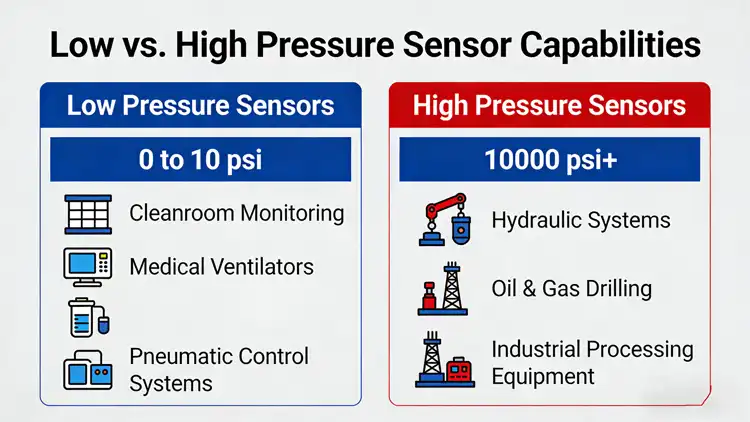
High-pressure sensors can work in harsh environments like hydraulic systems, oil and gas drills, and industrial processing equipment. These strong gadgets can measure pressures higher than 10,000 psi and stay accurate and reliable even in harsh environments. In exchange for better longevity and a wider measurement range, the sensor is less sensitive at lower pressures.
Automotive vs. Industrial Environment Requirements
For use in cars, sensors need to be able to handle vibrations, high temperatures, and electromagnetic interference while still taking accurate readings. Fuel rail pressure sensors need to work consistently in engine compartments that get hotter than 125°C and have a lot of vibration. Most of the time, these sensors are small and have certifications for use in cars.
Chemical exposure, high temperatures, and the need for long-term security are some of the problems that can happen in industrial settings. The specifications for an industrial pressure sensor range need to take into account things like process media compatibility, explosion-proof ratings, and longer operational lifespans that are measured in years instead of car service intervals.
Application-Specific Customization Requirements
For measuring gases, you need sensors that are made to deal with their specific qualities and any possible corrosive effects. For hydrogen uses, you need special materials and sealing methods to keep the measurements accurate and stop gases from leaking through. Sensors with the right pressure ranges and safety certifications for use in explosive environments are necessary for natural gas tracking systems.
When measuring liquids, there are special problems that come up because of the way the media works and the chance of contamination. Designs that are clean, have smooth surfaces, and are made of FDA-approved materials are needed for food and drink uses. For chemical handling, sensors need to be made of materials that don't corrode and can handle aggressive media while still measuring accurately.
How to Select the Right Pressure Sensor Range for Your Application?
Critical Application Parameter Assessment
Before choosing the best pressure sensor, it's important to carefully look at what the application needs. The type of media, the working temperature range, and the environmental conditions all have a direct effect on how sensors are chosen. Process pressures should be looked at to find out what the normal working conditions are and if there are any possible pressure spikes that could damage sensors that aren't rated properly.
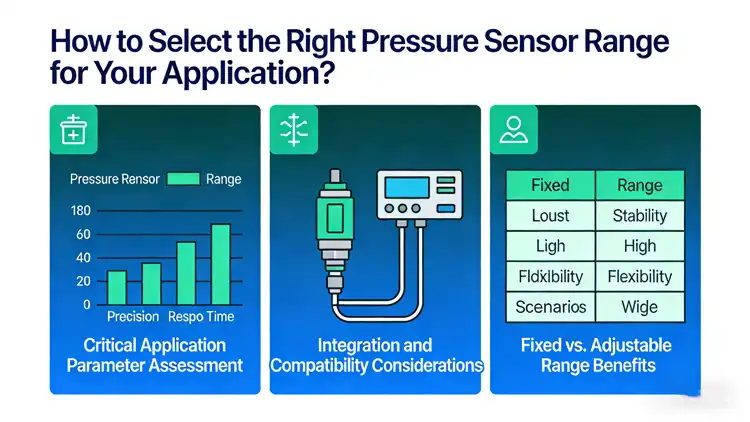
Temperature effects need to be carefully thought through because changes in material properties and thermal growth can affect how accurate measurements are. In situations where temperatures change a lot, you might need sensors that can compensate for temperature changes or separate temperature sensors so that pressure data can be mathematically corrected.
Integration and Compatibility Considerations
Electrical interfaces, mechanical mounting configurations, and communication methods are some of the things that are needed for system integration. For standard control systems, analog output sensors send signs of 4–20 mA or 0–10 V. Digital sensors, on the other hand, can communicate through protocols like HART, Modbus, or CAN bus, which improves their accuracy and diagnostic abilities.
When two pieces of equipment are mechanically compatible, they must have the same thread sizes, mounting orientations, and amount of room. For retrofit applications, sensors may need to be mounted in the same way as current units. On the other hand, new installations give you more options for choosing sensors and where to put them.
Fixed vs. Adjustable Range Benefits
Fixed-range sensors are a cheap way to meet clear pressure standards in a variety of situations. These sensors are very accurate within the area they are designed for, and the calibration process is made easier. Fixed-range sensors are often better for large-scale manufacturing because they are easier to use and cost less per unit.
Adjustable-range sensors are useful in situations where the pressure sensor range needs to change or where changes to the system are likely to happen in the future. These sensors let you change the measurement ranges in the field without having to change the hardware. This helps the system work better and cuts down on the amount of inventory that needs to be kept on hand for repair tasks.
Overview of Leading Pressure Sensor Ranges from Top Brands
Established Manufacturer Capabilities
The pressure sensor range portfolios from top companies like Honeywell, Bosch, and Siemens cover a wide range of applications, from measuring vacuums to ultra-high pressures of over 10,000 bar. Based on what they do best and what uses they want to serve, each manufacturer brings different strengths to different market segments.
Honeywell's history in flight makes its sensors very reliable and accurate for use in important situations. Their product lines include sensors for tracking fuel rails in cars, transmitters for process control in factories, and special sensors for use in harsh environments. Bosch uses its knowledge of cars to make a lot of sensors with designs that are both reliable and don't cost too much.
Technology Innovations and Specializations
TE Connectivity works on making sensors smaller and better able to handle harsh environments. Their sensors can be used in aerospace systems and oil and gas applications that go deep underground. Their MEMS-based sensors are small enough to fit in places where room is limited while still meeting industrial-grade performance standards. Siemens focuses on integrating sensors that work well with their control systems and industrial software tools so that process automation can run smoothly. Their pressure transmitters have advanced diagnostics and repair planning features that lower the overall cost of running the system.
OEM and Bulk Purchase Opportunities
Volume buying agreements help OEM applications and large-scale industrial installations save a lot of money. When you buy more than a certain amount, manufacturers usually offer customization services like private labels, changed electrical connections, and calibrations that are specific to your application.
Quality certifications are very important when choosing a seller for important projects. ISO 9001 certification makes sure that production methods are always the same, and industry-specific certifications, such as SIL ratings for safety instrumented systems or automotive IATF 16949 certification, show that a supplier can handle tough jobs.
Pressure Sensor Range Procurement and Supply Chain Insights
Supplier Evaluation and Verification
To find reliable suppliers, you need to look at their technical skills, quality systems, and how stable their business will be in the long run. To make sure that the quality of the products is consistent and that they can be tracked all the way through the supply chain, suppliers should be audited to look at their production methods, quality control systems, and calibration facilities.
Verification of certification means making sure that products meet all relevant business standards and legal requirements. The paperwork should have calibration certificates that can be tracked back to national standards, material approvals for parts that get wet, and statements that they follow all safety and environmental rules.
Customization and Bulk Purchase Benefits
Customized solutions meet the specific needs of an application that standard goods can't. pressure sensor range specs, output signals, mechanical configurations, and environmental ratings can all be changed by manufacturers to fit the needs of different applications. Lead times for customized products are usually longer than those for standard products, but they offer better performance for certain uses.
When you buy in bulk, you save money because you get deals for buying more and are sure to always have enough supplies. Long-term contracts can keep prices stable and help people get what they need when supplies are low. These deals are good for both buyers and sellers because they lower prices and help sellers plan for reliable demand.
Cost Optimization Strategies
The initial buy price, installation costs, maintenance needs, and expected operational life are all part of the total cost of ownership analysis. Higher-quality sensors may cost more up front, but they are worth it in the long run because they last longer and need less upkeep. Strategies for negotiating should find a mix between lowering costs, meeting quality standards, and meeting delivery dates. Procurement teams can get the best prices while keeping quality standards and supply security high if they know about market conditions, other providers, and volume leverage.
Conclusion
To choose the right pressure sensor range, you need to carefully think about the needs of the application, the surroundings, and how the system needs to be integrated. Knowing the main differences between different sensor technologies and what they can do helps you make smart choices that balance performance, cost, and reliability needs. Modern pressure sensors are very accurate and last a long time if they are properly matched to the needs of the application. They help many different types of factories work efficiently, from those that make cars to those that process chemicals.
FAQ
What is the difference between pressure sensor range and full scale (FS)?
The full range of pressure numbers that a sensor can pick up, from the lowest to the highest, is called its "range." Full scale (FS) is the difference in numbers between the range's upper and lower bounds. Range sets the limits of what can be done, and FS is the number that is used for accuracy specifications and calibration processes.
How does sensor range affect measurement accuracy and sensitivity?
Most of the time, sensor accuracy is given as a percentage of full scale. This means that error values may be higher for bigger ranges while the percentage accuracy stays the same. As the range gets wider, sensitivity goes down because the same change in electrical output has to represent bigger changes in pressure. Sensors with ranges that are closely matched to real working pressures are useful for applications that require precise measurement of small pressure changes.
Can one sensor range work for both gas and liquid measurements?
Even though the same sensor can measure pressure from both gases and liquids, different methods may be needed depending on the purpose. For liquid uses, you might need to make sure that the media is compatible, while for gas measurements, you might need faster response times or ratings that make them safe from explosions. The pressure sensor range is the same for both types of media, but the extra specs often change depending on the medium being measured and the location where it will be used.
Partner with GAMICOS for Your Pressure Sensor Range Solutions
If you need to measure pressure, GAMICOS has a wide range of sensor options that can be used in low-pressure situations all the way up to ultra-high-pressure industrial systems. For the best performance in your specific application, our skilled engineering team can help you choose the right pressure sensor range. As one of the biggest companies that makes pressure sensor ranges, we can make a lot of changes, offer fast prototyping, and make a lot of products at once to meet tight delivery dates. Get in touch with our technical experts at info@gamicos.com to talk about your pressure measurement problems and find out how our tried-and-true sensor technologies can improve the performance of your system while lowering its total cost of ownership.
References
1. Johnson, R.K. "Industrial Pressure Measurement: Principles and Applications." Instrumentation Engineering Journal, Vol. 45, 2023, pp. 123-145.
2. Smith, M.A. and Brown, L.C. "Automotive Pressure Sensor Design and Performance Standards." Society of Automotive Engineers Technical Paper, 2023-01-0245.
3. Zhang, H. "Advanced Materials for High-Pressure Sensor Applications." Materials Science and Engineering Review, Vol. 78, 2023, pp. 234-267.
4. Anderson, P.J. "Calibration and Accuracy Standards for Industrial Pressure Transmitters." Metrology and Measurement Science, Vol. 32, 2023, pp. 89-112.
5. Wilson, K.R. "MEMS Pressure Sensors: Technology Trends and Market Applications." Microsystems Technology Quarterly, Vol. 19, 2023, pp. 456-478.
6. Thompson, D.L. "Process Automation and Pressure Measurement Integration." Control Systems Engineering, Vol. 41, 2023, pp. 167-189.

Ivy
Ivy, product consultant, has focused on sensor consultation for ten years, is proficient in providing pressure and level measurement solutions for customers.
We're here to help — submit your request anytime!
Let us know how we can help solve your pressure level measurement challenge.

_1757930850792.jpg)






Recommended Blog
Waterproof Pressure Sensor vs Regular Pressure Sensor: How to Choose?
Waterproof Pressure Sensor vs Regular Pressure Sensor: How to Choose?
