Best Sanitary Pressure Transmitter for Pharmaceutical Applications
Understanding Sanitary Pressure Transmitters in Pharmaceutical Applications
- Understanding Sanitary Pressure Transmitters in Pharmaceutical Applications
- Key Features and Types of Sanitary Pressure Transmitters for Pharma Use
- How to Choose the Best Sanitary Pressure Transmitter for Pharmaceutical Applications?
- Why Choose GAMICOS Sanitary Pressure Transmitters for Your Pharmaceutical Needs?
- Conclusion
- FAQ
- Contact GAMICOS for Your Sanitary Pressure Transmitter Needs
- References
Precision, hygienic compliance, and regulatory adherence become critical factors while looking for the finest sanitary pressure transmitter for pharmaceutical applications. In order to preserve the sterility necessary for pharmaceutical production operations, these specialized equipment must provide precise pressure readings. Advanced sensor technology, food-grade materials like 316L stainless steel, and hygienic designs that enable complete cleaning and sterilization are all features of modern sanitary pressure transmitters. The best option ensures both product safety and operational dependability in crucial pharmaceutical settings by combining measurement precision with sturdy construction that can endure CIP (Clean-in-Place) and SIP (Sterilize-in-Place) processes.
Understanding Sanitary Pressure Transmitters in Pharmaceutical Applications
It is necessary to maintain an exceptionally high level of purity and precision throughout the whole of the pharmaceutical production process. In order to bridge the gap between accurate measurement and stringent hygiene rules, sanitary pressure transmitters are essential monitoring equipment that must be used. On account of their one-of-a-kind construction and the materials that they are made of, these cutting-edge devices are considerably distinct from the typical industrial pressure sensors.
Core Operating Principles and Design Features
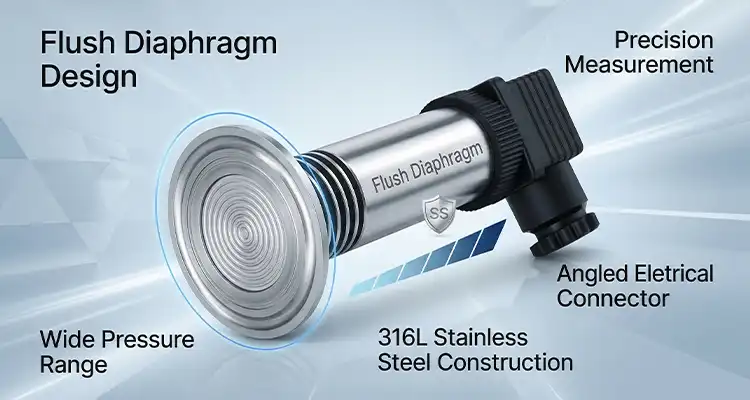
Using cutting-edge sensing technology, sanitary pressure sensors are able to monitor pressure without subjecting themselves to contamination while they are in operation. In most cases, the procedure for sensing makes use of piezoresistive devices or diffused silicon pressure cores, both of which respond to changes in pressure in a very exact manner. These devices, in contrast to conventional transmitters, feature flush diaphragm designs that eliminate any dead areas that may potentially accumulate pollutants or pathogens.
There is a significant amount of significance placed on the construction materials in terms of pharmacological compatibility. In addition to providing remarkable resistance to corrosion, premium 316L stainless steel fulfills the criteria set forth by the FDA for surfaces that come into contact with food. The use of specialized welding technologies ensures the creation of smooth, non-porous surfaces that are resistant to bacterial adhesion and make it possible to carry out complete cleaning operations.
Regulatory Compliance and Industry Standards
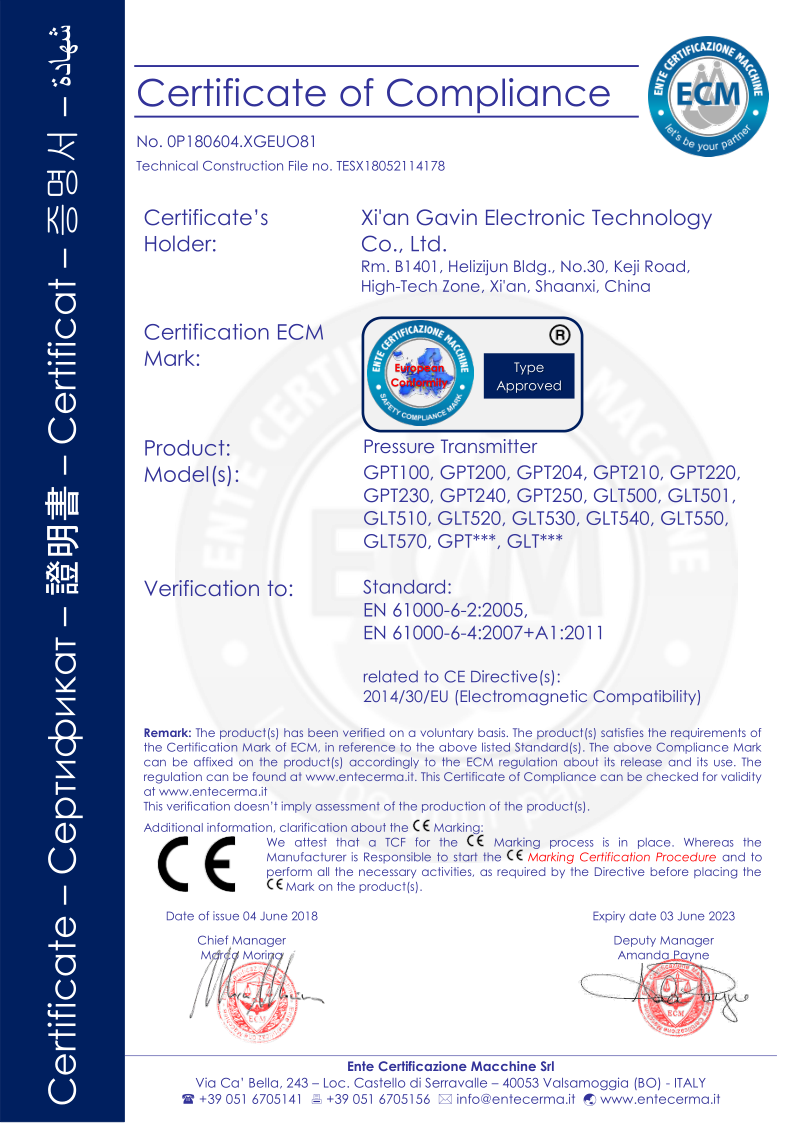
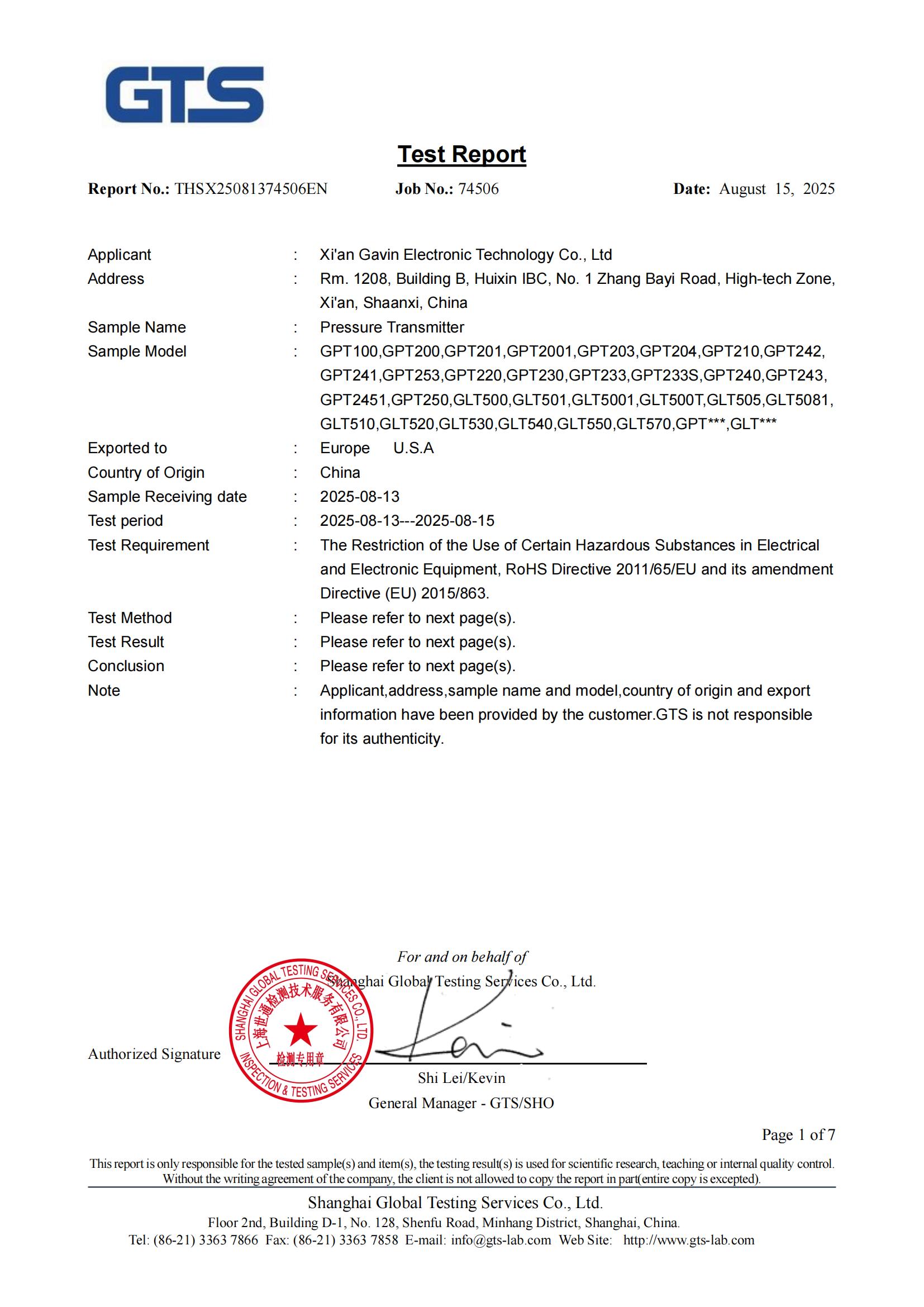
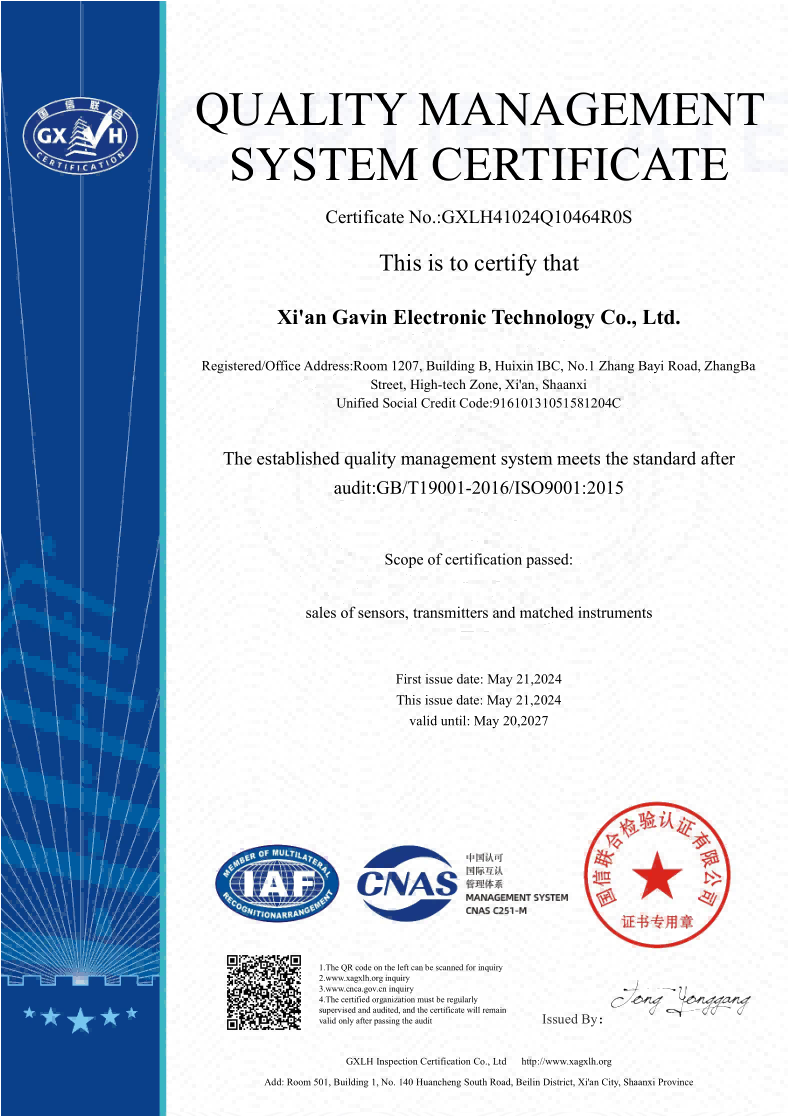
When employing pharmaceutical applications, it is necessary to adhere to a number of regulatory frameworks, including the laws of the Food and Drug Administration (FDA), the norms of current good manufacturing practice (cGMP), and international certifications such as CE marking and ISO conformance compliance. Certain material compositions, surface finishes, and documentation requirements are outlined in these standards, and sanitary transmitters are required to conform to these requirements.
Additional requirements for the design of sanitary equipment are offered by the European Sanitary Engineering and Design Group (EHEDG). This group lays a significant focus on the cleanability, drainability, and accessibility for inspection of the equipment. By following to these rules, pressure transmitters may be simply included into pharmaceutical operations that have been authorized without compromising the quality of the finished product or its regulatory status.
Key Features and Types of Sanitary Pressure Transmitters for Pharma Use
Specialized instrumentation skills are necessary to meet the particular problems found in pharmaceutical applications. Procurement experts may make well-informed judgments that meet the needs of certain applications by having a thorough understanding of the many kinds and characteristics that are accessible, including the appropriate sanitary pressure transmitter options for compliance and performance.
Diaphragm Seal and Flush-Mount Configurations
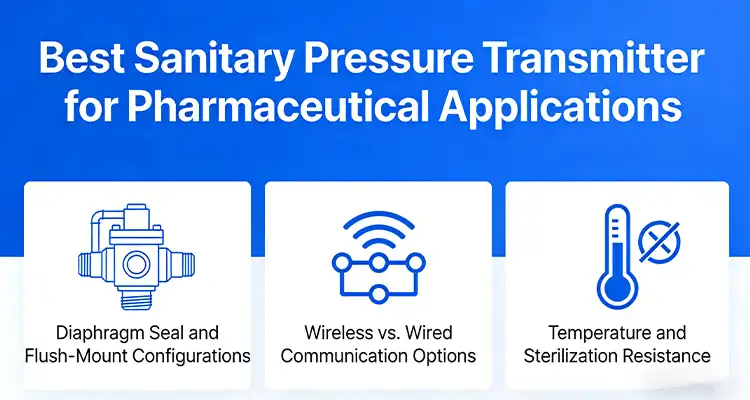
Diaphragm seal transmitters provide greater protection against process contamination in addition to providing accurate pressure monitoring. Because of the flush diaphragm design, these instruments are ideal for applications that need viscous media or particle-containing solutions. This design eliminates dead zones and fissures, which are potential places where residues might accumulate.
Through direct integration into vessel walls or process pipes, flush-mounted sensors provide seamless transitions that make it easier to perform thorough cleaning operations. This design reduces the likelihood of measurement errors caused by trapped air or debris, as well as pressure drop difficulties. Additionally, it reduces the possibilities of pressure drop.
Wireless vs. Wired Communication Options
As a means of simplifying the installation process and reducing the amount of money spent on maintenance, wireless pressure monitoring systems are becoming more prevalent in contemporary pharmaceutical industrial facilities. The use of wireless transmitters allows for the delivery of data in real time to central control systems without the need for a significant amount of cabling. It is nevertheless suggested to use wired connections for applications that are really important and cannot afford to compromise the dependability of the signal.
Ethernet-based systems, Profibus, the HART protocol, and 4-20 mA analog signals are some of the standard options available by manufacturers, despite the fact that communication techniques vary widely from one manufacturer to the next. Taking into consideration the requirements for data integration and compatibility with the existing infrastructure, the choice was made.
Temperature and Sterilization Resistance
It is common practice in the pharmaceutical industry to use sterilization cycles that reach temperatures of 284 degrees Fahrenheit (140 degrees Celsius) or higher. Sanitary transmitters are required to be able to withstand these temperature variations without damaging their structural integrity or making their calibration accuracy less accurate. In order to take into consideration the effects of heat on the sensor device, advanced systems make use of temperature compensation algorithms that automatically adjust the data.
In the course of CIP and SIP processes, instruments are put through cycles of steam sterilization and abrasive cleaning chemicals. When subjected to conditions that include frequent heat cycling, the transmitter housing, sealing systems, and internal components are required to be able to resist chemical attack while still maintaining their long-term stability.
How to Choose the Best Sanitary Pressure Transmitter for Pharmaceutical Applications?
Carefully weighing application-specific needs against more general pharmaceutical production issues is necessary when choosing the right pressure monitoring equipment. Technical requirements, operational considerations, and regulatory compliance all play a role in the decision-making process and have an effect on both short-term performance and long-term dependability, especially when selecting a sanitary pressure transmitter for the application.
Material Compatibility and Chemical Resistance
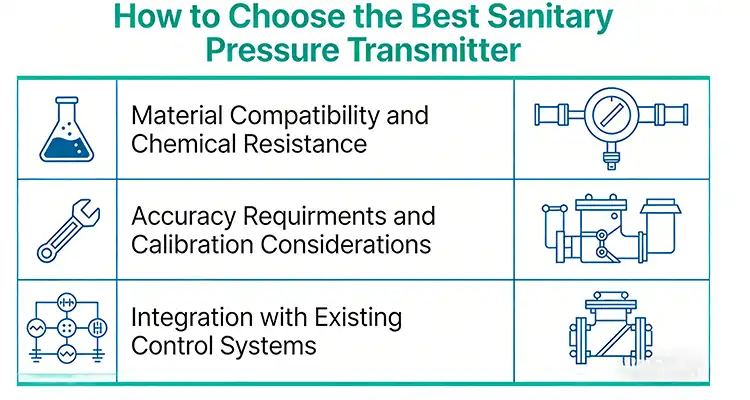
The characteristics of the medium going through the process have a significant impact on the requirements for the selection of the material. When severe solvents, cleaning agents, and medical drugs come into contact with incompatible materials, they have the potential to cause contamination problems or incorrect measurements. Stainless steel 316L offers excellent compatibility for a wide range of applications; nevertheless, applications that are very corrosive may need the use of specialized alloys such as Inconel or Hastelloy.
Seals and gaskets made of elastomeric material need particular attention since they are in close proximity to the material that is being processed. Chemical compatibility is ensured by materials that have been certified by the FDA and meet the regulatory requirements for pharmaceutical contact applications. Some examples of such materials are PTFE, Viton, and EPDM.
Accuracy Requirements and Calibration Considerations
Pharmaceutical operations often need pressure measurement precision that falls within the range of ±0.1% to ±0.25% of span. This is done to ensure that both the efficacy of process control and the quality of the product are maintained. This precision must be consistently given by the selected transmitter over the whole operating range, taking into account the features of long-term drift as well as the effects of temperature.
Both the regulatory requirements and the criticality of the application are taken into consideration when determining the frequency of calibration. Although applications with a lower level of importance might be conducted on a quarterly or semi-annual basis, operations that are considered to be vital would need monthly calibration verification. It is important that the design of the transmitter be able to accommodate field calibration procedures without requiring a complete shutdown of the operational system.
Integration with Existing Control Systems
The degree of compatibility with the existing process control infrastructure has an influence on both the operational effectiveness and the installation installation costs. In today's world, pharmaceutical facilities often make use of programmable logic controllers (PLC) or distributed control systems (DCS), both of which need certain signal formats and communication protocols.
The GAMICOS GPT210 Sanitary Flat Diaphragm Pressure Transmitter is a classic example of complex integration capabilities. It has numerous signal output choices, including 4-20 mA, RS485, IIC, 0-5V, and 0-10V formats, and it can output signals in a variety of forms. The versatility of this technology ensures interoperability with a wide range of control systems and provides future upgrade pathways.
Why Choose GAMICOS Sanitary Pressure Transmitters for Your Pharmaceutical Needs?
Thanks to its creative ingenuity and constant dedication to quality, GAMICOS has built a solid name in the pharmaceutical pressure measuring industry. Our sanitary pressure transmitters provide outstanding performance and dependability while addressing the unique difficulties encountered by pharmaceutical manufacturing.
Advanced Hygienic Design and Construction
The GPT210 hygienic Flat Diaphragm Pressure Transmitter incorporates contemporary design concepts that place a focus on both the precision of measurement and the hygienic functioning of the device. The layout of the flush diaphragm allows for the removal of dead regions and the provision of surfaces that are smooth, easily cleanable, and resistant to the colonization of germs. In order to provide a seamless transition between components, certain welding methods are used. These procedures reduce the likelihood of contamination.
Every single surface that comes into touch with the process is made out of high-quality 316L stainless steel, which is evidence of our commitment to achieving material perfection. This material selection not only provides long-term corrosion resistance under intensive working conditions, but it also ensures conformity with the cleaning procedures used in the pharmaceutical industry.
Superior Performance Characteristics
Excellence in engineering is the driving force behind each and every component of our sanitary transmitter design plan. In spite of the fact that conventional transmission medium alternatives such as silicon oil or olive oil may fulfill a wide range of application requirements, the diffused silicon pressure core provides an exceptional level of accuracy and stability throughout a wide temperature range.
The use of integrated protective measures has a number of advantages, including decreased maintenance requirements and greater operational dependability. Short-circuit prevention and reverse polarity protections warn against damage caused by installation faults or electrical malfunctions. Strong sealing systems ensure long-term steady operation in demanding pharmaceutical situations. In addition, these protections give protection against interference from reverse polarity.
Comprehensive Technical Support and Customization Services
Comprehensive technical help is provided by GAMICOS, beginning with the selection of the first product and continuing through installation and ongoing maintenance. Our highly qualified technical staff collaborates directly with pharmaceutical clients in order to get an understanding of the specific application requirements and to give the most effective solutions.
Instances of customization choices that go beyond standard product offerings include specialized configurations, replacement materials, and changed communication protocols. These are all instances of customization options. Our sanitary pressure transmitters are able to meet particular operational requirements because to their versatility, which also allows them to mix in well with the methods that are currently used in the pharmaceutical industry.
Conclusion
Technical performance, operational factors, and regulatory compliance must all be balanced when choosing the best sanitary pressure transmitter for pharmaceutical applications. Instruments used in modern pharmaceutical production must provide outstanding precision and maintain the highest standards of cleanliness throughout long operating times. The decision has a major effect on operational effectiveness, regulatory compliance, and product quality across important pharmaceutical processes. Through superior materials, cutting-edge engineering, and extensive support services, GAMICOS sanitary pressure transmitters provide tried-and-true solutions that satisfy these exacting specifications, guaranteeing dependable operation even in the most demanding pharmaceutical settings.
FAQ
Q1: What calibration intervals are recommended for pharmaceutical pressure transmitters?
A: Calibration frequency depends on application criticality and regulatory requirements. Critical pharmaceutical processes typically require monthly verification, while general applications may operate with quarterly intervals. The specific schedule should align with your facility's quality management system and regulatory compliance requirements.
Q2: What distinguishes hygienic from sanitary pressure transmitters?
A: Hygienic transmitters focus on general cleanliness requirements, while sanitary transmitters meet stricter pharmaceutical and food-grade standards. Sanitary designs incorporate flush diaphragms, crevice-free construction, and FDA-approved materials that support aggressive cleaning protocols and sterilization procedures.
Q3: Can these transmitters withstand steam sterilization processes?
A: Quality sanitary pressure transmitters are specifically designed to endure repeated steam sterilization cycles up to 284°F (140°C). They incorporate temperature compensation and robust sealing systems that maintain accuracy and integrity throughout CIP and SIP procedures common in pharmaceutical manufacturing.
Q4: What communication protocols are available for pharmaceutical integration?
A: Modern sanitary transmitters typically support multiple communication options including 4-20 mA analog signals, HART protocol, RS485, IIC, and various voltage outputs. The selection depends on your existing control system requirements and integration preferences.
Contact GAMICOS for Your Sanitary Pressure Transmitter Needs
GAMICOS stands ready to support your pharmaceutical pressure measurement requirements with industry-leading sanitary pressure transmitters designed for demanding applications. Our experienced team provides personalized consultations, technical demonstrations, and customized quotations tailored to your specific process needs. As a trusted sanitary pressure transmitter manufacturer, we deliver comprehensive solutions backed by global experience serving pharmaceutical clients across North America, Europe, and beyond. Contact our technical specialists at info@gamicos.com to discuss your requirements and discover how our advanced pressure sensing technology can enhance your pharmaceutical operations with reliable, hygienic measurement solutions.
References
1. Johnson, M.R. & Smith, K.L. (2023). "Hygienic Design Principles for Pharmaceutical Process Instrumentation." Journal of Pharmaceutical Engineering, 45(3), 127-142.
2. Anderson, P.T. et al. (2022). "Regulatory Compliance Requirements for Sanitary Pressure Transmitters in Pharmaceutical Manufacturing." International Pharmaceutical Technology Review, 18(7), 89-104.
3. Williams, D.J. & Chen, H.X. (2023). "Material Selection and Compatibility Guidelines for Pharmaceutical Pressure Sensing Applications." Process Safety and Environmental Protection, 156, 234-249.
4. Thompson, R.A. (2022). "Steam Sterilization Effects on Pressure Transmitter Performance in Biopharmaceutical Applications." Biotechnology Progress, 38(4), 412-428.
5. Garcia, S.M. & Kumar, V.P. (2023). "Wireless vs. Wired Communication Systems for Pharmaceutical Process Monitoring." Automation in Pharmaceutical Manufacturing, 29(2), 67-83.
6. Lee, J.H. & Miller, C.R. (2022). "Calibration Best Practices for Critical Pharmaceutical Pressure Measurement Systems." Quality Assurance in Pharmaceutical Manufacturing, 41(5), 198-215.

Spring
Spring, With 5 years of experience in sensor technology and product development, Mark specializes in helping clients identify the optimal pressure and level sensor solutions for demanding industrial environments。
We're here to help — submit your request anytime!
Let us know how we can help solve your pressure level measurement challenge.
_1757930850792.jpg)

Recommended Blog

Top Sanitary Pressure Transmitter Suppliers in Europe & America
Sanitary Pressure Transmitter Export Trends in Asia & Europe
Import Guide: Sanitary Pressure Transmitters for Europe & Americas
Top Sanitary Pressure Transmitter Suppliers in Europe & America
Sanitary Pressure Transmitter Export Trends in Asia & Europe
Import Guide: Sanitary Pressure Transmitters for Europe & Americas
Top Sanitary Pressure Transmitter Suppliers in Europe & America
Sanitary Pressure Transmitter Export Trends in Asia & Europe
Import Guide: Sanitary Pressure Transmitters for Europe & Americas
Top Sanitary Pressure Transmitter Suppliers in Europe & America
Sanitary Pressure Transmitter Export Trends in Asia & Europe