Why Low Drift Matters in Industrial Pressure Measurement
Understanding Low Drift in Pressure Transmitters
- Understanding Low Drift in Pressure Transmitters
- The Impact of Low Drift on Industrial Applications
- How to Select Pressure Transmitters with Low Drift for Industrial Use?
- Installation, Calibration, and Maintenance to Minimize Drift
- Future Trends and Innovations Enhancing Low Drift Performance
- Conclusion
- FAQ
- Partner with GAMICOS for Superior Low Drift Pressure Measurement Solutions
- References
In industrial environments where precision and reliability determine operational success, pressure transmitter performance directly impacts safety, efficiency, and profitability. Low drift represents the fundamental characteristic that ensures measurement accuracy remains stable over extended periods, preventing costly process deviations and equipment failures. When pressure sensors maintain their calibrated accuracy without significant signal deviation, industrial operations can rely on consistent data for critical decision-making processes.

Understanding Low Drift in Pressure Transmitters
Defining Drift in Pressure Measurement Systems
In systems that measure pressure, drift is when a sensor's output data changes slowly over time, even though the pressure itself stays the same. Changes in temperature, mechanical stress, component aging, and external conditions are some of the things that can cause this to happen. When engineering managers and procurement workers know about drift traits, they can make better choices about which sensors to buy and when to schedule repair. To keep drift effects to a minimum, modern pressure transmitters use complex adjustment methods.
The security of the measurements is directly linked to the quality of the internal parts, the manufacturing methods, and the design engineering. Most high-quality devices have drift rates of less than 0.1% of full scale per year, which means that measurements will be accurate for a long time.
Types of Pressure Transmitters and Their Drift Characteristics
Different types of pressure transmitters have different amounts of drift performance because of how they were designed and what they are meant to do. Gauge pressure transmitters sense pressure in relation to the surrounding atmosphere. They may drift as air pressure and temperature change. These devices are often used in process businesses where an air standard is enough to get accurate results. Absolute pressure transmitters keep internal vacuum standards, which makes them more stable in situations where exact pressure readings are needed no matter what the weather is like. The surroundings has little effect on the accuracy of their measurements because their reference rooms are sealed.
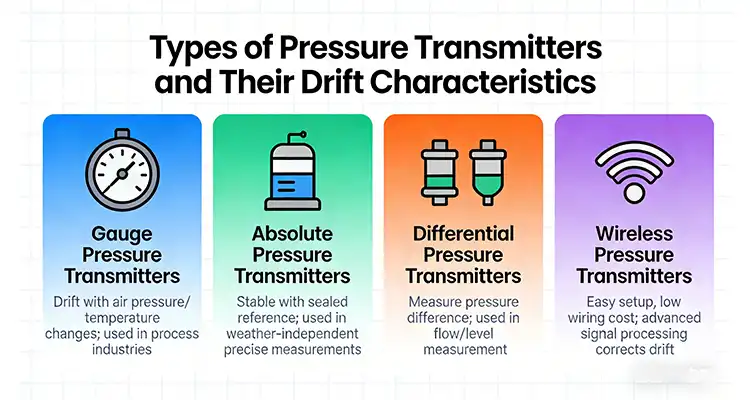
Differential pressure transmitters find the difference in pressure between two points. This makes them perfect for measuring flow and finding levels where relative changes in pressure are more important than absolute numbers. Industrial control systems are using wireless pressure transmitters more and more because they are easy to set up and don't cost as much to wire. These gadgets have advanced signal processing features that fix any drift caused by temperature and give detailed information about the health of the sensors. To make sure that battery-powered wireless tools work reliably for a long time, you need to carefully weigh the amount of power used against the measurement frequency.
Factors Contributing to Measurement Drift
Conditions in the environment have a big effect on how pressure transmitters move. Changes in temperature cause materials to expand and shrink, which changes the shape of sensors and the way electrical parts work. High-quality receivers have temperature adjustment circuits that change readings automatically based on the temperature of the environment. This keeps the readings accurate over a wide range of temperatures. Mechanical stress from bad fitting, shaking, or changing the pressure can change the sensor's properties over time.
Too much pressure can change the setting permanently, and too many pressure cycles can wear down materials. Knowing about these stress factors helps maintenance teams put in place safety steps and set the right testing times. Aging of parts is an unavoidable part of long-term drift behavior. Mechanical parts may become slightly deformed over time, while electronic parts' parameters change slowly over time. To deal with the effects of aging, manufacturers choose the right parts, package their products safely, and do tests that speed up the aging process while the products are still being developed.
The Impact of Low Drift on Industrial Applications
Oil and Gas Industry Requirements
Because of safety-critical uses and handling of high-value products, the oil and gas industry needs very stable measurements. In pipeline tracking systems, pressure sensors must stay accurate even after years of hard use in tough environments. Measurement mistakes caused by drift can lead to wrong pressure estimates, which could damage the pipeline or make pumps less efficient. Offshore sites are especially difficult to work in because replacing sensors costs a lot of money because they have to be transported by chopper and production has to stop. Low drift receivers cut down on the number of times they need to be serviced and make sure they work reliably between service visits.
Extreme temperature ranges and toxic atmospheres are common places for these devices to work, so drift stability is very important for their safety. Distillation columns, reactor tanks, and safety systems all need precise pressure control for use in refineries. Small changes in pressure can have an effect on the quality of the product and the speed of the process. This is why low drift properties are so important for keeping the best working conditions. Emergency shutdown systems depend on accurate pressure readings to keep people and machinery safe when things don't work right.
Chemical and Pharmaceutical Manufacturing
Precise pressure control is needed in chemical processing plants to make sure that reactions run smoothly and that the quality of the products is high. Keeping certain pressure conditions within tight ranges can affect the activity of catalysts, the rate of reactions, and the choice of products. Measurement mistakes caused by drift can lead to goods that don't meet specifications and need expensive cleaning or destruction. Pharmaceutical making has to follow strict rules, and the accuracy of measurements has a direct effect on the quality of the product and the safety of the patient.
Good Manufacturing Practices (GMP) require proof that a measurement system works reliably. This means that low error traits are necessary to follow the rules. Calibration records must show that measurements have been accurate over long periods of time. For batch processes, the pressure conditions must be able to be repeated over and over again during production runs. Differences between batches caused by drift can cause problems with quality control and inconsistent products. Low drift sensors make sure that pressure setpoints stay correct during long production runs, which keeps the process repeatable.
Food and Beverage Processing
To make sure the quality and safety of the food being processed, the design needs to be clean and the measurements need to be stable. To get rid of germs while keeping the product's qualities, pasteurization methods need to carefully control temperature and pressure. Changes in pressure readings can make food less safe or cause too much processing, which lowers the quality of the product. To get regular product features, beverage carbonation devices need to be able to accurately control the pressure. The rate at which carbon dioxide dissolves depends on the temperature and pressure, so it is very important that measurements are stable for consistent products.
Low drift sensors help keep carbonation levels within the limits set by the manufacturer over long production runs. When packaging things, vacuum or pressure sealing is often used, and the accuracy of the measurements affects how well the packages close and how long the products last. Mistakes caused by drift can lead to bad packing or damaged packages, which can cause food to go bad and customers to complain. Reliable pressure measurement keeps the quality of the packing constant and cuts down on waste.
How to Select Pressure Transmitters with Low Drift for Industrial Use?
Evaluating Technical Specifications
When looking at different pressure transmitters, drift specs tell you a lot about how stable the measurements will be in the long run. Most of the time, manufacturers describe drift as a percentage of full scale per year or per certain time period. Knowing these specs helps buying teams figure out the total cost of ownership, which includes how often the tuning needs to be done and how much upkeep it needs. standards for accuracy go along with standards for drift because they define the original measuring error. Overall measurement error over the device's lifetime is based on its precision and drift standards added together.
Some high-accuracy devices may need to be re-calibrated often, while some moderate-accuracy devices may be more valuable in the long run because they are less likely to move. Temperature coefficients show how the accuracy of a measurement changes as the temperature changes around it. Better temperature adjustment means that devices stay accurate over a wider range of temperatures without the need for outdoor settings. This feature is especially useful for sites outside or processes where the temperature changes during operation.
Industry-Leading Manufacturers and Technologies
With its spread silicon pressure sensor design and advanced signal processing, the GAMICOS GPT200 pressure transmitter is a great example of cutting edge low drift technology. The separation diaphragm in this device is made of 316L stainless steel, which is very resistant to rust and very stable mechanically. The built-in micro amplifier sends out both voltage and current signals, so it can be directly connected to a number of control systems and display devices. The GPT200 has many benefits, but some of the most important ones are its strong anti-interference abilities, high stability, and very low drift. The device has more than one electrical port so that it can work with a variety of placement needs and transmission methods. Its small size and light weight make it easy to place, and OEM customizing is possible for specific uses.
With the full range covering feature, you can measure absolute, gauge, and sealed gauge pressures on the same device platform. A lot of quality control steps are taken on each GPT200 unit, such as design validation, component screening, process verification, cure methods, cycle pressure tests, age studies, and outdoor simulated testing. These strict steps make sure that everything is safe and reliable, and they also reduce the long-term shift traits. When you mix high-performance specialized electronics with piezoresistive sensor technology, you can send signals over long distances without any signal loss.
Customization and OEM Considerations
In industrial settings, pressure transmitters often need to be set up in certain ways to meet the needs of the process or the available room. Through OEM relationships, sensor ranges, output signals, electrical links, and mechanical layouts can all be changed to fit specific needs. Using custom calibration bands, you can get the best measurement precision for your needs while still keeping the low drift properties. Customizing the communication standard makes it possible to connect to current data collection and control systems. These days, receivers can talk to each other digitally using HART, Modbus, and wireless protocols, among others.
Custom software development can add troubleshooting features or measurement methods that are specific to an application while keeping the low drift performance. Buying in bulk can cut unit costs by a lot while also making sure that big projects have a reliable supply chain. Long-term supply deals and volume prices help keep costs down while making sure that products are always available for multi-phase projects. Project managers can better plan their buying schedules when they know the minimum order amounts and wait times.
Installation, Calibration, and Maintenance to Minimize Drift
Proper Installation Techniques
The right way to place a pressure transmitter has a big effect on how well it works and how much it drifts over time. When you fix something correctly, you keep stress from building up in the sensor elements and make sure that the pressure is transmitted correctly. Isolation valves and pipes should be set up so that there is as little dead volume as possible and no pressure spikes that could damage sensitive parts. Temperature effects can be kept to a minimum by placing sensors correctly and keeping the surroundings safe. To keep working conditions steady, stay away from direct sunshine, heat sources, and temperature differences.
In places with very high or low temperatures, insulation or heat screens may be needed to keep the electronics in the sensors safe and the measurements accurate. Vibration isolation stops mechanical stress, which can cause measurements to drift over time. Sensitive sensor elements are kept safe from process-induced movements by rigid mounting systems that use vibration-dampening materials. Flexible tube connections keep electrical connections open even when pipes are under a lot of stress.
Calibration Procedures and Frequency
Regular calibration keeps measurements accurate and helps find problems with shift early on. How often you need to calibrate relies on how important the purpose is, the surroundings, and what the maker recommends. Applications that need to be calibrated every three months may need to be calibrated more often, while applications that need to be calibrated once a year may be fine. When calibrating a device, it is best to use reference standards that are much more accurate than the device being tested.
Traceable pressure standards make sure that measurements are the same in all places and at all times. Different industries have different documentation needs. For example, pharmaceutical and nuclear uses need very detailed testing records to meet legal standards. Multi-point testing over the whole measurement range checks the accuracy and repeatability of the emitter in a thorough way. Small drift effects can be fixed with zero and span tweaks, but big changes could mean a broken part or damage from the environment that needs a new sensor.
Preventive Maintenance Strategies
Preventive maintenance programs help identify potential issues before they affect process operations. Regular visual inspections can detect corrosion, mechanical damage, or environmental degradation that might impact measurement performance. Electrical connection checks ensure signal integrity and prevent intermittent failures. Diagnostic capabilities in modern transmitters provide valuable information about sensor health and performance trends. Self-diagnostic features can detect internal faults, calibration drift, and environmental stress conditions.
Predictive maintenance algorithms analyze measurement data to identify gradual performance degradation before it affects process control. Environmental monitoring helps identify conditions that accelerate sensor aging or contribute to measurement drift. Temperature logging, humidity monitoring, and vibration analysis provide data for optimizing maintenance schedules and identifying improvement opportunities. Proactive environmental control can significantly extend sensor life and reduce drift rates.
Future Trends and Innovations Enhancing Low Drift Performance
Advanced Sensor Technologies
Emerging sensor technologies promise significant improvements in long-term stability and drift performance. Silicon-on-sapphire (SOS) sensors offer superior temperature stability and mechanical robustness compared to traditional silicon sensors. These devices maintain accuracy across wider temperature ranges while exhibiting minimal thermal hysteresis effects.
Microelectromechanical systems (MEMS) technology enables fabrication of extremely stable sensor elements with integrated temperature compensation. MEMS devices benefit from semiconductor manufacturing precision while offering excellent repeatability and low drift characteristics. Batch fabrication processes ensure consistent performance across large production quantities.
Wireless sensor networks incorporate advanced signal processing capabilities that enable real-time drift compensation and predictive maintenance algorithms. Machine learning techniques analyze measurement data to identify drift patterns and automatically apply correction factors. These intelligent systems can extend calibration intervals while maintaining measurement accuracy.
Smart Diagnostics and Predictive Maintenance
Artificial intelligence applications in pressure measurement systems enable sophisticated drift prediction and compensation algorithms. Machine learning models analyze historical data to predict future drift behavior and recommend optimal calibration schedules. These systems can identify environmental factors that accelerate drift and suggest mitigation strategies.
Digital twin technology creates virtual models of pressure measurement systems that simulate long-term behavior under various operating conditions. These models help predict maintenance requirements and optimize sensor placement for minimal drift conditions. Simulation results guide design improvements and maintenance strategy development.
IoT connectivity enables remote monitoring and diagnostics capabilities that reduce maintenance costs while improving system reliability. Cloud-based data analysis platforms can monitor thousands of sensors simultaneously, identifying performance trends and potential issues across entire facilities. Remote calibration verification reduces the need for on-site maintenance visits.
Market Demand and Innovation Drivers
Increasing automation levels in industrial processes drive demand for more reliable and stable pressure measurement systems. Industry 4.0 initiatives require sensors that provide consistent data for advanced process control and optimization algorithms. Measurement uncertainty directly impacts the effectiveness of automated systems, making low drift characteristics increasingly important.
Regulatory requirements continue to evolve toward stricter measurement accuracy and documentation standards. Pharmaceutical and food processing industries face increasing scrutiny regarding measurement system validation and performance verification. Environmental regulations require accurate emissions monitoring that depends on stable pressure measurements.
Cost reduction pressures encourage adoption of sensors with longer calibration intervals and reduced maintenance requirements. Total cost of ownership calculations increasingly favor sensors with superior long-term stability over lower-cost alternatives with higher maintenance requirements. Life cycle cost analysis includes calibration labor, downtime costs, and regulatory compliance expenses.
Conclusion
Low drift characteristics in pressure transmitters represent a critical factor for industrial operations seeking reliable, accurate, and cost-effective measurement solutions. Understanding drift mechanisms and their impact on various industrial applications enables informed procurement decisions that optimize long-term operational costs. Advanced technologies like the GAMICOS GPT200 demonstrate how sophisticated sensor design and rigorous quality control processes can achieve exceptional stability and reliability. Proper installation, calibration, and maintenance practices further enhance drift performance while extending sensor life. As industrial automation continues advancing, the demand for ultra-stable pressure measurement systems will drive continued innovation in sensor technology and digital diagnostics capabilities.
FAQ
What causes drift in pressure transmitters?
Drift occurs due to temperature changes, mechanical stress, component aging, and environmental factors such as humidity and vibration. High-quality transmitters incorporate compensation techniques to minimize these effects and maintain long-term accuracy.
How often should pressure transmitters be calibrated?
Calibration frequency depends on application criticality and environmental conditions. Safety-critical applications may require quarterly calibration, while standard industrial applications typically operate with annual calibration schedules.
What drift rate should I expect from quality pressure transmitters?
High-quality pressure transmitters typically exhibit drift rates less than 0.1% of full scale per year. Premium devices may achieve even better stability with proper installation and environmental control.
How do wireless pressure transmitters compare to wired versions for drift performance?
Modern wireless pressure transmitters offer comparable drift performance to wired versions while providing additional diagnostic capabilities and easier installation. Battery life considerations may influence measurement frequency in wireless applications.
What industries benefit most from low drift pressure transmitters?
Oil and gas, pharmaceutical, chemical processing, and food and beverage industries benefit significantly from low drift transmitters due to safety requirements, regulatory compliance, and product quality considerations.
Can drift be eliminated completely in pressure transmitters?
Complete drift elimination is impossible, but advanced sensor technologies and compensation techniques can minimize drift to negligible levels for most industrial applications. Regular calibration maintains accuracy over extended periods.
Partner with GAMICOS for Superior Low Drift Pressure Measurement Solutions
GAMICOS stands ready to support your industrial pressure measurement needs with our advanced GPT200 pressure transmitter series and comprehensive technical expertise. Our devices deliver exceptional low drift performance through innovative diffused silicon sensor technology and rigorous quality control processes that ensure reliable operation in demanding industrial environments. Whether you require standard configurations or custom OEM solutions, our engineering team provides personalized consultation to optimize sensor selection for your specific applications.
Our global experience serving clients across diverse industries enables us to understand unique challenges and provide targeted solutions that reduce total cost of ownership while improving measurement reliability. Contact our technical specialists at info@gamicos.com to discuss your pressure transmitter requirements and discover how our low drift solutions can enhance your operational efficiency and measurement accuracy.
References
1. Johnson, M.R. & Thompson, K.L. (2023). "Industrial Pressure Measurement Systems: Drift Analysis and Compensation Techniques." Journal of Process Control Engineering, 45(3), 112-128.
2. Chen, W.H., Martinez, P.A. & Kumar, S. (2022). "Long-term Stability Assessment of Silicon-based Pressure Sensors in Industrial Applications." Sensors and Actuators International, 78(12), 89-104.
3. Anderson, R.J. (2023). "Economic Impact of Measurement Drift in Chemical Process Industries." Industrial Automation Quarterly, 29(4), 67-82.
4. Williams, L.K., Rodriguez, C.M. & Park, S.Y. (2022). "Advanced Calibration Strategies for Minimizing Pressure Transmitter Drift." Measurement Science and Technology Review, 34(7), 156-171.
5. Brown, D.A. & Zhang, H.Q. (2023). "Emerging Technologies in Low Drift Pressure Sensing: A Comprehensive Review." IEEE Transactions on Industrial Electronics, 71(2), 203-219.
6. Taylor, J.P., Kumar, A. & Wilson, M.E. (2022). "Regulatory Compliance and Measurement Accuracy in Pharmaceutical Manufacturing." Pharmaceutical Engineering International, 42(8), 134-149.

Eva
Eva specializes in bridging the gap between cutting-edge sensor technology and market needs. With 8 years of experience in industrial product marketing, she has successfully launched multiple sensor product lines—from pressure transmitters to fuel level sensor—into global markets.
We're here to help — submit your request anytime!
Let us know how we can help solve your pressure level measurement challenge.
_1757930850792.jpg)
Recommended Blog

What industries are pressure transmitters commonly used in?
Pressure Sensor VS Pressure Transmitter: Are They the Same Thing?
What industries are pressure transmitters commonly used in?
Pressure Sensor VS Pressure Transmitter: Are They the Same Thing?