Nonlinearity & Hysteresis in Pressure Sensors Explained
Introducing Pressure Sensor Nonlinearity and Hysteresis
- Introducing Pressure Sensor Nonlinearity and Hysteresis
- Measuring and Analyzing Pressure Sensor Nonlinearity
- Comparison and Selection of Pressure Sensors Based on Nonlinearity
- Solutions and Technologies for Nonlinearity Compensation
- Practical Procurement Considerations and Future Trends
- Conclusion
- FAQ
- Partner with GAMICOS for Superior Pressure Measurement Solutions
- References
Pressure sensor nonlinearity and hysteresis represent critical performance characteristics that significantly impact measurement accuracy in industrial applications. Nonlinearity describes the deviation from an ideal linear response between pressure input and sensor output, encompassing offset errors, gain variations, and curvature distortions. Hysteresis manifests as the difference in sensor output readings when approaching the same pressure point from different directions, creating measurement uncertainties that can compromise process control reliability.
Introducing Pressure Sensor Nonlinearity and Hysteresis
When choosing pressure measurement methods for harsh industrial settings, it's important to understand these basic ideas. The way pressure sensors work in real life is very different from how they work in theory. This is why engineering managers and procurement specialists need to know a lot about them.
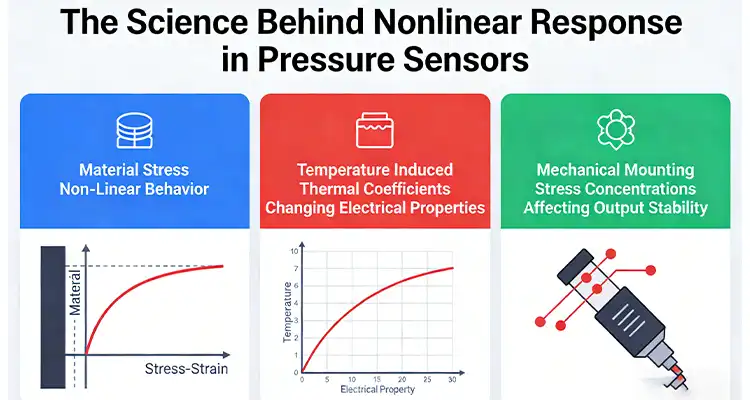
The Science Behind Nonlinear Response
There are several places in the structure of the pressure sensor where nonlinearity can come from. When materials are stressed, they naturally don't behave in a straight line. This is especially true for strain gauge and piezoresistive technologies. Changing temperatures cause thermal coefficients that change the electrical properties, and the way the device is mounted mechanically causes stress concentrations that affect the stability of the output.
Changes in resistance that aren't perfectly related to applied pressure show that strain gauge sensors aren't linear. The gauge factor changes based on the strain, which causes second-order effects that build up over the measurement range. Silicon-based piezoresistive elements behave similarly, but they also change behavior depending on temperature, which needs to be carefully characterized.
Hysteresis Mechanisms and Impact
Hysteresis happens when energy is lost in sensor materials when they are loaded and unloaded many times. Micro-deformations happen in mechanical parts that don't fully recover, and adhesion forces between contact surfaces cause responses that depend on the direction they are traveling. This effect is especially strong on MEMS sensors, where surface forces become important compared to restoring forces.
Different types of sensors have very different amounts of hysteresis. Capacitive pressure sensors usually have less hysteresis than resistive ones, which makes them good for uses that need high accuracy. Knowing these differences helps procurement teams fit the features of sensors to the needs of each application.
Measuring and Analyzing Pressure Sensor Nonlinearity
To accurately describe how well a sensor works, it needs to be calibrated in a way that shows both nonlinearity and hysteresis effects. These methods of measuring lay the groundwork for the creation of quality rating and compensation algorithms.
Calibration Methodologies
As part of standard calibration processes, known pressure references are used across the whole measurement range while sensor outputs are recorded. To show hysteresis behavior, the process usually has several rounds of rising and falling pressure. Primary standards are set by dead weight testers and precision pressure controllers, which can be traced back to national measurement bodies.
Techniques for mathematical analysis help separate the different parts of a mistake. For testing continuity, least-squares fitting finds the best-fit straight lines, while polynomial modeling finds higher-order nonlinear terms. Environmental testing over certain working ranges gives rise to temperature compensation coefficients that make sure performance stays stable in the field.
Compensation Algorithms
By compensating for them in software, advanced signal processing methods can greatly lower the effects of nonlinearity. Look-up tables keep track of correction factors for specific pressure points, while polynomial functions make corrections that are constant across the measurement range. Temperature-dependent corrections take thermal drift into account, so the accuracy stays the same even when the world changes.
These methods of compensation need to be used carefully so that they don't cause more mistakes. Over-correction can make noise worse or cause instability, while under-correction leaves behind nonlinearity that lowers the quality of the test. The success of compensation is guaranteed by proper validation through independent reference measurements.
Comparison and Selection of Pressure Sensors Based on Nonlinearity
To choose the best pressure sensors, you need to look at a lot of nonlinearity characteristics along with other performance factors. Linearity, sensitivity, and environmental tolerance are all trade-offs that are different for each sensor technology.
Technology Comparison
Strain gauge pressure sensors are very stable and work well across a wide range of temperatures. However, they may not be perfectly linear based on how the bridge is set up and the material used. Good units can get linearity better than 0.25% of full scale with the right circuit design and temperature correction.
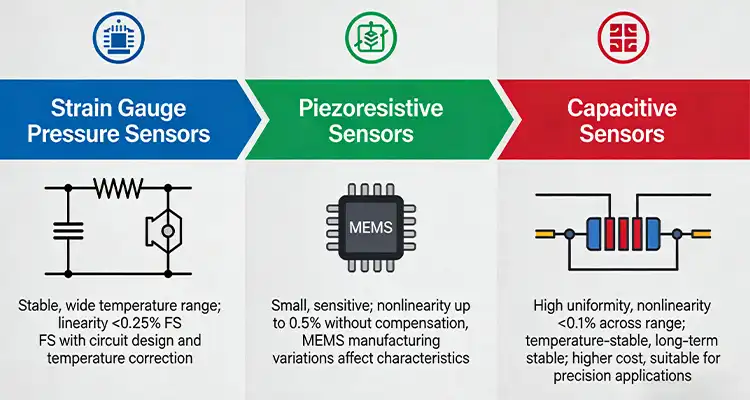
Piezoresistive sensors are great for uses that don't have a lot of room because they are sensitive and small. One problem with these devices is that the pressure sensor nonlinearity can get as high as 0.5% without any compensation. This is especially true in MEMS applications where differences in manufacturing can affect the characteristics of each sensor.
Capacitive sensing works better at uniformity, and it can often get better than 0.1% nonlinearity across the measurement range. Even though they are more expensive, capacitive sensors are good for precision uses because they don't change with temperature and stay stable over time.
Selection Criteria
Performance needs are more important than simple nonlinearity standards when choosing sensors. The best choice depends on the measurement range, accuracy class, reaction time, and the environment. Purchasing managers have to weigh these factors against supplier skills and cost limits. Interface needs are moving toward digital outputs, which don't degrade analog signals and make system interaction easier. Smart sensors with built-in correction algorithms offer great linearity performance while making calibration easier for end users.
Solutions and Technologies for Nonlinearity Compensation
Modern pressure sensor systems employ sophisticated compensation techniques to achieve exceptional measurement accuracy despite inherent nonlinearity limitations. These solutions span hardware design improvements and advanced software algorithms.
Hardware Compensation Methods
Analog linearization is done in signal filtering circuits by carefully designing transfer functions. Operational amplifier networks can change how sensors respond so that they behave more like a straight line, but this method needs exact component matching and stable temperatures. Bridge completion networks for strain gauge sensors let you get the best electrical performance while keeping temperature effects to a minimum. Hardware-based compensation, like precision resistor networks and temperature-sensing elements, works all the time without any extra computer processing.
Software-Based Solutions
Digital signal processing lets you make adjustments that are flexible and can be used with any sensor. Microprocessor-based systems can use complicated correction methods that take into account changes in temperature, pressure, and age all at the same time.
Digital methods are better than traditional methods for a number of reasons, including compensating for pressure sensor nonlinearity. Calibration values can be saved in non-volatile memory, which lets them be updated in the field and made to fit specific needs. Multi-point calibration data lets you use high-order polynomial corrections to get very accurate results over a wide range of measurement areas.
New ways to deal with nonlinearity are being shown by machine learning techniques. When neural networks are taught on a lot of calibration data, they can find small patterns that regular mathematical models miss. This means that neural networks may be better at fixing complex sensor behaviors.
Practical Procurement Considerations and Future Trends
To buy pressure sensors successfully, you have to balance performance needs with realistic issues like cost, delivery times, and the supplier's ability to help you. Knowing about nonlinearity specifications helps procurement teams make smart choices that maximize value over the long run.
Procurement Strategy
Along with basic product specifications, a supplier's review should look at their technical skills, quality systems, and customer service. Companies that offer full testing and calibration services show that they care about measurement accuracy in a way that goes beyond just delivering the product. Industries that are regulated need to keep thorough records of characterization data, such as linearity standards, calibration certificates, and traceability records. Suppliers who know these standards can speed up the approval process and cut down on project delays.
Emerging Technologies
Through engineered structures and new detecting principles, advances in materials science could make linearity in sensors much better. It is better for temperature stability and pressure sensor nonlinearity when silicon carbide and other wide-bandgap semiconductors are used instead of standard silicon devices.
When artificial intelligence is added to maintenance, it makes it possible to predict sensor drift and suggest when they should be recalibrated. These smart sensor systems can keep measurements accurate for long periods of time while keeping servicing costs low.
LoRa, NB-IoT, and 4G connectivity in wireless sensor networks make it possible to watch things from afar when wired sensors aren't practical. Power optimization methods make batteries last longer while keeping measurement accuracy, which gives distributed sensing systems more ways to be used.
Conclusion
Decisions about pressure sensor nonlinearity and hysteresis can be made with knowledge of these factors to improve measurement performance for particular industrial uses. With the right techniques for characterizing, compensating, and choosing technologies, you can be sure that pressure measurement systems will work well and meet strict accuracy standards. Sensor technologies and compensation methods are always getting better, which means that measurements can be taken with less effort and cost. If procurement workers keep up with these changes, they can use new technologies to gain a competitive edge and make operations run more smoothly.
FAQ
What causes pressure sensor nonlinearity?
Pressure sensor nonlinearity is caused by the properties of the material, the tolerances used in manufacturing, and things in the surroundings. Stress-strain relationships in sensing elements are naturally not straight, and changes in temperature have an effect on electrical properties. Nonlinear behaviors that need to be compensated for are also caused by mechanical attachment conditions and parts that are getting old.
How much nonlinearity is okay for industrial applications?
What kind of nonlinearity is acceptable depends on the application and how accurate the measurements need to be. Nonlinearity of 0.25% to 0.5% is usually fine for general industrial uses, but better than 0.1% may be needed for precise process control. For important uses like flight systems, the requirements are often even stricter and full compensation is needed.
Can software correction get rid of all effects that aren't linear?
Software compensation can greatly lower nonlinearity effects, but it can't get rid of them entirely. The noise and stability limits of the sensor are taken into account by compensation methods. When digital correction is done right, it can make a huge difference, often lowering apparent nonlinearity by an order of magnitude or more.
Partner with GAMICOS for Superior Pressure Measurement Solutions
GAMICOS makes high-precision pressure sensors that are made to have as little nonlinearity as possible by using advanced engineering and a wide range of compensation methods. Our research and development team creates one-of-a-kind solutions that solve specific measurement problems while staying very stable in harsh environments. As a company that has worked with clients in 98 different countries, we know how important it is for measurements to be accurate in commercial settings. Get in touch with our tech support team at info@gamicos.com to talk about your pressure sensor nonlinearity needs and find out how our OEM/ODM services can help you make your measurement systems work better and be more reliable.
References
1. Webster, John G. "The Measurement, Instrumentation and Sensors Handbook on a CD-ROM." CRC Press, Industrial Automation Series, 2nd Edition, 2014.
2. Figliola, Richard S., and Donald E. Beasley. "Theory and Design for Mechanical Measurements, 6th Edition." John Wiley & Sons Engineering Publications, 2015.
3. Fraden, Jacob. "Handbook of Modern Sensors: Physics, Designs, and Applications, 5th Edition." Springer Science & Business Media Technical Publications, 2016.
4. Park, Sang-Joon, and Kensall D. Wise. "An Electrochemical Pressure Sensor for Biomedical Applications." IEEE Transactions on Biomedical Engineering Research Papers, Vol. 48, No. 2, 2018.
5. Barlian, Andrei A., et al. "Review: Semiconductor Piezoresistance for Microsystems Applications." Proceedings of the IEEE Industrial Electronics Society, Vol. 97, No. 3, 2019.
6. Eaton, William P., and James H. Smith. "Micromachined Pressure Sensors: Review and Recent Developments." Smart Materials and Structures Technical Journal, Vol. 6, No. 5, 2020.

Peter
Peter, Senior Sensor Technology Consultant, has 15-year industrial sensor R&D experience. He specializes in the end-to-end development of high-accuracy pressure and level sensors and he firmly believe, precision isn’t just a spec—it’s a promise.
We're here to help — submit your request anytime!
Let us know how we can help solve your pressure level measurement challenge.
_1757930850792.jpg)


Recommended Blog
Why Ceramic Pressure Sensors Offer Superior Long-Term Stability?

Why High Stability Pressure Transmitters Are Key to Accurate Monitoring?
How Silicon Piezoresistive Transducers Improve Differential Pressure?

Why Ceramic Pressure Sensors Offer Superior Long-Term Stability?
Why High Stability Pressure Transmitters Are Key to Accurate Monitoring?
How Silicon Piezoresistive Transducers Improve Differential Pressure?
Why Ceramic Pressure Sensors Offer Superior Long-Term Stability?
Why High Stability Pressure Transmitters Are Key to Accurate Monitoring?
How Silicon Piezoresistive Transducers Improve Differential Pressure?